What to Do Before a Layoff Happens: The Visibility Checklist
Juan Mouton
VP Marketing
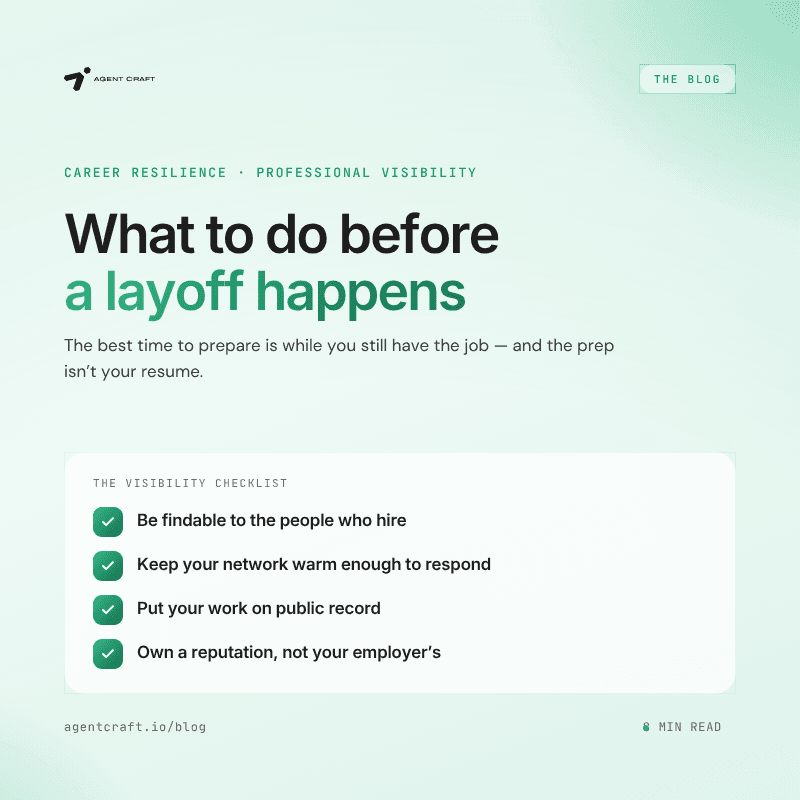
The best time to prepare for a layoff is while you still have the job. The preparation is not updating your resume. It is building professional visibility: making yourself findable to the people who hire, keeping your network warm enough to respond, putting your work on public record, and owning a reputation that does not live inside your employer. All four take weeks to build and minutes to maintain, and none of them can be built quickly once you need them.
That last point is the whole argument, so it goes first. A dormant network cannot be warmed in the week after bad news. A profile nobody has touched in two years does not start ranking in recruiter searches overnight. Visibility works like insurance: you pay small premiums while things are fine, and the coverage exists when they are not. Trying to buy the policy during the fire is the standard mistake, and it is why the first week of most job searches is spent doing two years of deferred maintenance under pressure.
Here is the checklist, in four areas. Everything on it is free and yours to do.
Findability: can the right people locate you
Recruiters and hiring managers search. If you do not surface, you do not exist for them.
- Rewrite your headline so it says what you do, for whom, in the words your field searches. Not your job title, and not a slogan. This is twenty minutes and the single largest gain on this list.
- Open your About section with one line that states who you help and with what. If the first two lines read like a resume summary, the reader is gone before line three.
- Update your experience entries with outcomes, not responsibilities. What changed because you were there.
- Check yourself: search your specialty the way a recruiter would and see whether you appear. Most people have never once done this.
Network liveness: would anyone respond this week
A network is not your connection count. It is the number of people who would take your call.
- Send three no-ask messages this week to people you have lost touch with. Share something useful to them, a link, an introduction, a genuine observation about their work, and want nothing back.
- Make it a standing habit: two or three touches a week, indefinitely. The total cost is minutes.
- Answer the honest question: when did someone outside your company last contact you about work? If you cannot remember, your network is not dormant, it is asleep, and it needs the same slow waking a person does.
Visibility: does anyone outside know what you are good at
Inside the company, your work speaks for itself. Outside, silence reads as absence.
- Publish one post about a lesson from your current work. An observation, not an announcement. The first one is the hardest and it breaks the seal.
- Set a floor of one public post a week. Small is fine. The mechanism is consistency, not brilliance.
- Comment on other people's work in your field, genuinely, most weeks. It is the lowest-effort visibility that exists and almost nobody senior does it.
Ownership: what survives leaving the badge behind
Everything you have achieved that lives only in internal documents belongs, functionally, to your employer.
- Build a public record of your wins and lessons, anonymized where confidentiality requires it. Numbers become ranges, names become company types.
- Publish under your own name, on surfaces you control. Your profile, your posts, your writing.
- Apply the test: if you left tomorrow, would people think of you or of your employer's brand when your specialty comes up? If the brand does all the work, start transferring the equity now.
The two-week version
If the checklist feels long, this is the compressed start: rewrite the headline today, send three no-ask messages this week, publish one post before the end of next week, and put a weekly half-hour in the calendar for the maintenance. That half-hour is the honest price of the whole system: profile upkeep, a few genuine touches, one post, every week, indefinitely. It is not hard. It is relentless, and relentless is exactly what makes it rare.
Where Agent Craft sits in this
Everything on the checklist is yours to do this week, and now you have it. Agent Craft is the version that keeps running after week three: voice note in, visibility out, content in your voice across LinkedIn, X, TikTok, and YouTube, with a strategy layer holding your positioning steady. The network touches stay yours, as they should. The coverage the checklist builds, the system maintains, which is the half that decays the moment maintenance stops.
Frequently asked questions
How long does it take to build professional visibility from zero?
Plan on a quarter of consistent weekly activity before the effects are noticeable: appearing in searches, engagement from outside your company, the first inbound. The setup steps take a week. The compounding takes the quarter.
Should I do this if my job feels secure?
That is precisely when to do it. Every step on the checklist is easier, cheaper, and less desperate-looking while you are employed and unhurried. Security is the best condition for building insurance and the worst reason to skip it.
Will my employer mind?
Publishing thoughtful material about your field generally reflects well on them, and many employers actively benefit. Stay inside your expertise, keep confidential material confidential, and check your company's social media policy if one exists.
What if I have nothing worth saying publicly?
You have years of lessons, patterns, and mistakes observed. The feeling of having nothing to say is almost always a missing prompt, not missing material. Start with one lesson from this month's work.
Share
Related Articles
How to Build a Personal Brand on LinkedIn From Zero (2026)
The sequence from zero is four steps in strict order: position (decide what you want to be known for), optimize (make your profile findable and legible), publish (put real thinking in public on a weekly rhythm), and engage (be present in the conversations around your subject). Run them in order because each one wastes without the one before it: publishing without a position produces noise, and a beautiful profile nobody arrives at is a brochure in a drawer. The honest timeline for the whole arc is a quarter, and the quarter is non-negotiable in a way this post will be specific about, because the timeline is where zero-starters actually fail.
How to Turn a Voice Note Into a Week of LinkedIn Content, By Hand
The method is this: record yourself talking for two minutes about something you know, transcribe it, find the two or three posts hiding inside the rambling, give each one a hook, cut it to length, format it for LinkedIn, re-form it for X if you use both, and schedule the lot. The two minutes of talking produce the whole week's raw material. The desk work after the talking takes about forty-five minutes per post. This post walks every step so you can run the entire method yourself, with the honest timing attached to each.
Personal Branding for Consultants: Turning Expertise Into Inbound
For a consultant, personal branding reduces to one move: showing your thinking in public, because your thinking is the product and buyers cannot want what they have not seen. Every other profession sells something separable from the person; consulting sells judgment, and judgment can only be evaluated by watching it operate. A consultant who publishes their reasoning is running free product demos at scale. A consultant who does not is asking strangers to buy an invisible service on the strength of a headshot, which is roughly the market's hardest sale, and explains most of the profession's cold-outreach misery.