Skip to content

Learn & Grow

Autonomous Marketing Insights

Strategies, patterns, and real-world lessons for running great marketing with an AI agent at the core.

Building in Public: What to Share and What to Keep
Personal Branding5 min read

Building in Public: What to Share and What to Keep

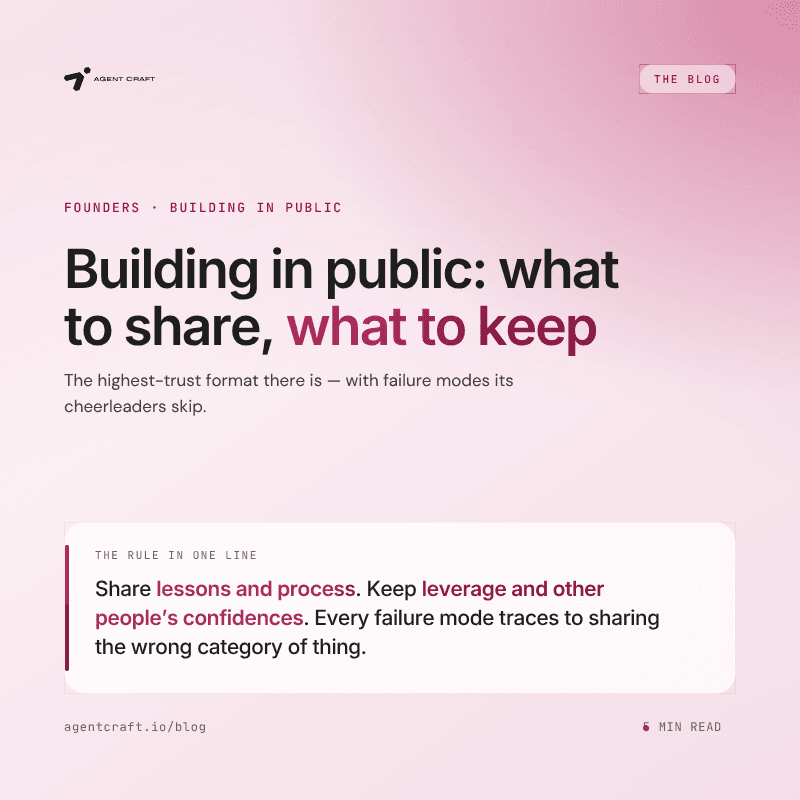
The rule set fits in one line: share lessons and process, keep leverage and other people's confidences. Building in public, narrating the real construction of a company or a career as it happens, is the highest-trust content format available, because watching someone decide under uncertainty is a due-diligence process no marketing survives. But the format has failure modes that its cheerleaders skip past, and they all trace to the same error: sharing the wrong category of thing. The categories are knowable in advance, which is what this post is for, the sharing rules, the failure modes, and a decision test that resolves the ambiguous cases in ten seconds.

Juan Mouton

VP Marketing

Jul 21, 2026
personal brandinglinkedinfounder marketing
How to Build a Personal Brand on LinkedIn From Zero (2026)
Personal Branding5 min read

How to Build a Personal Brand on LinkedIn From Zero (2026)

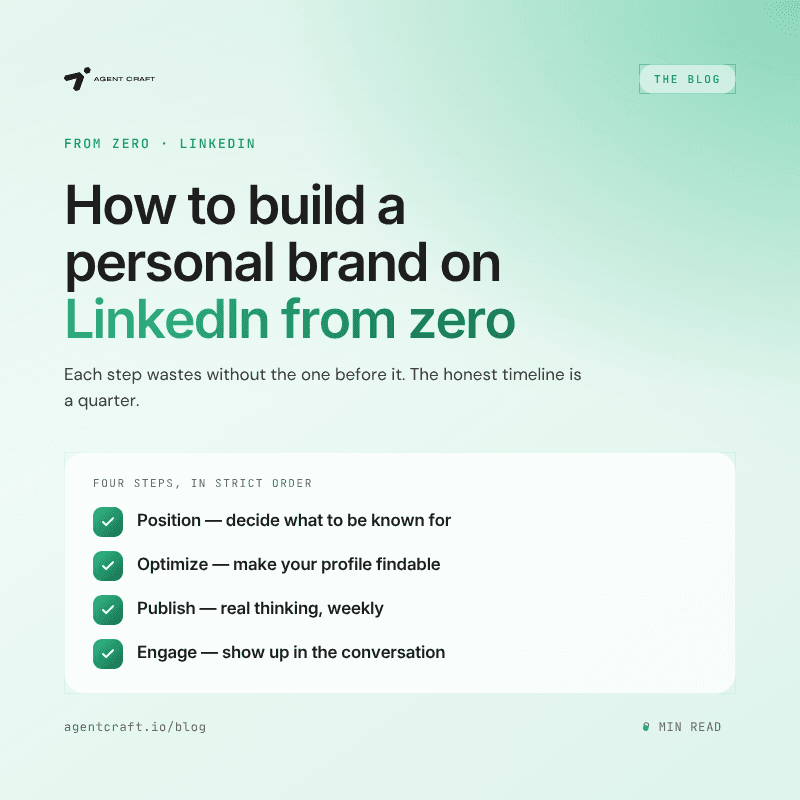
The sequence from zero is four steps in strict order: position (decide what you want to be known for), optimize (make your profile findable and legible), publish (put real thinking in public on a weekly rhythm), and engage (be present in the conversations around your subject). Run them in order because each one wastes without the one before it: publishing without a position produces noise, and a beautiful profile nobody arrives at is a brochure in a drawer. The honest timeline for the whole arc is a quarter, and the quarter is non-negotiable in a way this post will be specific about, because the timeline is where zero-starters actually fail.

Juan Mouton

VP Marketing

Jul 12, 2026
personal brandingLinkedInfounder marketing
How to Turn a Voice Note Into a Week of LinkedIn Content, By Hand
Personal Branding6 min read

How to Turn a Voice Note Into a Week of LinkedIn Content, By Hand

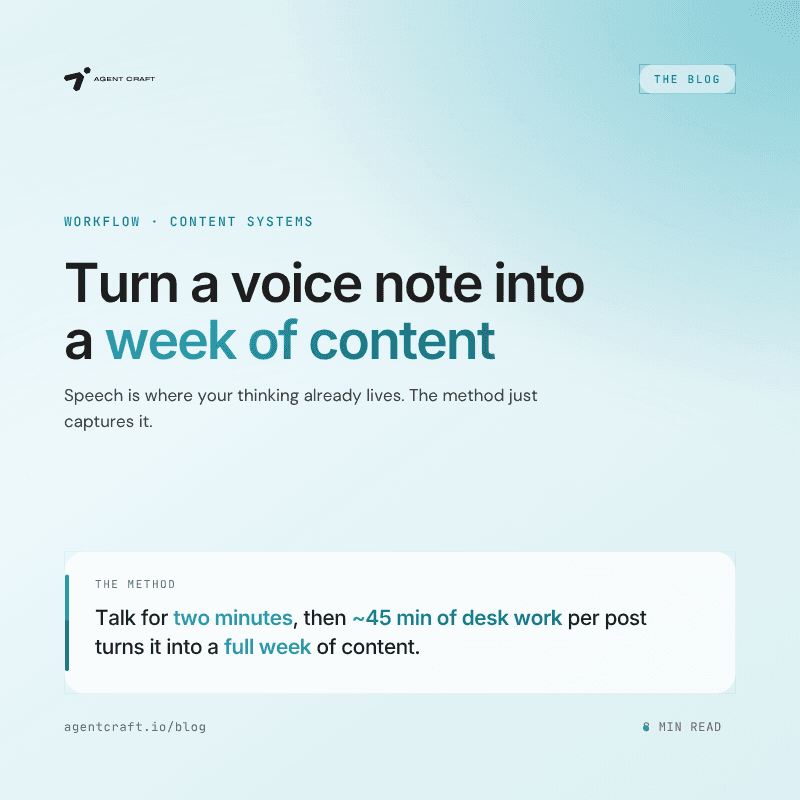
The method is this: record yourself talking for two minutes about something you know, transcribe it, find the two or three posts hiding inside the rambling, give each one a hook, cut it to length, format it for LinkedIn, re-form it for X if you use both, and schedule the lot. The two minutes of talking produce the whole week's raw material. The desk work after the talking takes about forty-five minutes per post. This post walks every step so you can run the entire method yourself, with the honest timing attached to each.

Juan Mouton

VP Marketing

Jul 12, 2026
voice note to contentpersonal brandingLinkedIn
How Much Does a Personal Branding Agency Cost in 2026? Real Rates
Personal Branding5 min read

How Much Does a Personal Branding Agency Cost in 2026? Real Rates

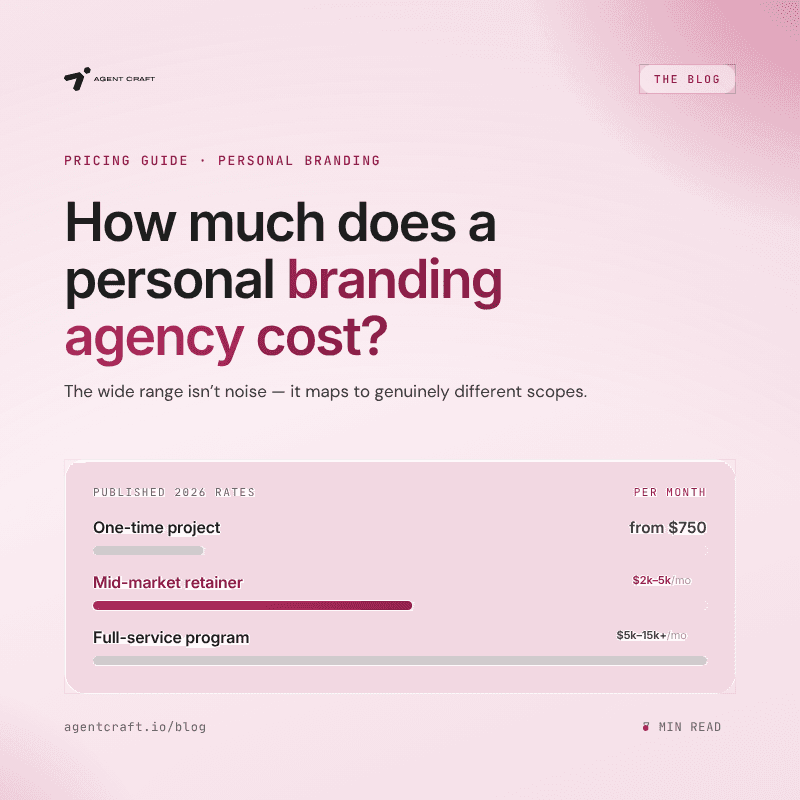
A personal branding agency costs $2,000 to $5,000 per month at the mid-market tier and $5,000 to $15,000 or more per month for full-service programs, based on published 2026 rates across the market. One-time projects, a positioning sprint or a profile overhaul, typically start around $750 and run into several thousand. The wide range is not noise; it maps to genuinely different scopes, and the difference between a $3,000 engagement and a $10,000 one is mostly what surrounds the writing rather than the writing itself. Here is what sits inside each tier and the questions that protect you before signing.

Juan Mouton

VP Marketing

Jul 12, 2026
personal branding agency. LinkedInfounder marketing
Personal Branding for Consultants: Turning Expertise Into Inbound
Personal Branding4 min read

Personal Branding for Consultants: Turning Expertise Into Inbound

For a consultant, personal branding reduces to one move: showing your thinking in public, because your thinking is the product and buyers cannot want what they have not seen. Every other profession sells something separable from the person; consulting sells judgment, and judgment can only be evaluated by watching it operate. A consultant who publishes their reasoning is running free product demos at scale. A consultant who does not is asking strangers to buy an invisible service on the strength of a headshot, which is roughly the market's hardest sale, and explains most of the profession's cold-outreach misery.

Juan Mouton

VP Marketing

Jul 12, 2026
personal brandingLinkedInfounder marketing
How to Build a Personal Brand While Employed (Without Friction)
Personal Branding5 min read

How to Build a Personal Brand While Employed (Without Friction)

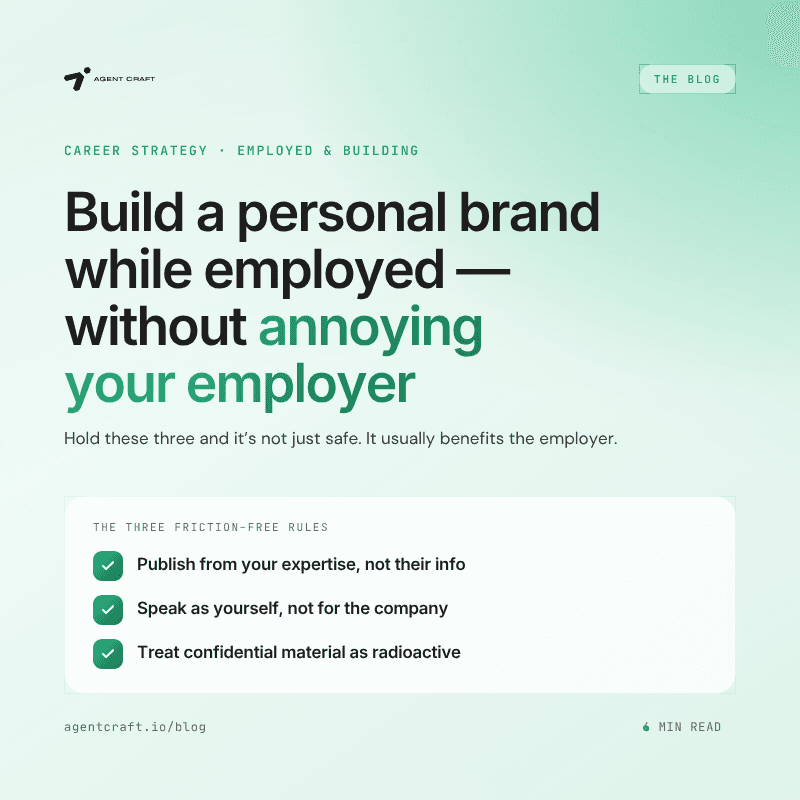
The rules that keep an employed personal brand friction-free are three: publish from your expertise rather than your employer's information, speak clearly as yourself rather than for the company, and treat confidential material as radioactive without exception. Hold those three and the arrangement is not merely safe, it usually benefits the employer, which is why so many companies now actively encourage it. The anxiety most employed professionals feel about this is directional, worrying about the wrong risks, so it is worth mapping where the real lines sit.

Juan Mouton

VP Marketing

Jul 12, 2026
personal brandingLinkedInX
How Agency Owners Use a Personal Brand to Sell the Agency
Personal Branding5 min read

How Agency Owners Use a Personal Brand to Sell the Agency

Clients hire the person they have been reading for a year, and then they sign with that person's agency. That single sentence is the entire mechanism, and it explains a pattern every agency owner has noticed without always naming: the best-fit clients arrive saying "I have been following your stuff," having pre-sold themselves through months of the owner's published thinking, while the agency's own polished channels generate polite inquiries that need convincing from zero. The owner's brand and the agency's brand are both real assets. They just do different jobs, and in a market that sells judgment, the personal one does the heavy lifting.

Juan Mouton

VP Marketing

Jul 12, 2026
personal brandingLinkedInfounder marketing
How to Choose Content Pillars (and the Topic to Never Pick)
Personal Branding5 min read

How to Choose Content Pillars (and the Topic to Never Pick)

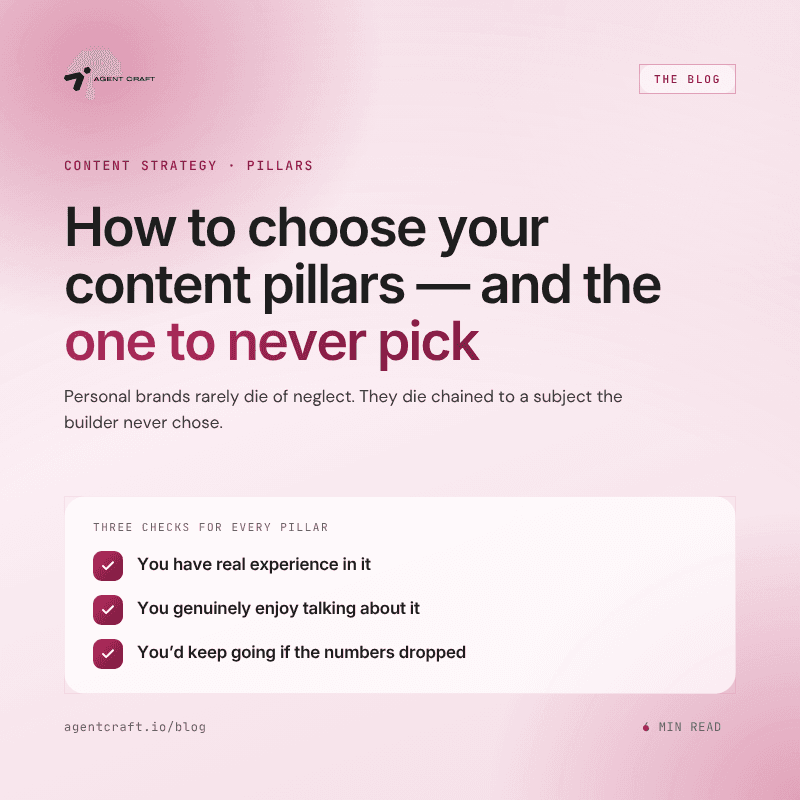
Choose one to three subjects, no more, and put each through three reality checks: you have real experience in it, you genuinely enjoy talking about it, and you would keep talking about it if the numbers dropped. Any subject passing all three is a pillar. Then run the exercise almost nobody runs: identify the one topic that would slowly make you resent your own brand if you were chained to it, and formally ban it, because the most common way personal brands die is not neglect. It is the builder waking up one day imprisoned by a subject they never chose.

Juan Mouton

VP Marketing

Jul 12, 2026
personal brandingLinkedInfounder marketing
What Personal Branding Costs in Time If You Do It Yourself
Personal Branding4 min read

What Personal Branding Costs in Time If You Do It Yourself

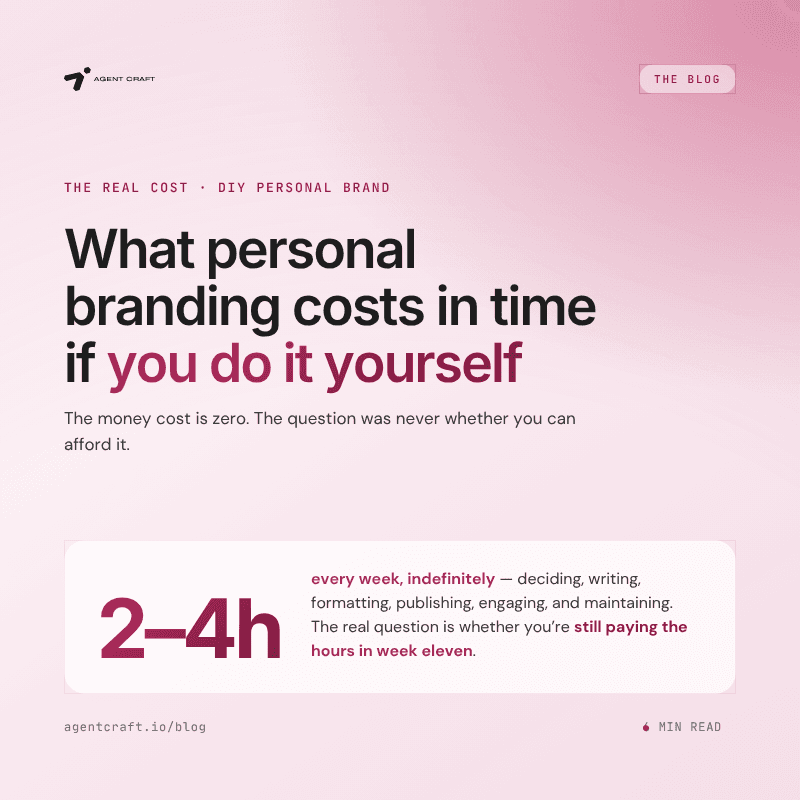
Doing your own personal brand costs two to four hours a week, every week, indefinitely. That covers deciding what to say, writing it, formatting it, publishing it, engaging around it, and maintaining the profile that all of it points back to. The money cost is zero and the method is not secret, which is why the honest question was never whether you can afford to do it yourself. It is whether you will still be paying the hours in week eleven, because the ledger below is due weekly whether or not the week cooperates.

Juan Mouton

VP Marketing

Jul 12, 2026
personal brandingghost writerLinkedIn
Career Insurance: Why Your Reputation Is a Policy You Pay Weekly
Personal Branding5 min read

Career Insurance: Why Your Reputation Is a Policy You Pay Weekly

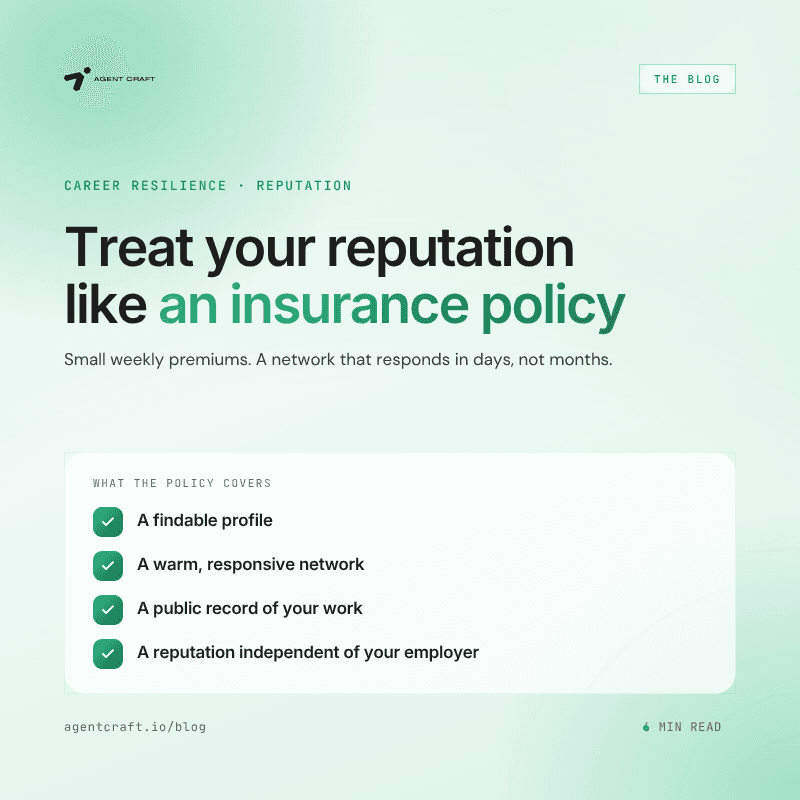
Career insurance is professional visibility built before you need it: a findable profile, a warm network, a public record of what you are good at, and a reputation that exists independently of your employer. The premiums are small and weekly, an hour or less of maintenance. The payout is a network that responds within days instead of months when your situation changes. And like every other kind of insurance, it has one unbreakable rule: you cannot buy the policy during the fire.

Juan Mouton

VP Marketing

Jul 12, 2026
personal brandingLinkedInfounder marketing
How Recruiters Actually Find Executives on LinkedIn
Personal Branding4 min read

How Recruiters Actually Find Executives on LinkedIn

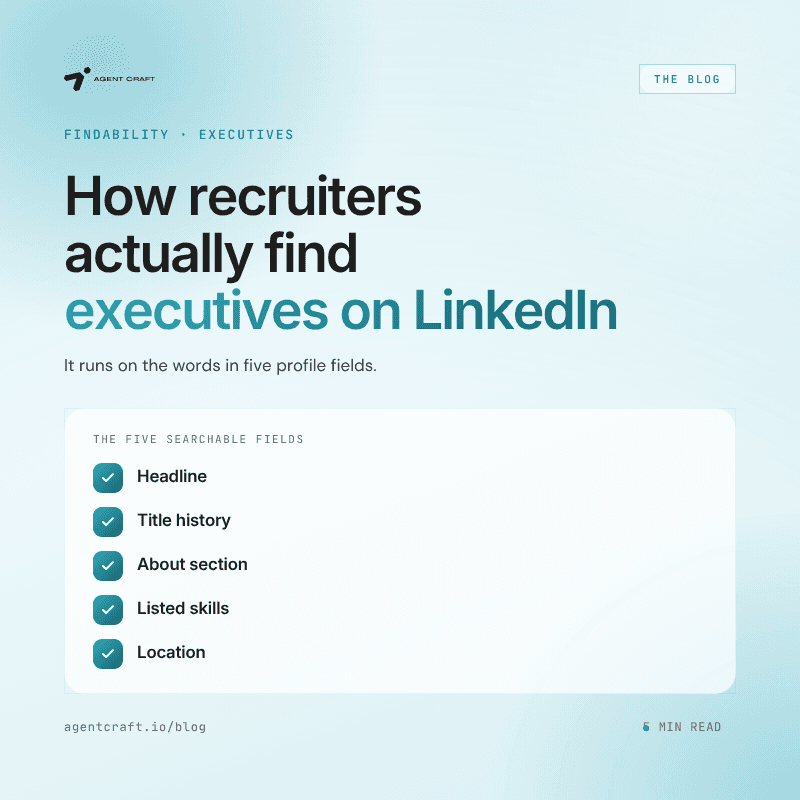
Recruiters find executives by searching, and the search runs on words in a handful of profile fields: your headline, your title history, your About section, your listed skills, and your location. If the words a recruiter would type do not appear in those fields, you do not surface, no matter how good you are at the thing they are searching for. That is the entire mechanism, and it means executive findability is less about fame and more about vocabulary: describing yourself in the words your market uses rather than the words your business card uses.

Juan Mouton

VP Marketing

Jul 21, 2026
personal brandinglinkedinrecruitment
Personal Branding for Fractional Executives: Visible Between Roles
Personal Branding5 min read

Personal Branding for Fractional Executives: Visible Between Roles

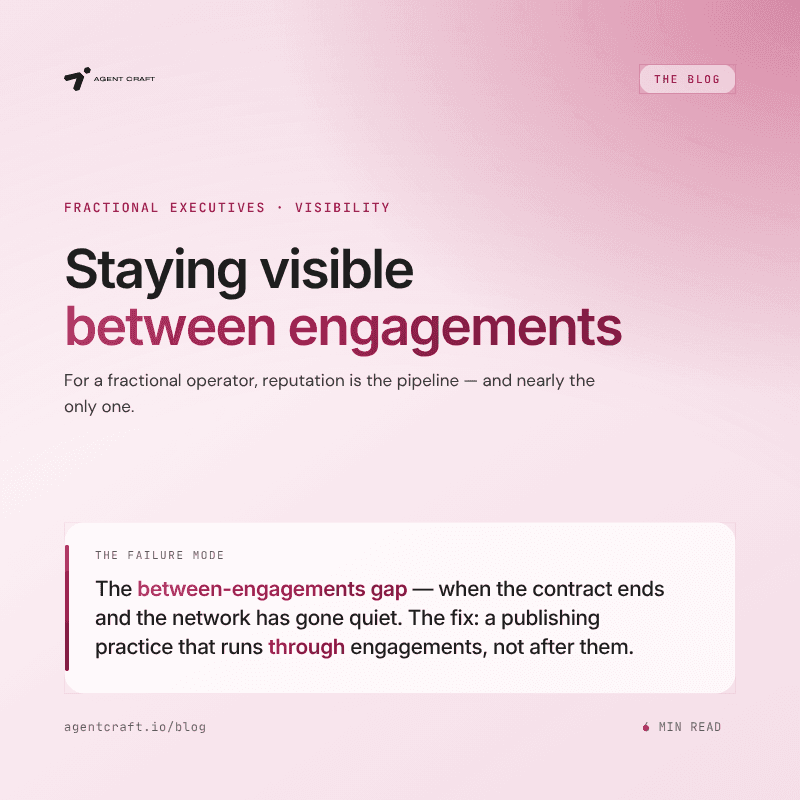
For a fractional executive, reputation is the pipeline between engagements, and it is close to the only one, because the fractional market runs almost entirely on trust: nobody hires a part-time CFO or CMO from a cold advertisement, they hire the person whose judgment they have already watched or whose name arrived through someone who has. That makes visibility a structural requirement of the business model rather than a marketing preference, and it makes the between-engagements gap, the months when the current contract ends and the network has gone quiet, the fractional operator's characteristic failure mode. The fix is a publishing practice that runs through engagements, not after them, and it is more compatible with NDA-heavy work than most fractionals assume.

Juan Mouton

VP Marketing

Jul 21, 2026
personal brandinglinkedinlead generation
What Makes a Good LinkedIn Headline (With 10 Examples)
Personal Branding5 min read

What Makes a Good LinkedIn Headline (With 10 Examples)

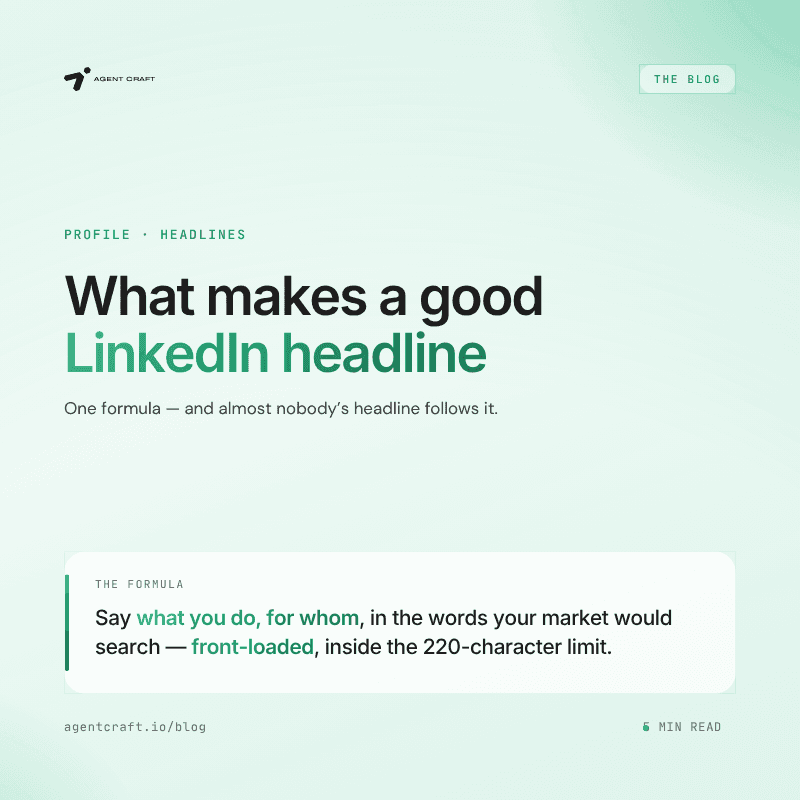
A good LinkedIn headline says what you do, for whom, in the words your market would search, front-loaded, inside the 220-character limit. That is the entire formula, and almost nobody's headline follows it, because the default habit is to use the field as a title plate: role, company, done. A title plate wastes the most-read line you own. Your headline travels everywhere your name does, search results, comment threads, connection requests, other people's notifications, and in most of those places it is truncated to its first few words, which is why the front-loading matters as much as the content. Below: the formula unpacked, ten before-and-afters, and the four mistakes that account for most weak headlines.

Juan Mouton

VP Marketing

Jul 21, 2026
personal brandinglinkedinprofile setup
LinkedIn Profile Optimization for Executives: Field by Field
Personal Branding5 min read

LinkedIn Profile Optimization for Executives: Field by Field

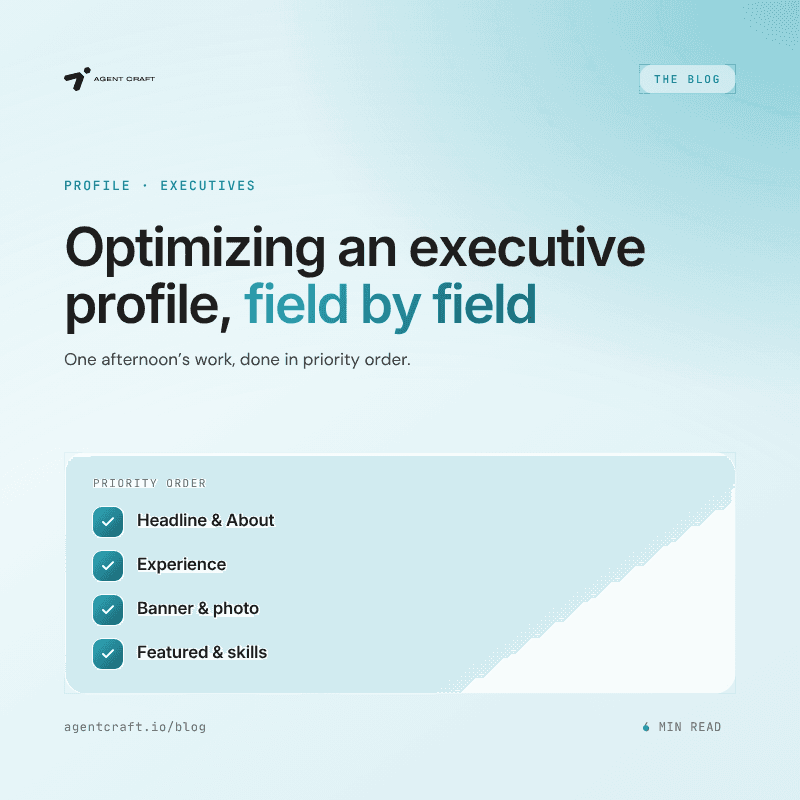
An executive profile has one job: when someone arrives checking you out, a recruiter, an investor, a board member, an acquirer running quiet diligence, it answers their question in seconds and gives them a reason to keep reading. Optimizing it is a single afternoon's work, done field by field in priority order: headline, About, experience, banner and photo, featured, skills. Each field below comes with the characteristic executive mistake and its fix, because at senior levels the profiles are rarely empty. They are full of the wrong register: written for the org chart instead of for the stranger deciding whether to trust you.

Juan Mouton

VP Marketing

Jul 21, 2026
personal brandinglinkedincontent
Why Your LinkedIn Posts Get No Reach (and What Fixes It)
Personal Branding5 min read

Why Your LinkedIn Posts Get No Reach (and What Fixes It)

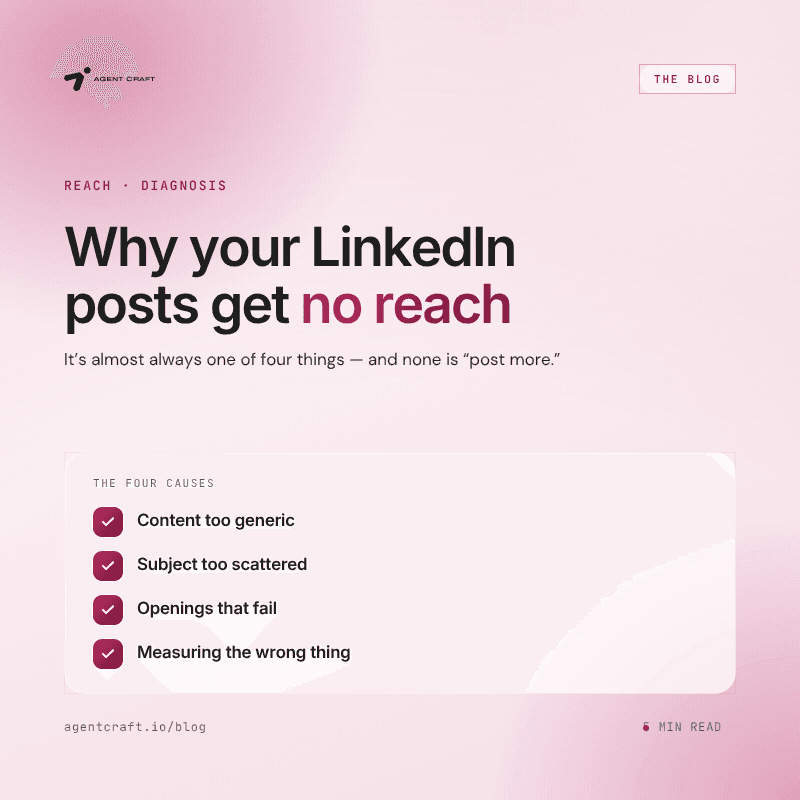
When your posts consistently get no reach, the cause is almost always one of four things: the content is generic enough to be skippable, your subject matter is too scattered for anyone to know what you are for, your openings fail before the substance arrives, or you are measuring the wrong thing and the reach is actually fine. Each has a distinct signature and a distinct fix, and none of them is the fix people reach for first, which is posting more. Volume multiplies whatever is already true, so diagnose before you scale.

Juan Mouton

VP Marketing

Jul 21, 2026
personal brandinglinkedinfounder marketing
 How to Write LinkedIn Hooks: The Four Formats That Work
Personal Branding5 min read

How to Write LinkedIn Hooks: The Four Formats That Work

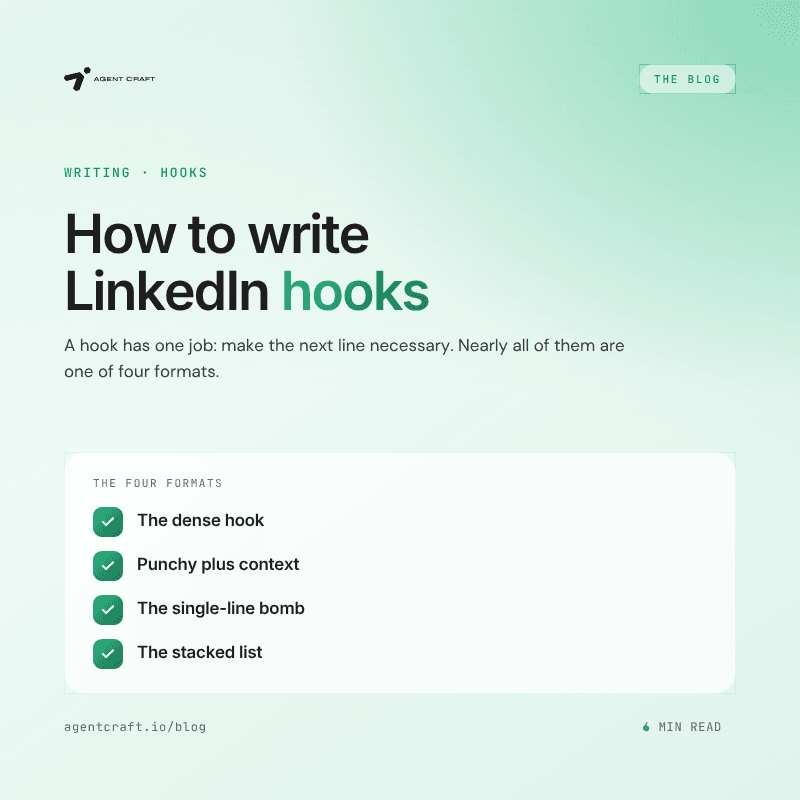
A hook is the first line or two of a post, and it has exactly one job: make the next line necessary. Nearly every hook that works is one of four formats: the dense hook (a complete provocative claim), the punchy-plus-context hook (a short jab followed by one grounding line), the single-line bomb (one sentence, standing alone), or the stacked list (three or four parallel fragments building to a turn). Below are all four with their rules, ten worked examples, and the banned moves, because hooks fail by formula more often than they fail by weakness, and the formulas that kill them are recognizable.

Juan Mouton

VP Marketing

Jul 21, 2026
personal brandinglinkedinfounder marketing
Can People Tell When AI Wrote Your LinkedIn Post? Yes. Here's How
Personal Branding5 min read

Can People Tell When AI Wrote Your LinkedIn Post? Yes. Here's How

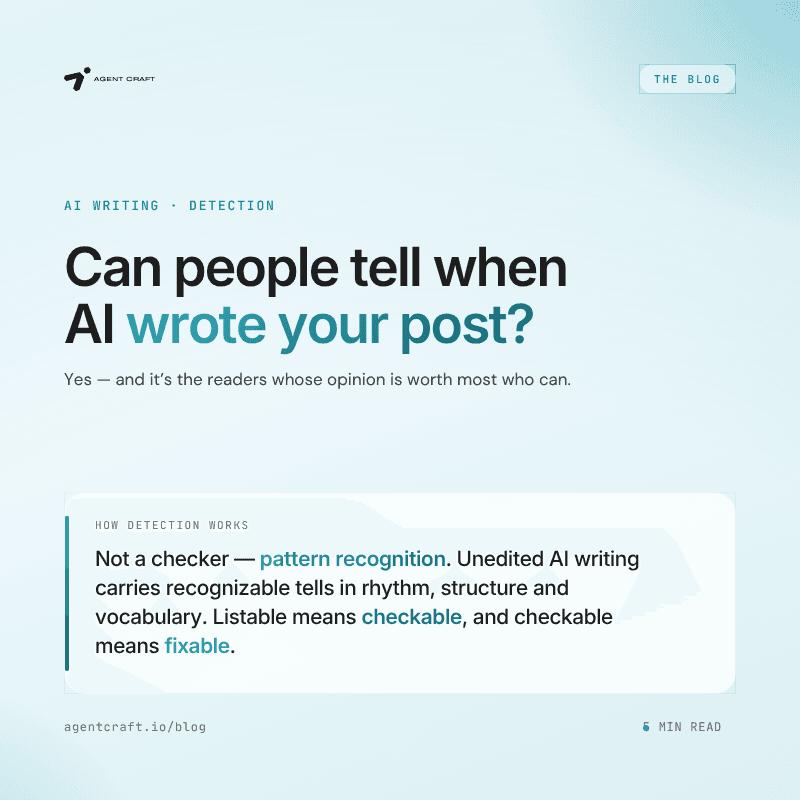
Yes, sophisticated readers usually can, and they are precisely the readers whose opinion of you is worth anything. Detection does not work the way people imagine, no one is running your post through a checker; it works by pattern recognition, because unedited AI writing carries a set of recognizable tells, habits of rhythm, structure, and vocabulary that repeat across millions of posts. Readers who spend time in professional feeds have absorbed the pattern the way you absorb any dialect, and once absorbed it cannot be unheard. The tells are listable, which is good news: listable means checkable, and checkable means fixable. Here is the list, why it matters more the more senior you are, and where the actual fix lives.

Juan Mouton

VP Marketing

Jul 21, 2026
personal brandinglinkedinfounder marketing
Does AI-Generated Content Hurt Your Reach on LinkedIn?
Personal Branding5 min read

Does AI-Generated Content Hurt Your Reach on LinkedIn?

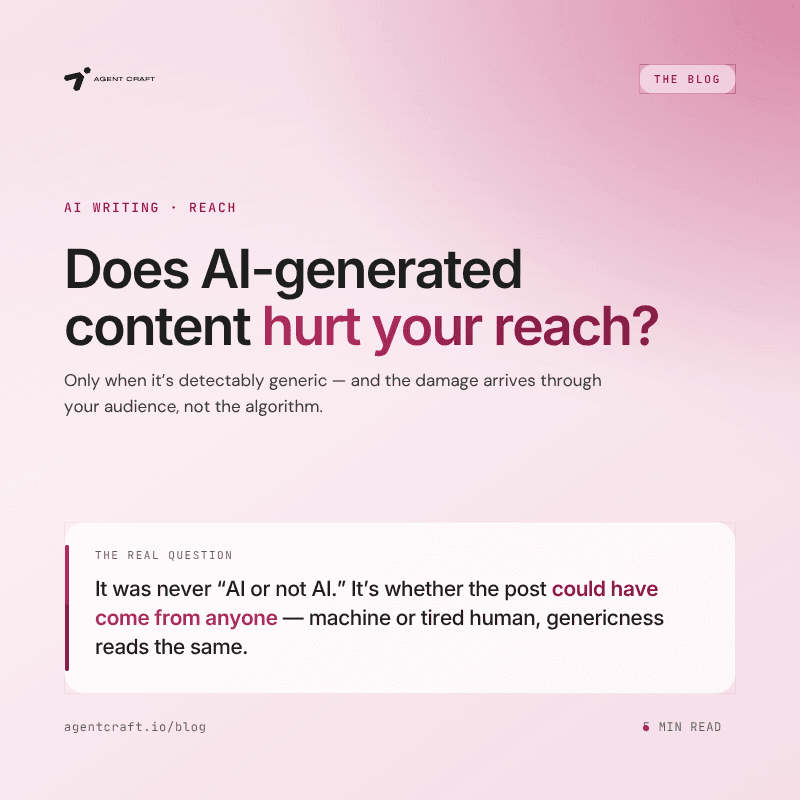
AI-generated content hurts your reach when it is detectably generic, and the mechanism requires no inside knowledge of any algorithm to understand: feeds distribute what earns genuine engagement, readers disengage from content that reads like everyone else's, and unedited AI output reads like everyone else's by construction, because it is built from the average of everything. The damage, in other words, arrives through your audience before it arrives through any ranking system, which also points at the real fix: the question was never "AI or not AI." It is whether the post could have come from anyone, and that question has the same answer mechanics whether a machine or a tired human produced the genericness.

Juan Mouton

VP Marketing

Jul 21, 2026
personal brandinglinkedinfounder marketing
The Swap Test: Could Your Content Have Come From Anyone?
Personal Branding5 min read

The Swap Test: Could Your Content Have Come From Anyone?

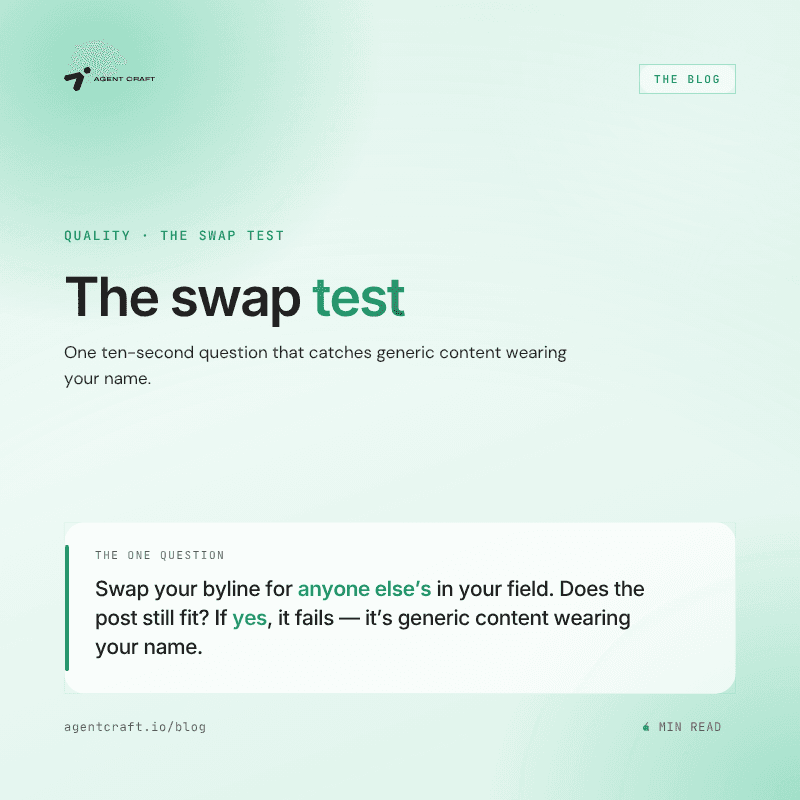
The swap test is one question applied to anything you are about to publish: if you swapped your byline for that of anyone else in your field, would the post still make sense, still feel right, still fit? If yes, the post fails. It is generic content wearing your name, and publishing it builds everyone's reputation fractionally and yours not at all. The test takes ten seconds, requires no tools, and is the single highest-leverage quality gate available to anyone building a professional reputation, because it checks the only thing that was ever scarce in a feed: evidence that a specific person, with specific experience, is behind the words.

Juan Mouton

VP Marketing

Jul 21, 2026
personal brandinglinkedinfounder marketing
How to Use AI for Your Personal Brand Without Sounding Generic
Personal Branding5 min read

How to Use AI for Your Personal Brand Without Sounding Generic

The principle that governs everything: the input decides the output. Prompt an AI from nothing and it returns the consensus of everything it has read, which is by definition what everyone else sounds like; feed it your own raw material, your spoken thinking, your transcripts, your real documents, and it has your specifics, your phrasing, and your stances to work with, and the output can actually be yours. Every technique below is a variation on that one principle, plus the editing pass that strips the surface tells. Get the input right and AI is leverage for a personal brand. Get it wrong and you are paying a machine to make you indistinguishable at scale.

Juan Mouton

VP Marketing

Jul 21, 2026
personal brandinglinkedinfounder marketing
Why Voice Notes Beat Prompts for AI Content
Personal Branding5 min read

Why Voice Notes Beat Prompts for AI Content

A prompt contains a request. A voice note contains your thinking. That is the entire difference, and it is decisive, because an AI system can only shape what it is given: handed a request ("write a post about hiring lessons"), it fills the vacuum with the consensus of everything it has read, and handed two minutes of you actually talking about the hire that went wrong, it has your story, your phrasing, your emphasis, and your conclusions to work with. The first workflow produces content about a topic. The second produces content by a person. Everything else in the AI-content debate is downstream of this distinction.

Juan Mouton

VP Marketing

Jul 21, 2026
personal brandinglinkedinfounder marketing
LinkedIn vs X for Professional Visibility: Where to Invest
Personal Branding4 min read

LinkedIn vs X for Professional Visibility: Where to Invest

The honest split: LinkedIn is where professional reputations are checked, so it wins for career security, B2B trust, and anyone whose buyers are operators; X is where conversations move faster and earlier, so it earns its place for technical founders, investors, developer audiences, and anyone whose market lives in the discourse. For most professionals the answer is LinkedIn first, X as a genuine second surface if your audience is there, and both only if each gets content in its native shape. Where to invest depends on one question: where do the people who matter to your work actually look?

Juan Mouton

VP Marketing

Jul 21, 2026
personal brandinglinkedinfounder marketing
Why Reposting LinkedIn Content to X Does Not Work (and What Does)
Personal Branding5 min read

Why Reposting LinkedIn Content to X Does Not Work (and What Does)

Reposting fails because the two platforms reward different shapes, and the shape mismatch is visible instantly: a LinkedIn post pasted onto X arrives too long, too formatted, too warm-up-heavy, and too obviously written for somewhere else, and the X audience, the most format-fluent readers on the internet, reads it as exactly what it is. What works instead is re-forming: same thinking, rebuilt in the destination's native shape. The difference costs about ten minutes per post by hand, and it is the entire difference between running two surfaces and littering one of them.

Juan Mouton

VP Marketing

Jul 21, 2026
personal brandinglinkedinfounder marketing
Executive Presence Online: What It Means Now
Personal Branding5 min read

Executive Presence Online: What It Means Now

Executive presence online is consistency plus point of view: being reliably findable, saying substantive things at a rhythm people can trust, and holding recognizable positions on your subject. That is the whole definition, and it is worth stating plainly because the term arrived carrying baggage from the physical world, where it meant bearing, gravitas, command of a room, and the translation is not what people assume. Online, nobody can see you hold a room. They can only see what you have said, how often, and whether it was worth reading, which means digital executive presence is built from artifacts rather than aura, and artifacts can be constructed deliberately.

Juan Mouton

VP Marketing

Jul 21, 2026
personal brandinglinkedinfounder marketing
How to Become a Thought Leader Without Calling Yourself One
Personal Branding5 min read

How to Become a Thought Leader Without Calling Yourself One

Publish your actual thinking, in one lane, at a steady rhythm, until other people start associating you with the subject. That is the entire method, and the qualifier in the title is not a joke: the label is the one part of thought leadership you can never award yourself, because it only exists in other people's descriptions of you. "Thought leader" in your own headline is the tell that the substance is missing, the same way "classy" self-applied never once was. So the practical question is not how to become one but how to do the work whose byproduct is other people using words like that about you, and that work is specific, unglamorous, and almost entirely about having thoughts worth following.

Juan Mouton

VP Marketing

Jul 21, 2026
personal brandinglinkedinfounder marketing
Thought Leadership vs Content Marketing: The Difference That Matters
Personal Branding5 min read

Thought Leadership vs Content Marketing: The Difference That Matters

Content marketing fills a calendar; thought leadership argues a position. That is the working distinction, and it is about intent and risk rather than format or quality. Content marketing serves an audience's existing questions, how to do X, what is Y, and earns attention by being useful; thought leadership stakes a view the audience did not already hold, and earns authority by being right, or at least by being seriously arguable. Both are legitimate. Both compound. The trouble starts when one is dressed as the other, which is most of what currently wears the thought-leadership label, and the mislabeling matters because the two are built differently, measured differently, and fail differently.

Juan Mouton

VP Marketing

Jul 21, 2026
personal brandinglinkedinfounder marketing
How to Network Without Feeling Transactional
Personal Branding5 min read

How to Network Without Feeling Transactional

The transactional feeling comes from one source: the ask. Remove the ask, and networking becomes what it always should have been, being useful and visible to people whose work touches yours, which nobody has ever felt gross about. The method is two-sided: give first in your direct contact, small useful touches with nothing wanted back, and be visible in public, so that relationships form around your thinking without you soliciting them at all. Run both and the strange result is a stronger network than the transactors build, because the currency they are spending, extracted favors, depreciates, and the one you are spending, demonstrated usefulness, compounds.

Juan Mouton

VP Marketing

Jul 21, 2026
personal brandinglinkedinnetworking
How to Stay Visible Between Roles (Without Looking Desperate)
Personal Branding5 min read

How to Stay Visible Between Roles (Without Looking Desperate)

Between roles, visibility does one job: it controls the narrative that would otherwise be written for you. The method is to keep publishing as the professional you are rather than the job-seeker you temporarily also are, one substantive piece a week from your expertise, genuine presence in your field's conversations, and deliberate reactivation of the network, while avoiding the three moves that read as desperation. Done right, the gap becomes the most visible stretch of your career instead of a silence people interpret, because the honest structural truth of the in-between is that you finally have the one asset employment always rationed: time to think in public.

Juan Mouton

VP Marketing

Jul 21, 2026
personal brandinglinkedinjob search
Founder-Led Content: Why It Outperforms Brand Content
Personal Branding5 min read

Founder-Led Content: Why It Outperforms Brand Content

Founder-led content outperforms brand content because people buy from people, and the mechanics behind that phrase are specific: a founder's post carries personal accountability, can hold an opinion, and accumulates an auditable record of judgment, while a brand account structurally has none of the three. Readers do not need to articulate this to act on it; they simply stop for the human and scroll past the logo, and they are being rational when they do. For any company whose sale runs on belief, services, expertise, early-stage products, anything bought before it can be fully verified, the founder's voice is the most efficient marketing asset available, and usually the least deployed.

Juan Mouton

VP Marketing

Jul 21, 2026
personal brandinglinkedinfounder marketing
What changes when your marketing just runs
Marketing Strategy4 min read

What changes when your marketing just runs

The phone doesn't suddenly ring off the hook. The change is quieter than that. Here's what actually shifts when marketing stops being a thing you have to think about.

Agent Craft

Apr 27, 2026
small business marketingmarketing automationcontent marketing
How much does a LinkedIn ghostwriter cost in 2026
Personal Branding7 min read

How much does a LinkedIn ghostwriter cost in 2026

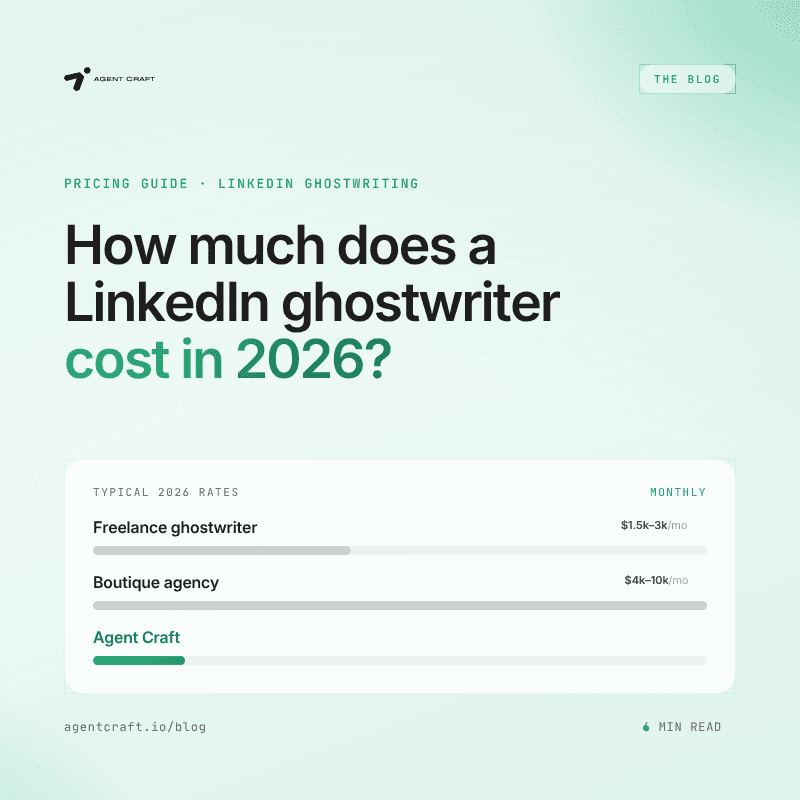
A LinkedIn ghostwriter costs between $500 and $3,000 per month for a freelancer, $2,000 to $5,000 per month for a mid-market retainer, and $5,000 to $15,000 or more per month for a full-service agency.

Juan Mouton

VP Marketing

Jul 11, 2026
LinkedInPersonal BrandingLead Generation
How to Reactivate a Dormant Professional Network Without Being Awkward
Personal Branding5 min read

How to Reactivate a Dormant Professional Network Without Being Awkward

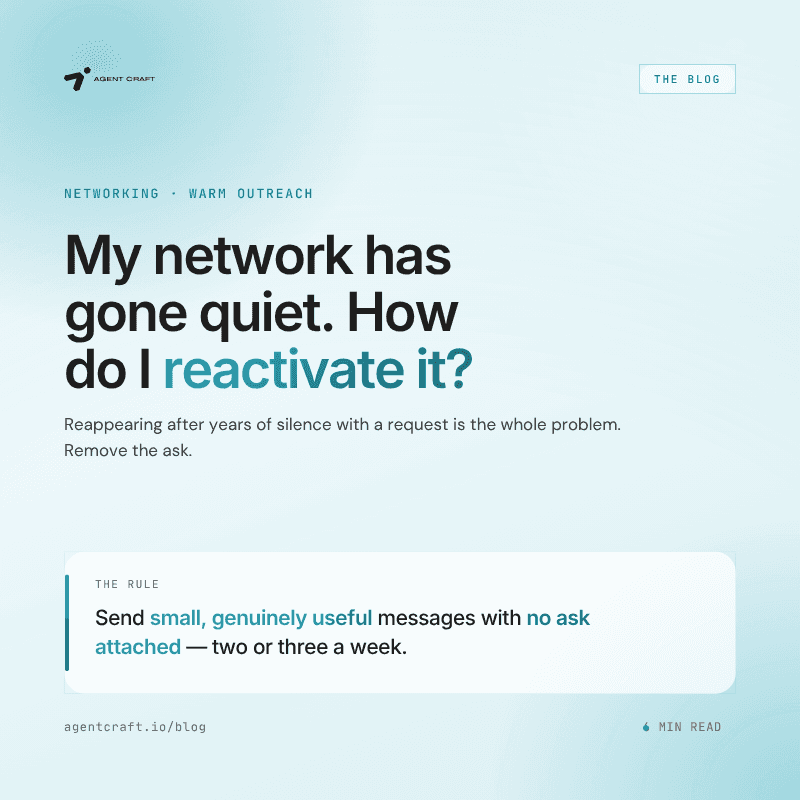
The way to reactivate a dormant network is to send small, genuinely useful messages with no ask attached, two or three a week, and to become quietly visible in public so the rest of your network rewarms passively. The awkwardness you are dreading comes from one specific mistake: reappearing after years of silence with a request. Remove the request and the awkwardness goes with it. Everything below is the mechanics.

Juan Mouton

VP Marketing

Jul 12, 2026
personal brandingengagementLinkedIn
Personal Brand Examples: What Good Looks Like (Executives, Founders)
Personal Branding5 min read

Personal Brand Examples: What Good Looks Like (Executives, Founders)

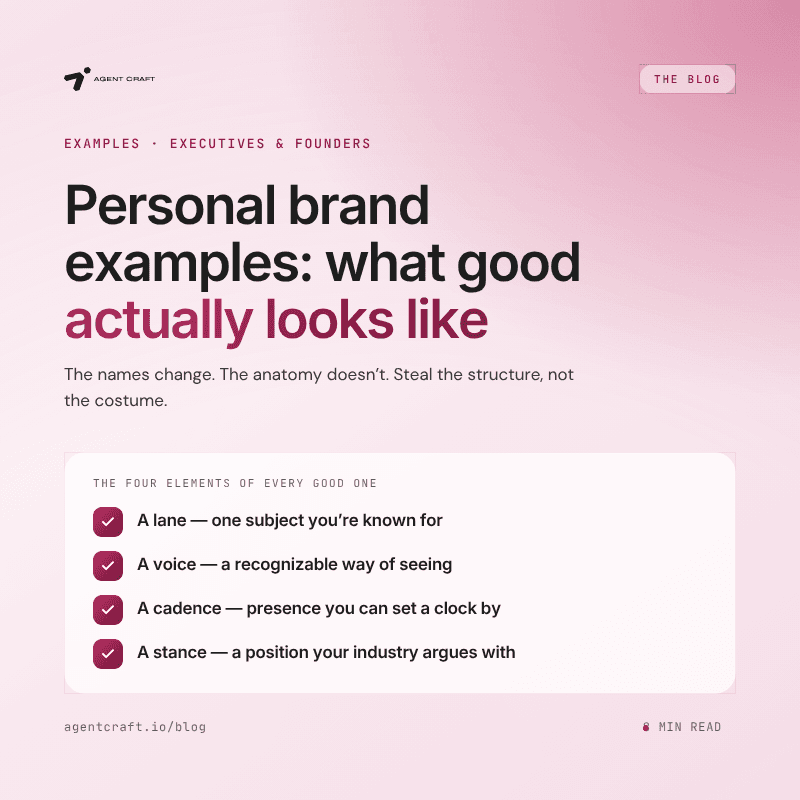
Every good personal brand, examined closely, is built from the same four elements: a lane (one subject the person is known for), a voice (a recognizable way of seeing), a cadence (presence you could set a calendar by), and a stance (at least one position their industry argues with). The names change; the anatomy does not. So rather than a list of famous accounts to envy, here are six archetypes drawn from how the pattern actually plays out for executives and founders, each with the mechanism exposed so you can steal the structure rather than the costume.

Juan Mouton

VP Marketing

Jul 12, 2026
personal brandingLinkedInfounder marketing
Founder Personal Brand: Why Buyers Trust Founders More Than Brands
Personal Branding5 min read

Founder Personal Brand: Why Buyers Trust Founders More Than Brands

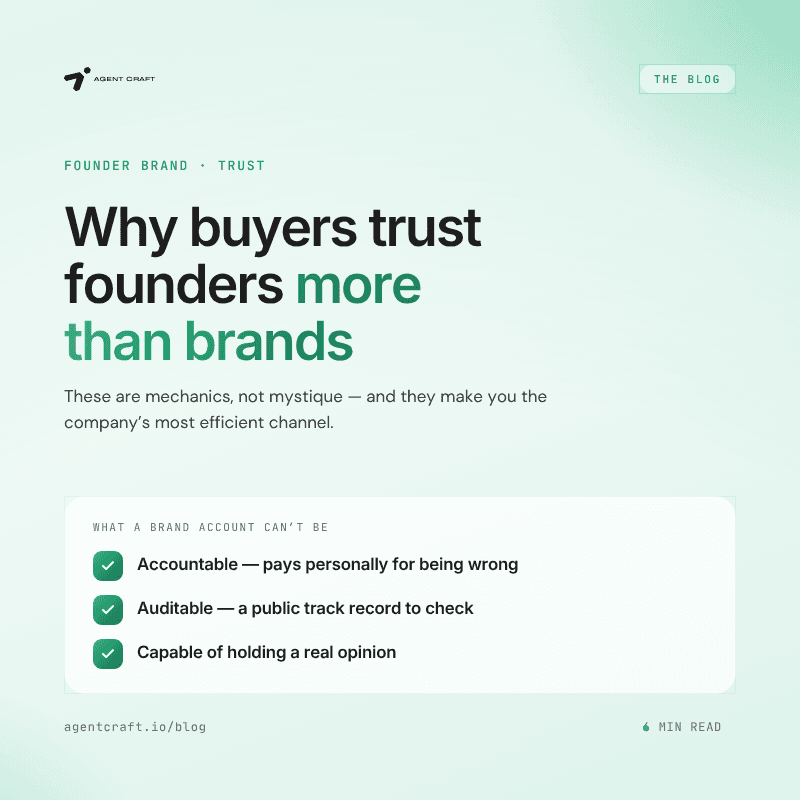
Buyers trust founders more than brands because a founder is accountable, auditable, and capable of holding an opinion, and a brand account is none of the three. A person who says something wrong in public pays for it personally, which is exactly what gives their claims weight. A person who has thought in public for a year has left a track record any buyer can audit before the first call. And a person can take a side, where a brand voice holding an opinion is a committee performing one, and reads that way. These are mechanics, not mystique, and a founder who understands them can run their reputation as the company's most efficient acquisition channel.

Juan Mouton

VP Marketing

Jul 12, 2026
personal brandingLinkedInfounder marketing
What to Post on LinkedIn When You Have Nothing to Say
Personal Branding5 min read

What to Post on LinkedIn When You Have Nothing to Say

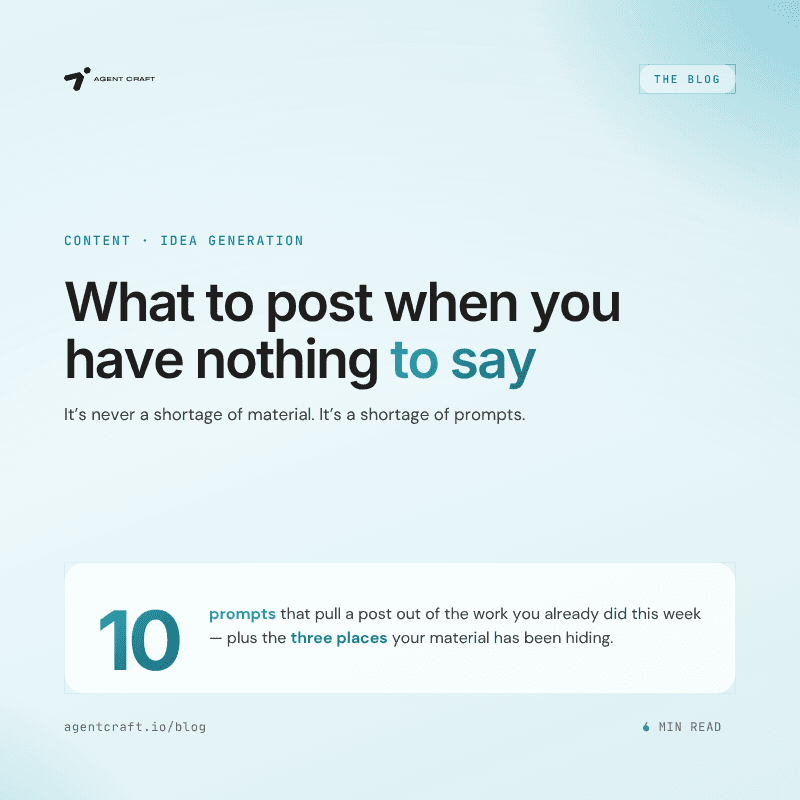
When you have nothing to post, the problem is almost never a shortage of material. It is a shortage of prompts. You spent this week solving problems, noticing patterns, answering questions, and holding opinions, any of which would make a post, but none of it is filed in your head under "content." A prompt is the retrieval key: a question specific enough to pull one of those things out. Below are ten that work, plus the three places your material has been hiding all along.

Juan Mouton

VP Marketing

Jul 12, 2026
personal brandingLinkedIncontent
How to Write a Personal Brand Statement (Structure + Examples)
Personal Branding6 min read

How to Write a Personal Brand Statement (Structure + Examples)

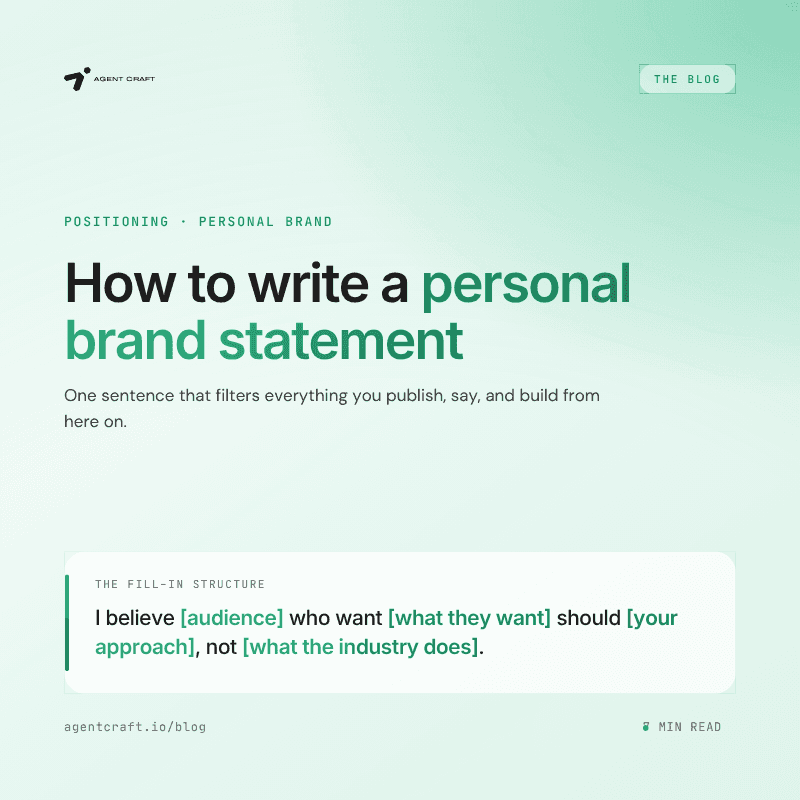
A personal brand statement is one sentence that captures what you believe about your space and who you believe it for. The structure that works: I believe [audience] who want [what they want] should [your approach], not [what the industry does instead]. Fill those four slots honestly and you have the sentence that filters everything you publish, say, and build from here on. This post explains each slot, gives you five worked examples, and covers the three mistakes that produce statements which sound fine and do nothing.

Juan Mouton

VP Marketing

Jul 12, 2026
personal brandingcontentLinkedIn
Is It Cringe to Post on LinkedIn as an Executive? An Honest Answer
Personal Branding5 min read

Is It Cringe to Post on LinkedIn as an Executive? An Honest Answer

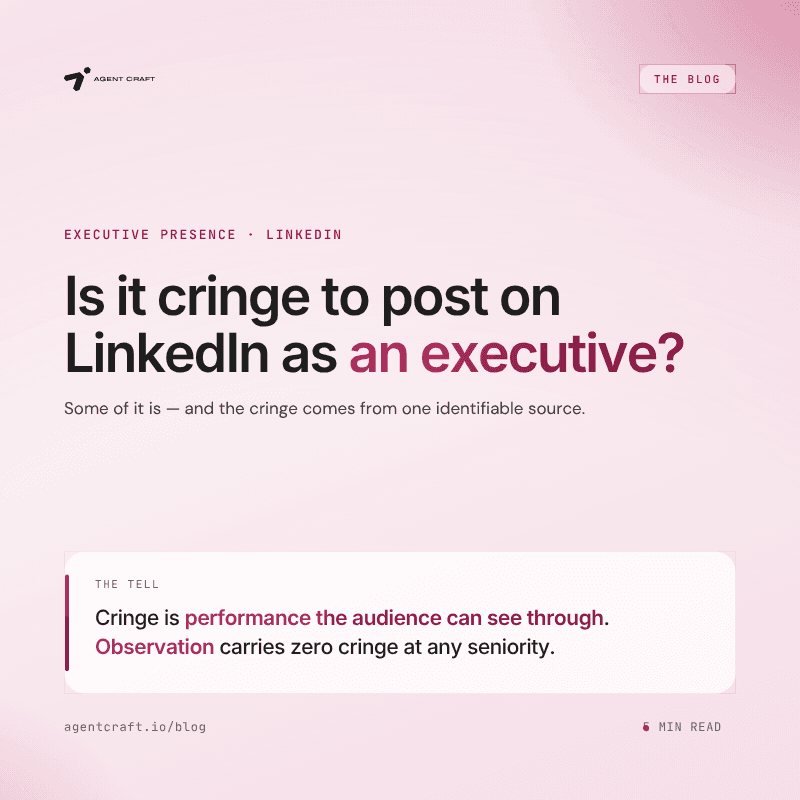
An observational post is about the work, and it gives something instead of wanting something. "Here is a mistake I keep seeing and what it costs." "Here is a problem we untangled last month and the wrong assumption underneath it." "Here is what I got wrong about this five years ago." The poster appears in these, but as the lens, not the subject. Nobody has ever cringed at a sharp observation clearly earned by experience. It is the same reason nobody cringes when you say something insightful in a meeting: substance, offered plainly, is not a performance, whatever the venue.

Juan Mouton

VP Marketing

Jul 12, 2026
personal brandingLinkedIncontent
What to Do Before a Layoff Happens: The Visibility Checklist
Personal Branding5 min read

What to Do Before a Layoff Happens: The Visibility Checklist

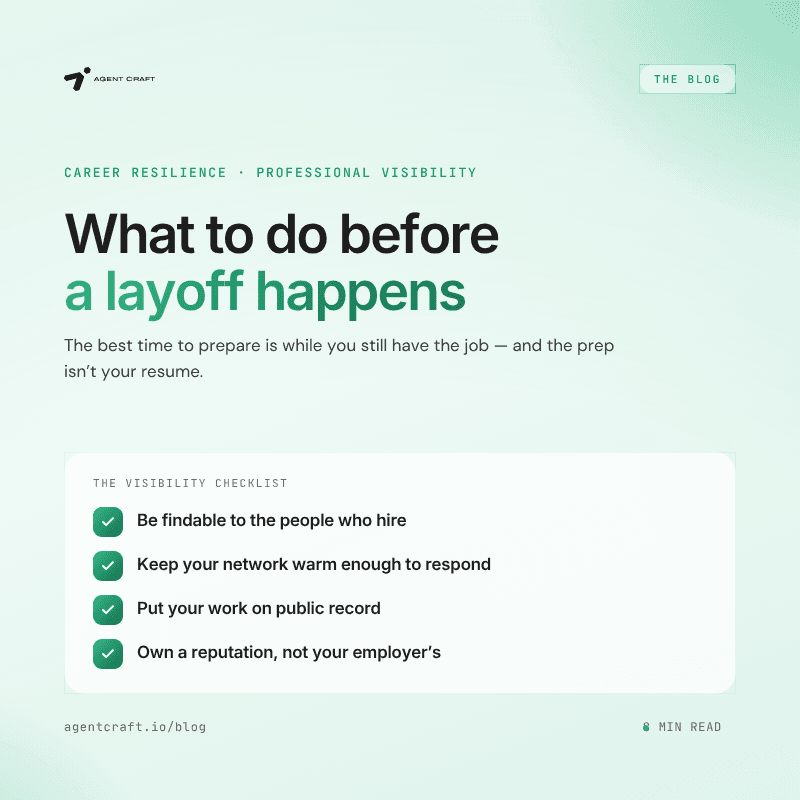
The best time to prepare for a layoff is while you still have the job. The preparation is not updating your resume. It is building professional visibility: making yourself findable to the people who hire, keeping your network warm enough to respond, putting your work on public record, and owning a reputation that does not live inside your employer. All four take weeks to build and minutes to maintain, and none of them can be built quickly once you need them.

Juan Mouton

VP Marketing

Jul 12, 2026
personal brandingLinkedInreputation
Is a LinkedIn Ghostwriter Worth It? The Honest Math for 2026
Personal Branding5 min read

Is a LinkedIn Ghostwriter Worth It? The Honest Math for 2026

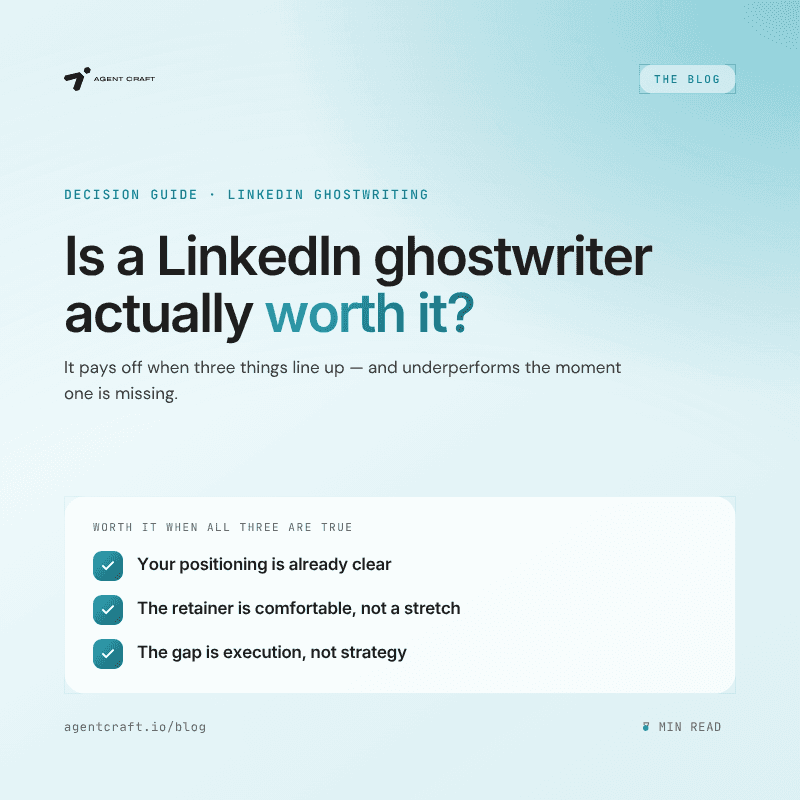
A LinkedIn ghostwriter is worth it if three things are true: you already know your positioning, the retainer is a comfortable line item rather than a stretch, and your problem is execution and consistency rather than strategy. If any of the three is missing, the money underperforms. The market runs from $500 a month for a basic freelancer to $15,000 and beyond for a full agency, with most serious buyers landing between $2,000 and $5,000, so the question deserves real math rather than a vibe. Here is the math.

Juan Mouton

VP Marketing

Jul 12, 2026
ghostwriterpersonal brandingLinkedIn
Personal Branding for Executives: Why It Is Different
Personal Branding4 min read

Personal Branding for Executives: Why It Is Different

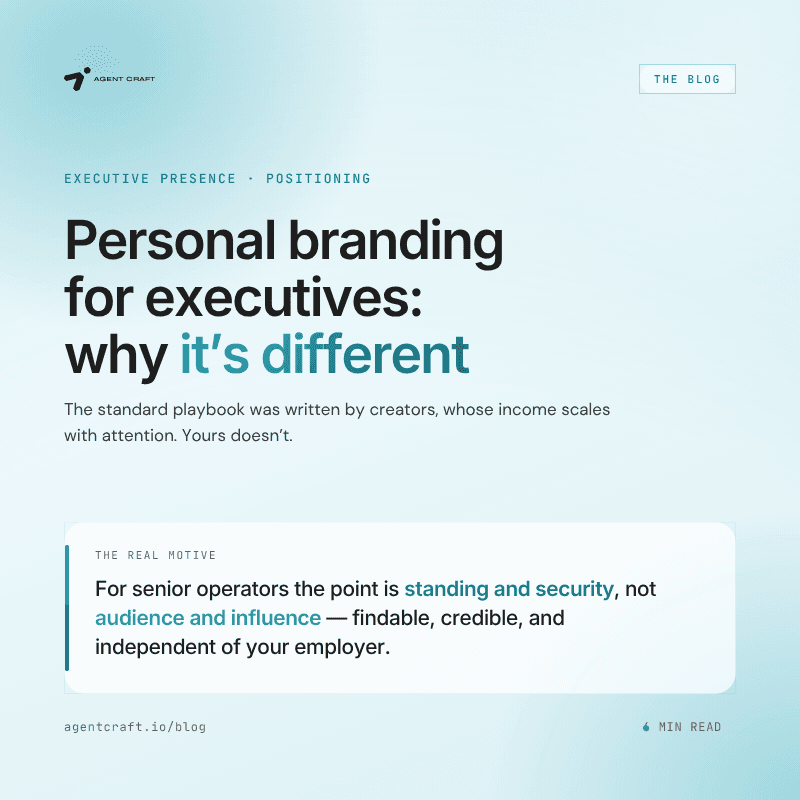
Executive personal branding is different because the motive is different: for most senior operators the point is standing and security, not audience and influence. That single difference invalidates most of the advice in circulation, because the standard playbook was written by and for creators, people whose income scales with attention. An executive's reputation does a quieter job: it makes them findable, credible, and independent of their employer's brand, so that opportunity finds them and setbacks cannot erase them. Build for that job and the whole approach changes.

Juan Mouton

VP Marketing

Jul 12, 2026
personal brandingfounder marketingLinkedIn
How to Brief a LinkedIn Ghostwriter (and What a Good One Asks)
Personal Branding5 min read

How to Brief a LinkedIn Ghostwriter (and What a Good One Asks)

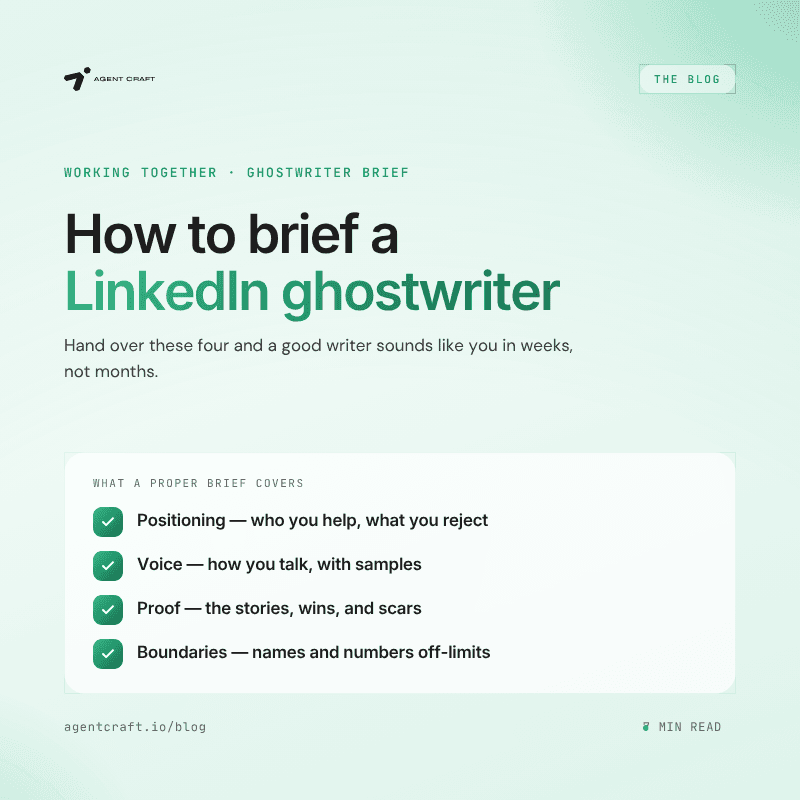
A proper ghostwriter brief covers four things: your positioning (who you help, what you want to be known for, what you reject), your voice (how you actually talk, with samples), your proof (the stories, wins, and scars they can draw on), and your boundaries (topics, names, and numbers that never go public). Hand over those four and a competent writer can start sounding like you in weeks instead of months. This post gives you the brief structure, and just as usefully, the questions a good ghostwriter will ask you unprompted, because the questions they ask in the first session are the cheapest quality test in the market.

Juan Mouton

VP Marketing

Jul 12, 2026
personal brandingLinkedInfounder marketing
Ghostwriter vs AI Writing Tools: What You Get for the Money
Personal Branding4 min read

Ghostwriter vs AI Writing Tools: What You Get for the Money

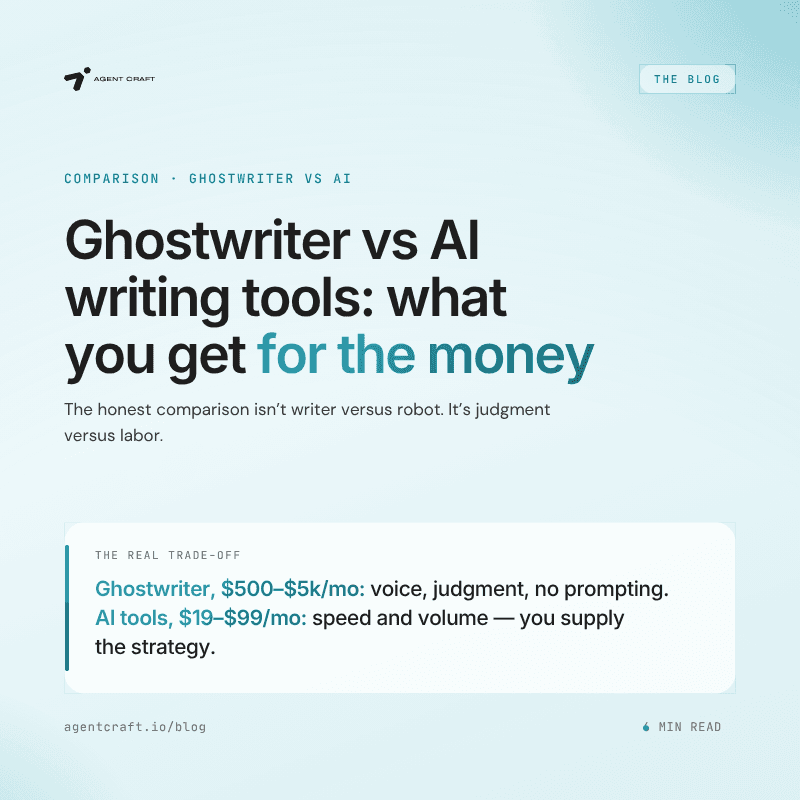
A ghostwriter costs $500 to $5,000 a month and gives you a human who learns your voice, supplies judgment, and needs no prompting. An AI writing tool costs $19 to $99 a month and gives you speed, volume, and availability, with the strategy and the quality control left to you. The honest comparison is not writer versus robot. It is judgment versus labor, and once you see which one you are short of, the decision mostly makes itself.

Juan Mouton

VP Marketing

Jul 12, 2026
personal brandingghost writerLinkedIn
What a Contrarian Angle Is (and Why Positioning Needs One)
Personal Branding5 min read

What a Contrarian Angle Is (and Why Positioning Needs One)

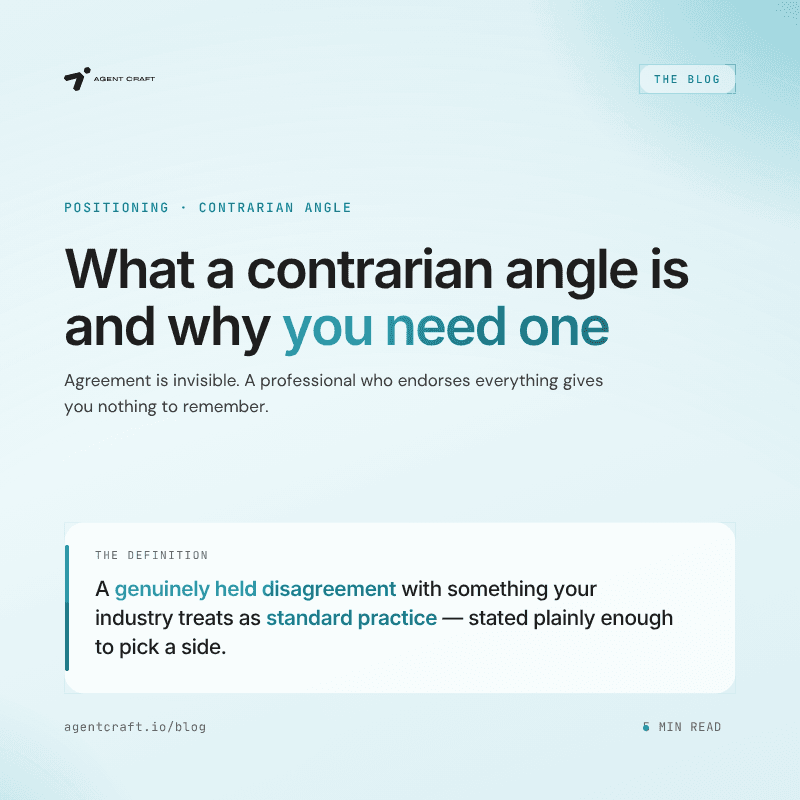
A contrarian angle is a genuinely held disagreement with something your industry treats as standard practice, stated plainly enough that people can tell which side you are on. Your positioning needs at least one because agreement is invisible: a professional who endorses everything their field already believes gives an audience nothing to remember, nothing to argue with, and no reason to choose them over the consensus they are politely restating. The disagreement is where the edges are, and edges are what make a position graspable.

Juan Mouton

VP Marketing

Jul 12, 2026
personal brandingLinkedInfounder marketing
How to Position Yourself When Your Expertise Is Broad
Personal Branding4 min read

How to Position Yourself When Your Expertise Is Broad

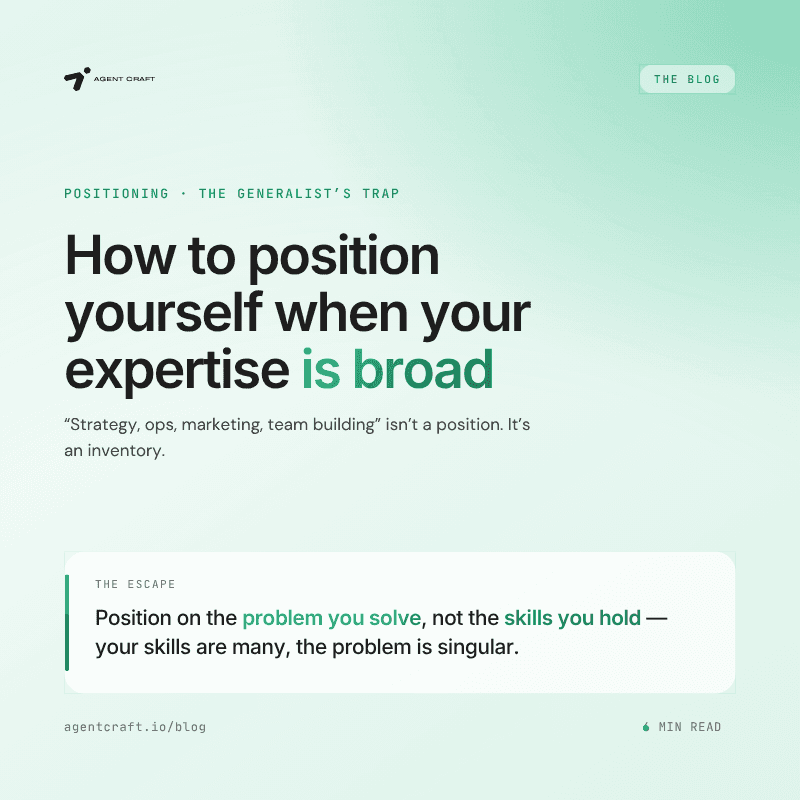
Position on the problem you solve, not the skills you hold. That is the escape from the generalist's trap, because while your skills are many, the problem your particular mix of skills is unusually good at solving is nearly always singular, and a position built on it uses everything you have without listing anything. The listing is the failure mode: "strategy, operations, marketing, and team building" is not a position, it is an inventory, and inventories are what audiences skim past on the way to someone who sounds specific.

Juan Mouton

VP Marketing

Jul 12, 2026
personal brandingLinkedInfounder marketing
Personal Brand Statement Examples: Founder, Consultant, Executive
Personal Branding5 min read

Personal Brand Statement Examples: Founder, Consultant, Executive

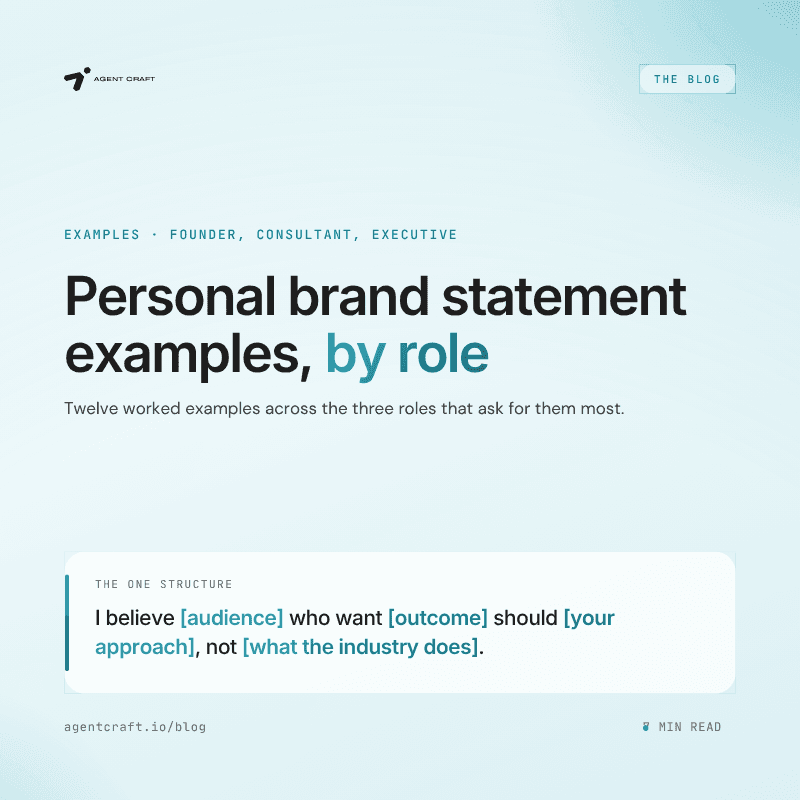
A working personal brand statement follows one structure: I believe [audience] who want [outcome] should [your approach], not [what the industry does instead]. Below are twelve worked examples across the three roles that ask for them most, founders, consultants, and executives, each with a short teardown of the moving parts, because the useful thing about examples is never the words. It is seeing where the edge sits, so you can find your own. If you want the slot-by-slot method first, the companion how-to covers it; this page is the gallery.

Juan Mouton

VP Marketing

Jul 12, 2026
personal brandingLinkedInfounder marketing
Do I Need a Personal Brand? An Honest Five-Question Test
Personal Branding5 min read

Do I Need a Personal Brand? An Honest Five-Question Test

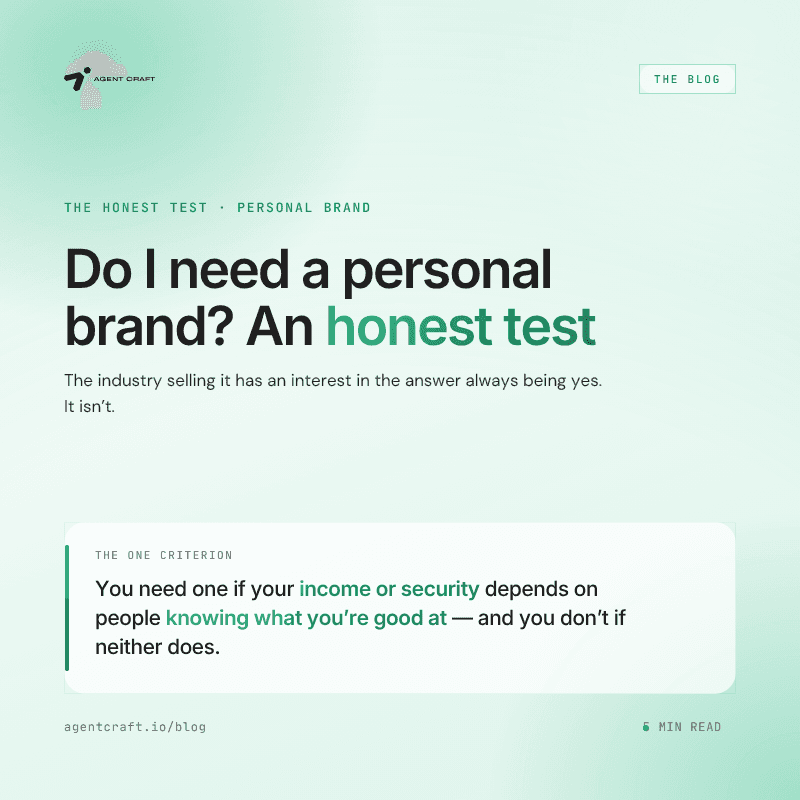
You need a personal brand if your income or your security depends on people knowing what you are good at, and you do not need one if neither does. That single criterion sorts almost every case, and it is worth applying coldly, because the industry that sells personal branding has an obvious interest in the answer always being yes. It is not always yes. It is, however, yes rather more often than the people avoiding the work would prefer, so below is the five-question version of the test, followed by the honest list of who passes it in the other direction.

Juan Mouton

VP Marketing

Jul 12, 2026
personal brandingfounder marketingLinkedIn
Personal Brand vs Company Brand: Which One Does the Work
Personal Branding4 min read

Personal Brand vs Company Brand: Which One Does the Work

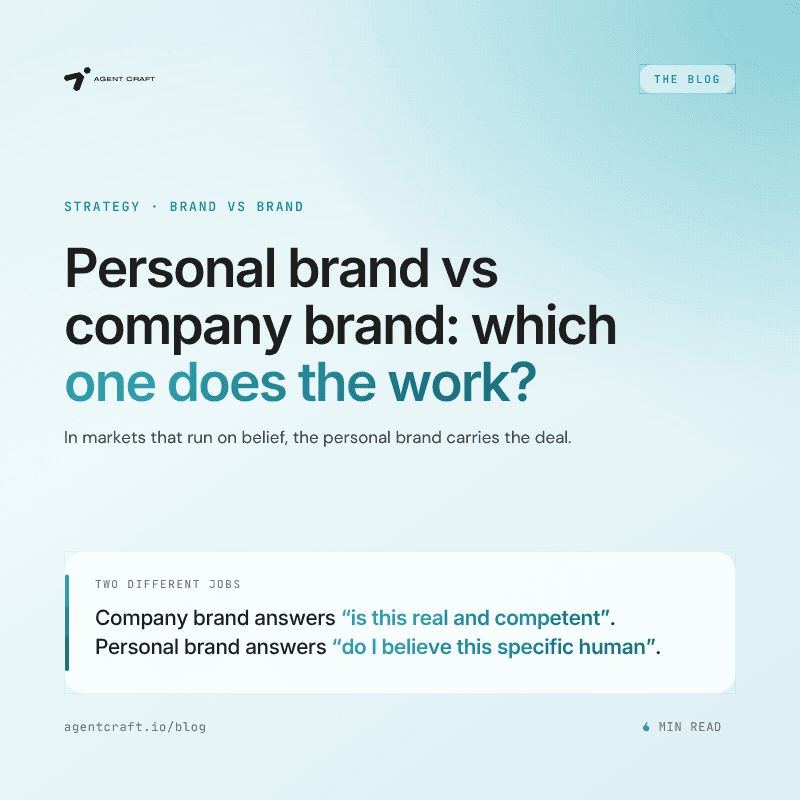
The short answer: people trust people, so the personal brand does the trust-building work while the company brand does the reassurance work, and confusing the two jobs wastes both. A company brand answers "is this a real, competent organization." A personal brand answers "do I believe this specific human." In markets where the sale runs on belief, expertise, services, early-stage products, anything bought before it can be fully verified, the personal brand carries the deal and the company brand catches it.

Juan Mouton

VP Marketing

Jul 12, 2026
personal brandingLinkedInfounder marketing
What Is a Personal Brand? A Definition Without the Hype
Personal Branding4 min read

What Is a Personal Brand? A Definition Without the Hype

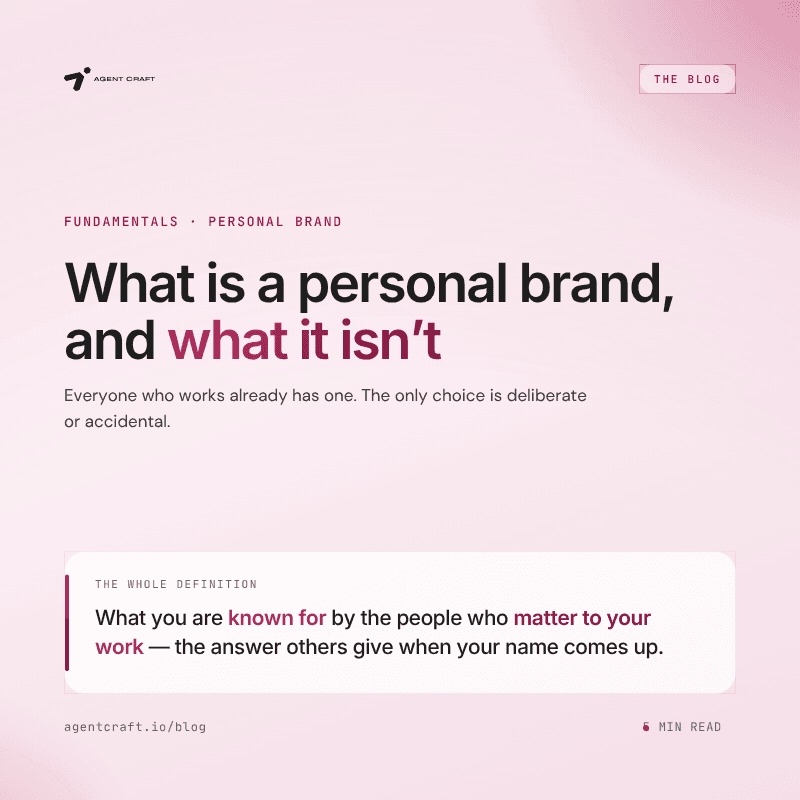
A personal brand is what you are known for by the people who matter to your work. That is the whole definition. It is the answer others give when your name comes up: she is the pricing person, he is the one who fixes broken supply chains, they are sharp on early-stage hiring. Everyone who works already has one, because being known for something, or for nothing, is not optional. The only choice available is whether the reputation is deliberate or accidental, and personal branding, stripped of its baggage, is simply the deliberate version.

Juan Mouton

VP Marketing

Jul 12, 2026
personal brandingLinkedInfounder marketing

The 90-Day Rule: Why Personal Brands Fail in Week Three
Personal Branding5 min read

The 90-Day Rule: Why Personal Brands Fail in Week Three

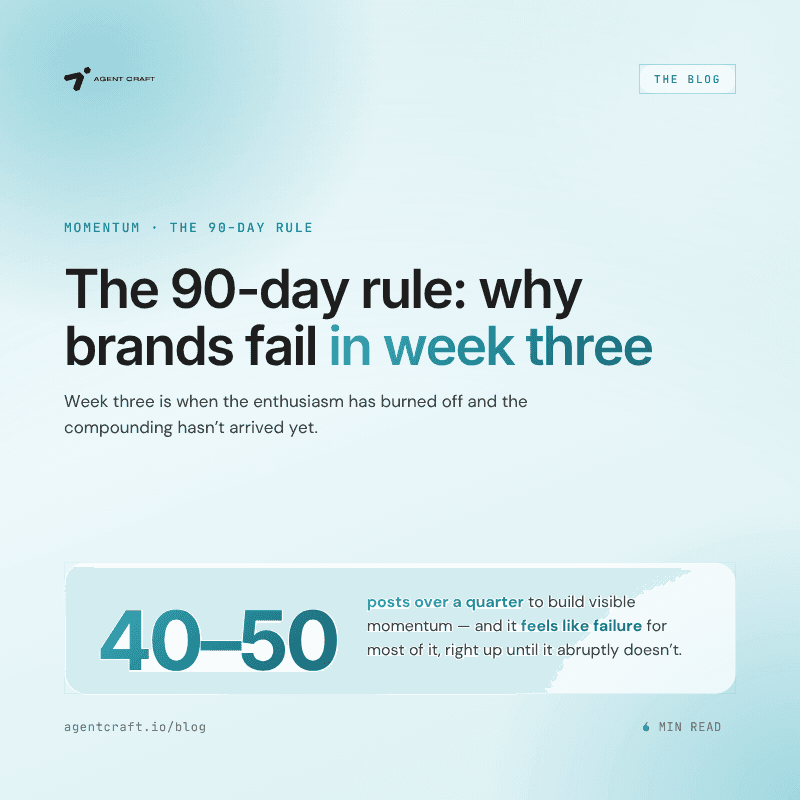
The 90-day rule says that building visible momentum takes roughly forty to fifty posts over a quarter, and that the effort will feel like failure for most of that quarter before it abruptly does not. Most people never find out, because they quit in week three, which is precisely when the founding enthusiasm has burned off and the compounding has not yet arrived, leaving nothing in the tank but the schedule itself. Understanding why the timeline has this shape, a long flat and then a curve, is the difference between reading week three's silence as a verdict and reading it as a stage, and that single interpretive choice decides most outcomes in this game.

Juan Mouton

VP Marketing

Jul 12, 2026
personal brandingLinkedInfounder marketing
How Often Should You Post on LinkedIn? The Honest Answer
Personal Branding5 min read

How Often Should You Post on LinkedIn? The Honest Answer

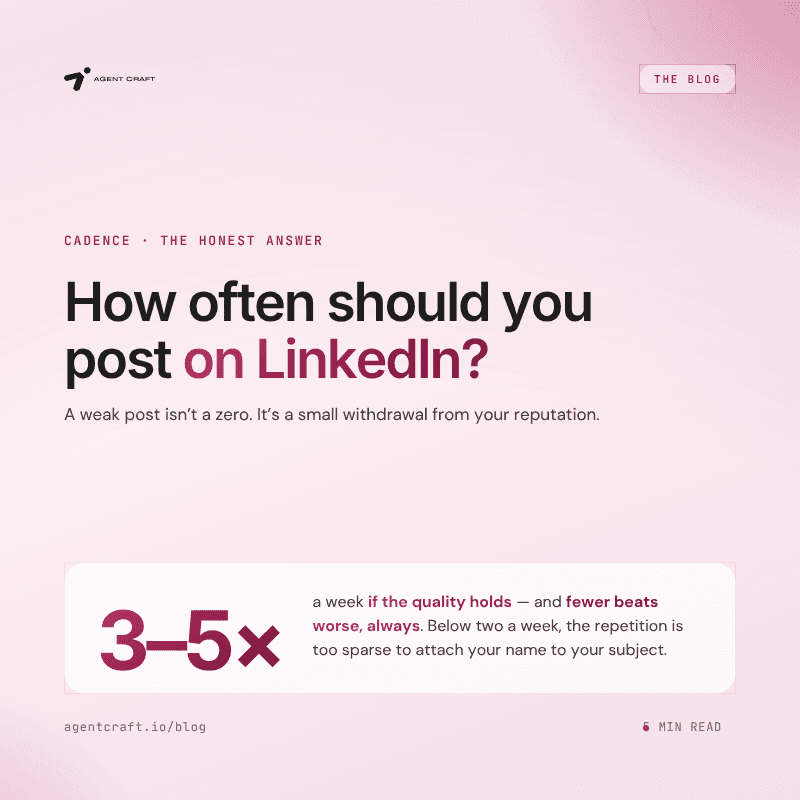
Three to five times a week if the quality holds, and fewer beats worse, always. That is the honest answer, and both halves matter. The first half exists because reputations form through repetition, and below roughly two posts a week the repetition is too sparse for an audience to attach your name to your subject. The second half exists because a weak post is not a zero, it is a small withdrawal: it teaches the exact readers you most want that your name can be safely skipped. The real question hiding inside the frequency question is therefore not "how often should I post" but "what is the highest cadence at which everything I ship is genuinely worth a busy person's attention," and that number is personal, discoverable, and lower than the advice industry implies.

Juan Mouton

VP Marketing

Jul 12, 2026
personal brandingLinkedInfounder marketing
How much should small business marketing actually cost?
Marketing Strategy5 min read
How much should small business marketing actually cost?
Most advice tells you to spend 5 to 10 percent of revenue. For most small businesses that number is laughable. Here's the honest math.

Agent Craft

Apr 25, 2026
small business marketingmarketing budgetmarketing cost
Why having marketing tools isn't the same as doing marketing
Marketing Strategy4 min read

Why having marketing tools isn't the same as doing marketing

You've got a Mailchimp account, a Canva login, a Facebook page, and the phone still isn't ringing. Here's the gap nobody explains to small business owners.

Agent Craft

Apr 24, 2026
small business marketingmarketing strategyorganic content
Why AI hasn't worked for your marketing yet
AI for Marketing3 min read

Why AI hasn't worked for your marketing yet

You tried ChatGPT. It wrote something forgettable. You closed the tab. Here's what actually went wrong, and what's different now.

Agent Craft

Apr 23, 2026
AI marketingsmall business marketingChatGPT