How to Build a Personal Brand on LinkedIn From Zero (2026)
Juan Mouton
VP Marketing
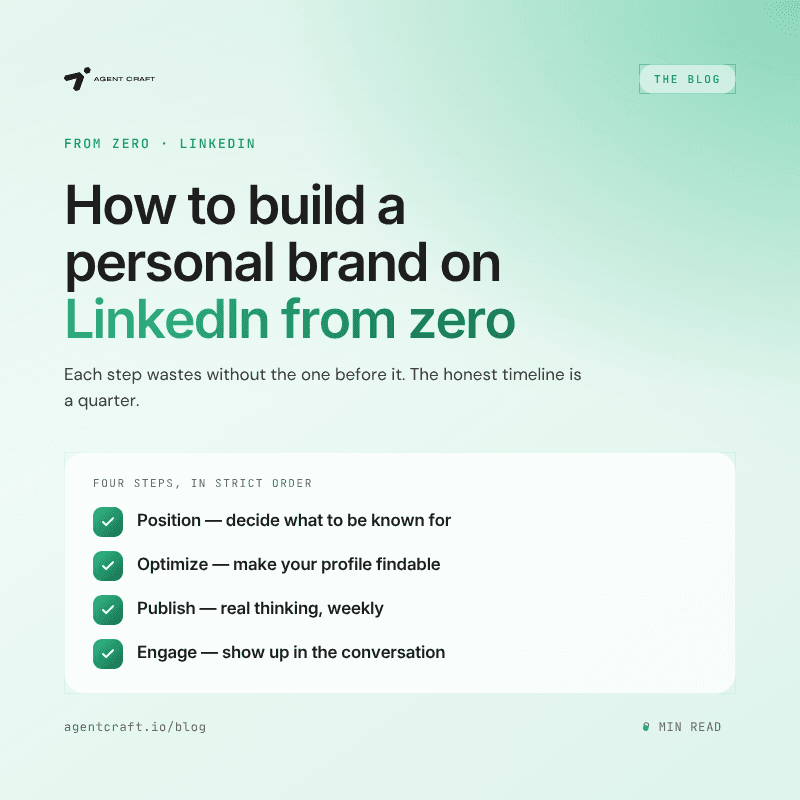
The sequence from zero is four steps in strict order: position (decide what you want to be known for), optimize (make your profile findable and legible), publish (put real thinking in public on a weekly rhythm), and engage (be present in the conversations around your subject). Run them in order because each one wastes without the one before it: publishing without a position produces noise, and a beautiful profile nobody arrives at is a brochure in a drawer. The honest timeline for the whole arc is a quarter, and the quarter is non-negotiable in a way this post will be specific about, because the timeline is where zero-starters actually fail.
Step one: position, before anything touches the keyboard
One afternoon, three decisions. What you want to be known for: one to three subjects where you have real experience, genuine interest, and the stamina to continue unapplauded. Who it is for: the specific reader whose "that is me" you are writing toward. And what you reject: at least one standard practice in your field you genuinely disagree with, because agreement is invisible and the disagreement is where your edges live. Write the three decisions down; they are the filter every future post passes through, and skipping them is how people end up eight months in with momentum and no direction.
Step two: optimize, one working session
The profile is the landing page every post points back to, so it gets fixed before the posting starts. Headline: what you do, for whom, in the words your field would search, never just a title. About: first line states who you help and with what; the rest supplies evidence. Experience: outcomes, not responsibilities. Photo and banner: current and unembarrassing clears the bar. This is two hours once, plus quarterly touch-ups, and it converts every future reader your posts create, which is why it precedes them.
Step three: publish, the weekly evidence
Now the engine. From zero, two to three posts a week is the right cadence: enough for the rhythm to form, light enough to hold. What to post divides into four buckets worth knowing by name: growth content (observations and patterns that reach new people), authority content (the deeper lessons and frameworks that prove you know the thing), conversion content (the occasional piece that asks for something, once there is anyone to ask), and personal content (the light human layer that keeps you a person). From zero, live almost entirely in the first two, roughly evenly, and let the observational register carry you: the lesson from the work, the pattern you keep seeing, the question you are genuinely working on. That last format is the zero-starter's best friend, because it requires no audience and no conclusions, only honesty and specificity.
Expect the early posts to land in silence. This is normal, universal, and temporary, and the next section is about surviving it.
Step four: engage, the half everyone skips
Publishing broadcasts; engagement builds. Fifteen to twenty minutes a day: genuine comments on posts in your subject, replies to everyone who comments on yours, and the slow accumulation of being a recognizable presence in your corner's conversations. From zero this step matters more than the posting, because comments put you in front of established audiences before you have one of your own, and the relationships they start are the actual asset. A useful comment on the right post reaches more of your future readers than your own post will for weeks. Do both anyway; they compound.
The honest timeline, and week three
Here is the shape of the first quarter, stated plainly so it cannot ambush you. Weeks one and two run on novelty. Week three is where zero-starters die: the novelty is gone, the numbers are small, the calendar is full, and the post is due anyway. Weeks four through eight are quiet accumulation, small signals, a comment from a stranger, a profile view spike, nothing that feels like success. Somewhere in weeks nine through twelve the compounding becomes visible: recognition in comments, the first inbound message, posts that travel beyond your network. Forty to fifty posts is the standard price of that arc, and there is no evidence anyone reliably shortcuts it. The single strongest predictor of reaching week twelve is deciding, in week one, that week three's silence is a stage and not a verdict.
The week-one checklist
Positioning decisions written down. Headline rewritten. About opened with the who-and-what line. First post published, a lesson or an observation from real work. Three genuine comments made. Recurring hour blocked in the calendar. That is the whole first week, and it is deliberately small, because the game is not starting big. It is still being here in week twelve.
Where Agent Craft sits in this
Agent Craft runs the whole sequence above. The positioning happens in onboarding rather than on a blank page, a strategy layer shaped by best practice and a marketing VP with twenty-plus years on global brands. From there the system takes the labor: voice notes become drafts in your voice, published across LinkedIn, X, TikTok, and YouTube, aimed squarely at week three, where schedules beat willpower. And when the momentum produces inbound, the personal brand CRM catches it, qualifies it, and nurtures it by email. From zero, with the grind removed.
Frequently asked questions
How long does it take to build a personal brand on LinkedIn?
Visible momentum typically takes a quarter of consistent activity, roughly forty to fifty posts plus daily light engagement. The early weeks are quiet by design; the compounding arrives in months two and three.
How often should I post when starting from zero?
Two to three times a week: enough to build rhythm and data, light enough to sustain. Consistency across the quarter beats volume in any single week.
What should my first LinkedIn post be?
A specific lesson or observation from your real work, written plainly. Not an introduction, not an announcement that you will be posting. Start as you mean to continue, with substance.
Share
Related Articles
How to Turn a Voice Note Into a Week of LinkedIn Content, By Hand
The method is this: record yourself talking for two minutes about something you know, transcribe it, find the two or three posts hiding inside the rambling, give each one a hook, cut it to length, format it for LinkedIn, re-form it for X if you use both, and schedule the lot. The two minutes of talking produce the whole week's raw material. The desk work after the talking takes about forty-five minutes per post. This post walks every step so you can run the entire method yourself, with the honest timing attached to each.
Personal Branding for Consultants: Turning Expertise Into Inbound
For a consultant, personal branding reduces to one move: showing your thinking in public, because your thinking is the product and buyers cannot want what they have not seen. Every other profession sells something separable from the person; consulting sells judgment, and judgment can only be evaluated by watching it operate. A consultant who publishes their reasoning is running free product demos at scale. A consultant who does not is asking strangers to buy an invisible service on the strength of a headshot, which is roughly the market's hardest sale, and explains most of the profession's cold-outreach misery.
How Agency Owners Use a Personal Brand to Sell the Agency
Clients hire the person they have been reading for a year, and then they sign with that person's agency. That single sentence is the entire mechanism, and it explains a pattern every agency owner has noticed without always naming: the best-fit clients arrive saying "I have been following your stuff," having pre-sold themselves through months of the owner's published thinking, while the agency's own polished channels generate polite inquiries that need convincing from zero. The owner's brand and the agency's brand are both real assets. They just do different jobs, and in a market that sells judgment, the personal one does the heavy lifting.