Career Insurance: Why Your Reputation Is a Policy You Pay Weekly
Juan Mouton
VP Marketing
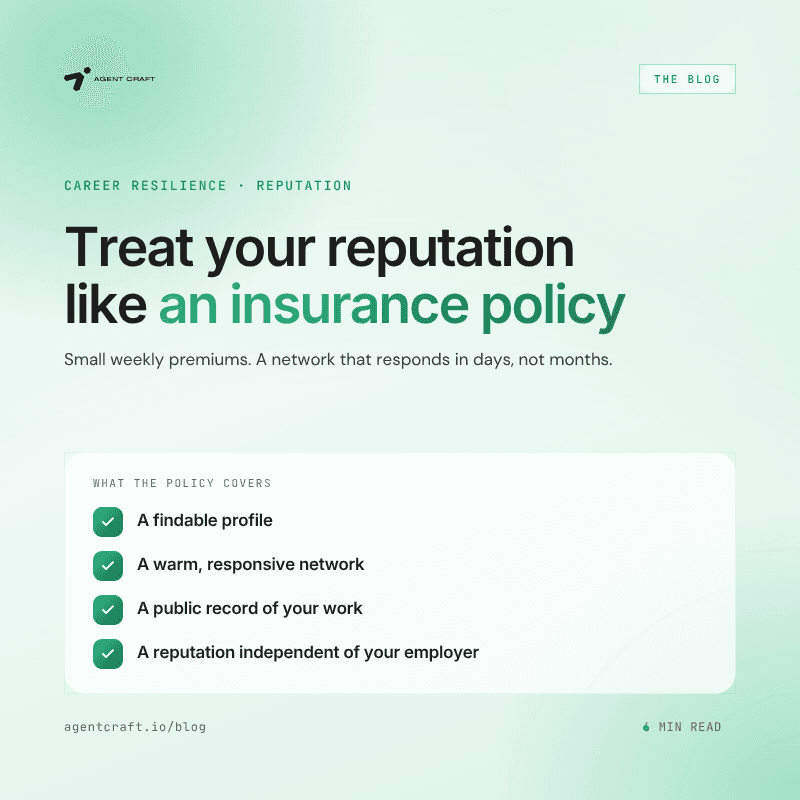
Career insurance is professional visibility built before you need it: a findable profile, a warm network, a public record of what you are good at, and a reputation that exists independently of your employer. The premiums are small and weekly, an hour or less of maintenance. The payout is a network that responds within days instead of months when your situation changes. And like every other kind of insurance, it has one unbreakable rule: you cannot buy the policy during the fire.
The concept earns the name because the analogy holds at every joint, which is rare for analogies. Walk it through.
The premiums
Insurance works by converting a catastrophic, unpayable cost into small regular payments. Career insurance does the same. The catastrophic version is the cold start: losing a role with a dormant network, an outdated profile, and no public evidence of your abilities, then trying to build all three in a panic while unemployed. People who have done it describe the first month as two years of deferred maintenance performed under pressure, and it costs exactly what deferred maintenance always costs.
The premium version is small and boring. Each week: keep the profile current, send two or three genuinely useful messages to people you know with nothing asked in return, and publish one piece of professional thinking in public. Call it forty-five minutes to an hour. That is the entire premium schedule, and like all premiums it feels mildly annoying to pay and existentially cheap in hindsight.
The coverage
What the policy actually covers, dimension by dimension:
Findability. When someone goes looking for a person who does what you do, you surface. This is your headline and profile written in the words your field searches, and it is the cheapest coverage on the schedule: mostly a one-time rewrite plus quarterly upkeep.
Network liveness. The difference between two thousand connections and ten people who would take your call this week. Liveness is bought with the no-ask touches, and it decays fastest of all four dimensions when the premiums stop.
Visibility. People outside your employer knowing what you are good at, because they have seen you think in public. This is the weekly post, and it compounds: every piece is still working for you years later, findable by anyone who checks whether you know your subject.
Ownership. The share of your reputation that survives handing back the badge. Work that lives only in internal documents is, functionally, your employer's asset. Work published under your name on surfaces you control is yours, permanently.
The claim
The claim event is any moment you need the market to respond to you: a layoff, a company failing, a decision to leave, a fundraise, a career pivot. An insured professional files the claim and the coverage pays out fast: the profile is already ranking, the network is already warm, the public record already answers the diligence questions people quietly run. Conversations start in days.
The uninsured professional discovers the actuarial truth everyone learns exactly once: reputations respond at the temperature you left them. A network untouched for three years responds at three-year-old temperature, no matter how urgent your situation is now. Warmth cannot be expedited. That is why the policy has to exist before the claim.
Why most professionals are uninsured
Not laziness. The incentives are miscalibrated. While employed, the premiums feel optional because the employer's brand is providing free coverage: people return your calls because of the logo next to your name. The coverage feels real right up until the logo is removed, at which point you find out how much of it was ever yours. Borrowed coverage is still coverage, but it has one exclusion clause, and the exclusion is the exact event you most need to be covered for.
There is also the cringe objection, the sense that visibility work is self-promotion. It is worth answering plainly: publishing what you are learning and helping people in public is not promotion, it is professional generosity with a paper trail, and the people who find it distasteful are rarely the ones who will be hiring you later.
Underwriting yourself
Every policy starts with an assessment. Yours is four questions, answered honestly: Would a recruiter searching your specialty find you this week? When did someone outside your company last contact you about work? Does anyone beyond your employer know what you are specifically good at? And if you left tomorrow, how much of your reputation walks out with you?
If two or more answers are uncomfortable, you are underinsured, and the good news is that underinsured is a state, not a trait. The premiums start whenever you do, and the first payment, rewriting your headline and sending three no-ask messages, costs under an hour.
Where Agent Craft sits in this
The premiums above are all payable by hand, and the visibility premium, the weekly public post due regardless of the week, is the one that defeats most people. Agent Craft pays it as a system: a two-minute voice note becomes consistent publishing in your voice across LinkedIn, X, TikTok, and YouTube, with a strategy layer keeping the coverage aimed at findability, liveness, and record. The network touches stay yours. The policy stays in force through the quarters that used to lapse it.
Frequently asked questions
What is career insurance?
Professional visibility built before it is needed: a findable profile, a warm network, a public record of your abilities, and a reputation independent of your employer, maintained through small weekly habits.
How much time do the premiums take?
Forty-five minutes to an hour a week: profile upkeep, two or three no-ask messages to people in your network, and one public post about your professional thinking.
Is it too late to start if I might lose my job soon?
Start today regardless. Coverage built in a month is thinner than coverage built over a year, but every week of premiums paid before the claim improves the payout, and the first actions take under an hour.
Is this just personal branding renamed?
The activities overlap; the motive differs. Personal branding usually aims at growth and influence. Career insurance aims at security and optionality, and it changes what you build: less audience-chasing, more findability, liveness, and record.
Share
Related Articles
How to Build a Personal Brand on LinkedIn From Zero (2026)
The sequence from zero is four steps in strict order: position (decide what you want to be known for), optimize (make your profile findable and legible), publish (put real thinking in public on a weekly rhythm), and engage (be present in the conversations around your subject). Run them in order because each one wastes without the one before it: publishing without a position produces noise, and a beautiful profile nobody arrives at is a brochure in a drawer. The honest timeline for the whole arc is a quarter, and the quarter is non-negotiable in a way this post will be specific about, because the timeline is where zero-starters actually fail.
How to Turn a Voice Note Into a Week of LinkedIn Content, By Hand
The method is this: record yourself talking for two minutes about something you know, transcribe it, find the two or three posts hiding inside the rambling, give each one a hook, cut it to length, format it for LinkedIn, re-form it for X if you use both, and schedule the lot. The two minutes of talking produce the whole week's raw material. The desk work after the talking takes about forty-five minutes per post. This post walks every step so you can run the entire method yourself, with the honest timing attached to each.
Personal Branding for Consultants: Turning Expertise Into Inbound
For a consultant, personal branding reduces to one move: showing your thinking in public, because your thinking is the product and buyers cannot want what they have not seen. Every other profession sells something separable from the person; consulting sells judgment, and judgment can only be evaluated by watching it operate. A consultant who publishes their reasoning is running free product demos at scale. A consultant who does not is asking strangers to buy an invisible service on the strength of a headshot, which is roughly the market's hardest sale, and explains most of the profession's cold-outreach misery.