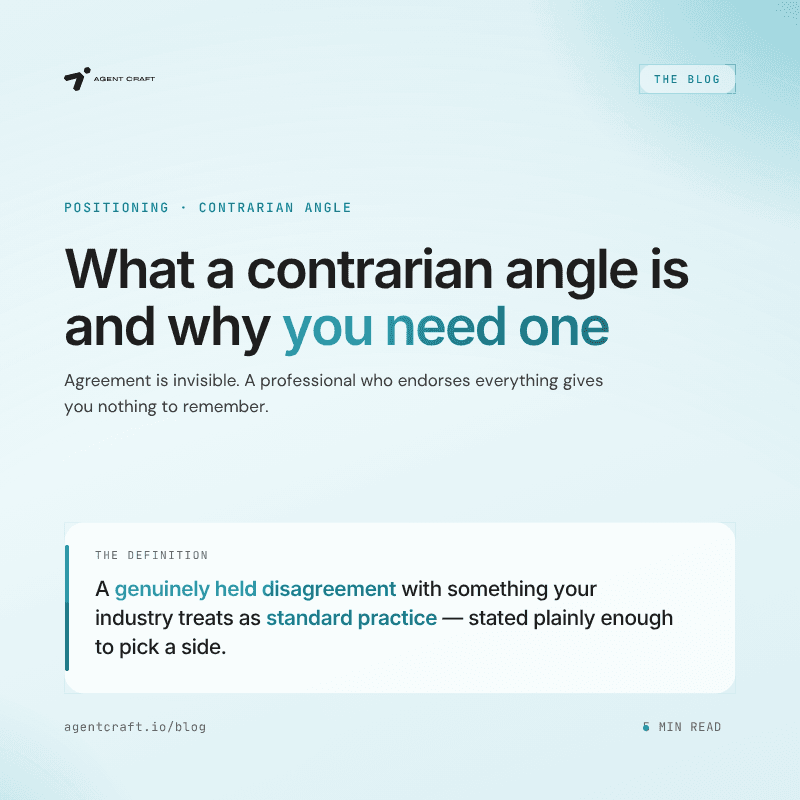
What a Contrarian Angle Is (and Why Positioning Needs One)
Juan Mouton
VP Marketing
A contrarian angle is a genuinely held disagreement with something your industry treats as standard practice, stated plainly enough that people can tell which side you are on. Your positioning needs at least one because agreement is invisible: a professional who endorses everything their field already believes gives an audience nothing to remember, nothing to argue with, and no reason to choose them over the consensus they are politely restating. The disagreement is where the edges are, and edges are what make a position graspable.
Note what the definition requires before anything else: genuinely held. The internet is oversupplied with manufactured contrarianism, hot takes reverse-engineered from what would perform, and audiences have become expert at detecting the manufacture. The angle only works when it is a real belief with your experience underneath it, which conveniently is also the only version you can defend when someone pushes, and someone will push. That is rather the point.
Why consensus content fails quietly
The failure is not that agreeable content is bad. It is that it is indistinguishable. Run the swap test on a consensus post, swap the byline for anyone else in the field, and it reads identically, because it could have come from anyone; it is the field talking to itself through your account. Readers do not punish this content. They do something worse: they process it as ambient noise, agree mildly, and retain nothing, including your name. Meanwhile the post that says "the standard advice on this is wrong, and here is what I have seen instead" forces a small decision in the reader, agree or argue, and either decision requires them to register who said it. Memory follows friction. Consensus has none.
The disagree-and-flip exercise
The mechanical way to find your angles, from the positioning workbook, takes twenty minutes with a pen.
Left column: list four things people in your space commonly do or say that you disagree with. Not straw men, real practices with real defenders, the advice that gets repeated at conferences, the default your competitors run. If nothing comes, prompt yourself with irritation: what makes you sigh when you see it in your feed? Professional irritation is usually a belief wearing a frown.
Right column: flip each into the opposite, the approach you would defend instead, stated as your practice rather than their failure. "Everyone chases reach" flips to "I build for the two hundred people who matter." "The industry sells tools before diagnosis" flips to "I fix the process before recommending software."
The right column is your set of angles. Two tests before any of them ship. The dinner test: would you argue this position unpaid, at some social cost, because you actually believe it? The constituency test: do reasonable people practice the thing you are rejecting? A rejection with no real constituency ("I believe in quality, not laziness") is a platitude in a leather jacket.
Contrarian versus contrarian-for-clicks
The line between the two is worth drawing precisely, because the failure mode is expensive. A working angle attacks a practice and offers a lived alternative; clickbait attacks a person, a company, or everything at once, and offers heat. A working angle is stable, you will hold it next quarter, because experience put it there; clickbait rotates weekly with the discourse. And a working angle survives the strongest counterargument being stated fairly, while clickbait depends on the counterargument never showing up. One practical tell covers most cases: if a position makes you slightly nervous to post because you mean it, it is probably an angle. If it makes you excited to post because of what it will do, it is probably bait.
Putting the angle to work
An angle is not one spicy post; it is a filter that runs indefinitely. It generates content on its own schedule: every new example of the rejected practice is a post, every case study of your alternative is a post, every fair-minded engagement with the other side is a post that builds more credibility than agreement ever could. It pre-sorts your audience, attracting the people who share the frustration and repelling the ones who were never your people, which is the filter doing you a favor. And it hardens your positioning sentence: the "not X" slot of a brand statement is exactly one of these angles, promoted to headquarters.
Hold two or three angles, no more, attached to your pillars. A person with one disagreement is interesting. A person disagreeing with everything is exhausting, and reads as the bitterness the good version carefully is not.
Where Agent Craft sits in this
The exercise above is the workbook's Differentiation Breakdown, free and complete. Inside Agent Craft, your angles are stored in the Brand Book and enforced: drafts that fence-sit on a question you have taken a side on get flagged before they ship, because the drift back to comfortable consensus is real and invisible from inside. The strategy layer holds the line across LinkedIn, X, TikTok, and YouTube. The disagreeing remains your department, and the best part of the job.
Frequently asked questions
What is a contrarian angle in personal branding?
A genuinely held disagreement with a standard practice in your field, stated clearly and backed by your experience. It gives your positioning edges an audience can remember and choose.
How do I find my contrarian angle?
List four things your industry does that you disagree with, then flip each into the approach you would defend instead. Keep only the ones you would argue for unpaid and that real practitioners would argue against.
Is being contrarian risky for my reputation?
Manufactured contrarianism is; genuine, experience-backed disagreement is the opposite. The risk profile follows the sincerity: real angles survive pushback, and surviving pushback is what builds standing.
Share
Related Articles
How to Build a Personal Brand on LinkedIn From Zero (2026)
The sequence from zero is four steps in strict order: position (decide what you want to be known for), optimize (make your profile findable and legible), publish (put real thinking in public on a weekly rhythm), and engage (be present in the conversations around your subject). Run them in order because each one wastes without the one before it: publishing without a position produces noise, and a beautiful profile nobody arrives at is a brochure in a drawer. The honest timeline for the whole arc is a quarter, and the quarter is non-negotiable in a way this post will be specific about, because the timeline is where zero-starters actually fail.
How to Turn a Voice Note Into a Week of LinkedIn Content, By Hand
The method is this: record yourself talking for two minutes about something you know, transcribe it, find the two or three posts hiding inside the rambling, give each one a hook, cut it to length, format it for LinkedIn, re-form it for X if you use both, and schedule the lot. The two minutes of talking produce the whole week's raw material. The desk work after the talking takes about forty-five minutes per post. This post walks every step so you can run the entire method yourself, with the honest timing attached to each.
Personal Branding for Consultants: Turning Expertise Into Inbound
For a consultant, personal branding reduces to one move: showing your thinking in public, because your thinking is the product and buyers cannot want what they have not seen. Every other profession sells something separable from the person; consulting sells judgment, and judgment can only be evaluated by watching it operate. A consultant who publishes their reasoning is running free product demos at scale. A consultant who does not is asking strangers to buy an invisible service on the strength of a headshot, which is roughly the market's hardest sale, and explains most of the profession's cold-outreach misery.