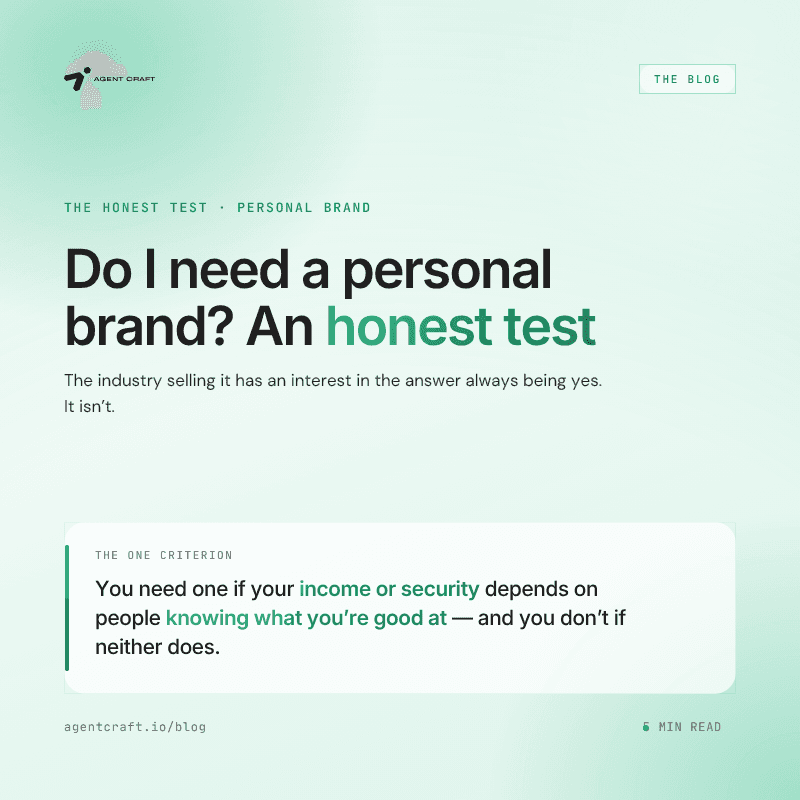
Do I Need a Personal Brand? An Honest Five-Question Test
Juan Mouton
VP Marketing
You need a personal brand if your income or your security depends on people knowing what you are good at, and you do not need one if neither does. That single criterion sorts almost every case, and it is worth applying coldly, because the industry that sells personal branding has an obvious interest in the answer always being yes. It is not always yes. It is, however, yes rather more often than the people avoiding the work would prefer, so below is the five-question version of the test, followed by the honest list of who passes it in the other direction.
The five questions
Answer each without flattering yourself.
One. If you lost your income source tomorrow, would the market respond to you within days, or would you be starting cold? This is the security half of the criterion. A warm network, a findable profile, and a public record of your ability are what compress a cold start into a short one, and none of the three can be built quickly once needed.
Two. Does new business, or new opportunity, ever need to find you? Founders, consultants, fractional operators, advisors, anyone whose pipeline benefits from inbound: this is the income half, and it is nearly automatic. If your economics improve when strangers arrive pre-sold, visible expertise is a channel, and you either build it or keep paying for its substitutes.
Three. Do the people who decide things about you check you out first? Boards, investors, acquirers, senior hiring processes, big clients: all of them quietly search before committing, and what they find is your reputation operating without you in the room. If your career has reached the altitude where you get diligenced, silence is no longer neutral; it reads as absence at the exact moment someone went looking for evidence of judgment.
Four. Is your standing currently rented from your employer? If your calls get returned because of the logo next to your name, you have coverage, and it is borrowed. The test within the test: would people think of you, or of the company, when your specialty comes up? Rented standing is fine right up until the lease ends, which is not a date you get to choose.
Five. Are you invisible relative to your ability? The quiet frustration of watching louder, lesser peers get the opportunities is not vanity; it is a market inefficiency, and it is yours to correct. Ability that cannot be seen gets priced like ability that does not exist.
Two or more uncomfortable answers means the criterion applies to you. One means it probably will soon. Zero means read the next section, because you may genuinely be excused.
Who honestly does not need one
The exemptions are real and worth stating, since the industry never does. You are excused if your career runs entirely on internal reputation and you are content with that trade, some large-organization paths genuinely do, provided you accept the concentration risk of one employer holding your entire standing. You are excused if your work is oversubscribed through channels that need no visibility, the surgeon with a two-year waitlist, the fund that is closed. And you are excused if you are near the end of a career you have no wish to extend or protect. Notice what all three exemptions share: either the risk is consciously accepted, or the payoff is already banked. If neither is true of you, the exemption you are claiming is probably just the discomfort talking.
What "yes" actually commits you to
Smaller than feared, which is worth saying because the imagined version stops more people than the real one. Not an audience, not a persona, not daily posting: a clear position, a findable profile, one piece of visible thinking a week, and a few genuine network touches, sustained. An hour or two weekly, indefinitely. The indefinitely is the real cost, and it is also why the test above matters: nobody sustains that schedule on someone else's reasons. You sustain it because one of those five questions made your stomach drop slightly, and that answer is the fuel.
Where Agent Craft sits in this
Our incentive is for your answer to be yes, so the test above was built to survive it: score zero and close the tab with our blessing. Score two or more and here is the offer, stated plainly. Agent Craft runs the commitment for you: strategy built in, weekly evidence from a two-minute voice note, published in your voice across LinkedIn, X, TikTok, and YouTube, with a personal brand CRM and email nurture catching what the standing produces. The hour a week becomes the two minutes you were going to spend thinking anyway.
Frequently asked questions
Who needs a personal brand?
Anyone whose income or security depends on people knowing what they are good at: founders, consultants, independents, and any professional senior enough to be searched before being trusted.
Who does not need a personal brand?
People whose careers run entirely and contentedly on internal reputation, whose work is oversubscribed without visibility, or who are winding down with nothing left to protect. The exemptions are real but narrower than the discomfort suggests.
What does building one actually require?
A chosen position, a findable profile, one piece of public thinking a week, and light network maintenance: an hour or two weekly, sustained over quarters. Consistency, not volume, is the mechanism.
Share
Related Articles
How to Build a Personal Brand on LinkedIn From Zero (2026)
The sequence from zero is four steps in strict order: position (decide what you want to be known for), optimize (make your profile findable and legible), publish (put real thinking in public on a weekly rhythm), and engage (be present in the conversations around your subject). Run them in order because each one wastes without the one before it: publishing without a position produces noise, and a beautiful profile nobody arrives at is a brochure in a drawer. The honest timeline for the whole arc is a quarter, and the quarter is non-negotiable in a way this post will be specific about, because the timeline is where zero-starters actually fail.
How to Turn a Voice Note Into a Week of LinkedIn Content, By Hand
The method is this: record yourself talking for two minutes about something you know, transcribe it, find the two or three posts hiding inside the rambling, give each one a hook, cut it to length, format it for LinkedIn, re-form it for X if you use both, and schedule the lot. The two minutes of talking produce the whole week's raw material. The desk work after the talking takes about forty-five minutes per post. This post walks every step so you can run the entire method yourself, with the honest timing attached to each.
Personal Branding for Consultants: Turning Expertise Into Inbound
For a consultant, personal branding reduces to one move: showing your thinking in public, because your thinking is the product and buyers cannot want what they have not seen. Every other profession sells something separable from the person; consulting sells judgment, and judgment can only be evaluated by watching it operate. A consultant who publishes their reasoning is running free product demos at scale. A consultant who does not is asking strangers to buy an invisible service on the strength of a headshot, which is roughly the market's hardest sale, and explains most of the profession's cold-outreach misery.