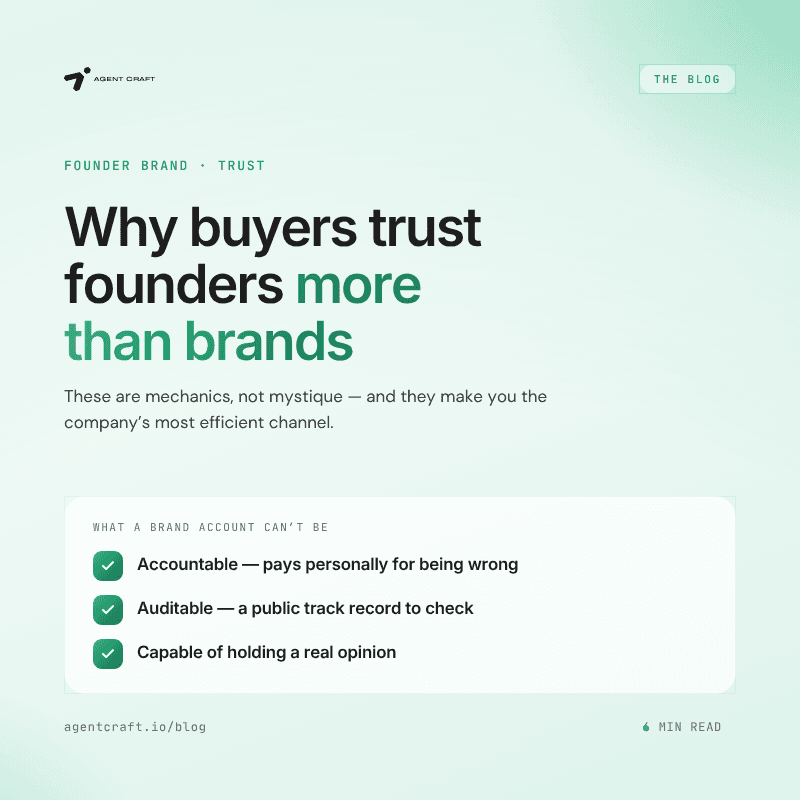
Founder Personal Brand: Why Buyers Trust Founders More Than Brands
Juan Mouton
VP Marketing
Buyers trust founders more than brands because a founder is accountable, auditable, and capable of holding an opinion, and a brand account is none of the three. A person who says something wrong in public pays for it personally, which is exactly what gives their claims weight. A person who has thought in public for a year has left a track record any buyer can audit before the first call. And a person can take a side, where a brand voice holding an opinion is a committee performing one, and reads that way. These are mechanics, not mystique, and a founder who understands them can run their reputation as the company's most efficient acquisition channel.
The three mechanics, unpacked
Accountability. Corporate content is understood by every reader to be marketing: reviewed, sanded, and attributable to no one. It gets processed accordingly, with the specific polite skepticism people reserve for material that cannot be embarrassed. A founder's post carries personal risk, their name, their judgment, their standing among peers, and readers price that risk in as credibility. The claim costs the founder something to make, therefore it means something.
Auditability. By the time a serious buyer books a call, they have usually done their quiet diligence, and a founder who publishes has handed them the file: a year of visible decisions, opinions held and revised, questions engaged honestly. No landing page survives that comparison, because landing pages do not think, they assert. The founder's back catalog is a due-diligence process the buyer runs alone, at midnight, before you ever knew they existed, and buyers who arrive through it arrive substantially pre-sold.
Opinion. Markets are arguments, and buyers are choosing a side as much as a vendor. A founder can say "the standard approach in our category is wrong, and here is what we do instead," which is simultaneously a belief, a differentiation, and a filter. The buyers who agree self-select in, already aligned with the product's whole premise. Brand accounts structurally cannot make this move with a straight face, which is why category arguments are founder work.
What founder content actually is
The trust does not come from volume or polish; it comes from exposure to real thinking, which means the working formats are narrow and conveniently cheap. The decision and its logic: what you chose, what you weighed, what you would now do differently. The pattern from the front line: what you keep seeing in customer conversations that the market has not named yet. The stance: the practice in your category you refuse, and why. And the honest middle: what you are figuring out right now, unresolved, which reads as confidence because only the secure publish their uncertainty.
Notice what the list excludes: launch announcements, milestone theater, and anything the company account could have posted. If the company page could have said it, it is not founder content, it is corporate content wearing a face.
The objection: I am too busy building
The standing objection, and the honest answer is that the good version costs less than the objection assumes, because founder content is a byproduct of founding. You already think about the market daily; the content is that thinking, captured rather than manufactured. Two minutes of talking about the decision you made this week is the raw material of a post; the expensive part was making the decision, and that cost is already sunk. The founders who sustain this for years are not the ones with spare time. They are the ones who stopped treating content as a separate job and started treating it as exhaust from the real one.
The second honest answer: some weeks the objection wins anyway, and the practice survives on whether the founder's system can carry a bad fortnight. Which is a solvable problem, and a different one from time.
The concentration caveat
Stated plainly because founder-brand advice usually omits it: a company whose entire market trust rests on one person has key-person risk in its marketing, the same as anywhere else in the business. The mature version, as the company grows, is multiplication rather than dilution: other senior voices building their own standing alongside the founder's, so the trust portfolio holds more than one asset. The founder's voice stays the anchor. It stops being the whole fleet.
Where Agent Craft sits in this
Agent Craft is built on the byproduct principle above: the founder talks for two minutes about what they were already deciding, and the system does the manufacturing, drafts in their voice, strategy enforced, published across LinkedIn, X, TikTok, and YouTube. Then it closes the loop the feed cannot: a personal brand CRM collects the buyers your thinking pre-sold, qualifies them, and nurtures them by email until they book the call. The judgment stays the founder's. That was always the cargo.
Frequently asked questions
Why does founder content outperform company content?
Accountability, auditability, and opinion: a founder's claims carry personal risk, leave an auditable record, and can take sides. Brand accounts have none of the three, and readers price the difference automatically.
How much time does a founder personal brand take?
Treated as exhaust from real work, minutes of capture per week plus whatever processing your system absorbs. Treated as a separate content job, hours, which is why the separate-job framing is where most founder brands die.
Should the founder or the company account post our news?
The company account announces; the founder thinks. If a post could plausibly come from the company page, it is not founder content, and putting a face on it does not change what it is.
Share
Related Articles
How to Build a Personal Brand on LinkedIn From Zero (2026)
The sequence from zero is four steps in strict order: position (decide what you want to be known for), optimize (make your profile findable and legible), publish (put real thinking in public on a weekly rhythm), and engage (be present in the conversations around your subject). Run them in order because each one wastes without the one before it: publishing without a position produces noise, and a beautiful profile nobody arrives at is a brochure in a drawer. The honest timeline for the whole arc is a quarter, and the quarter is non-negotiable in a way this post will be specific about, because the timeline is where zero-starters actually fail.
How to Turn a Voice Note Into a Week of LinkedIn Content, By Hand
The method is this: record yourself talking for two minutes about something you know, transcribe it, find the two or three posts hiding inside the rambling, give each one a hook, cut it to length, format it for LinkedIn, re-form it for X if you use both, and schedule the lot. The two minutes of talking produce the whole week's raw material. The desk work after the talking takes about forty-five minutes per post. This post walks every step so you can run the entire method yourself, with the honest timing attached to each.
Personal Branding for Consultants: Turning Expertise Into Inbound
For a consultant, personal branding reduces to one move: showing your thinking in public, because your thinking is the product and buyers cannot want what they have not seen. Every other profession sells something separable from the person; consulting sells judgment, and judgment can only be evaluated by watching it operate. A consultant who publishes their reasoning is running free product demos at scale. A consultant who does not is asking strangers to buy an invisible service on the strength of a headshot, which is roughly the market's hardest sale, and explains most of the profession's cold-outreach misery.