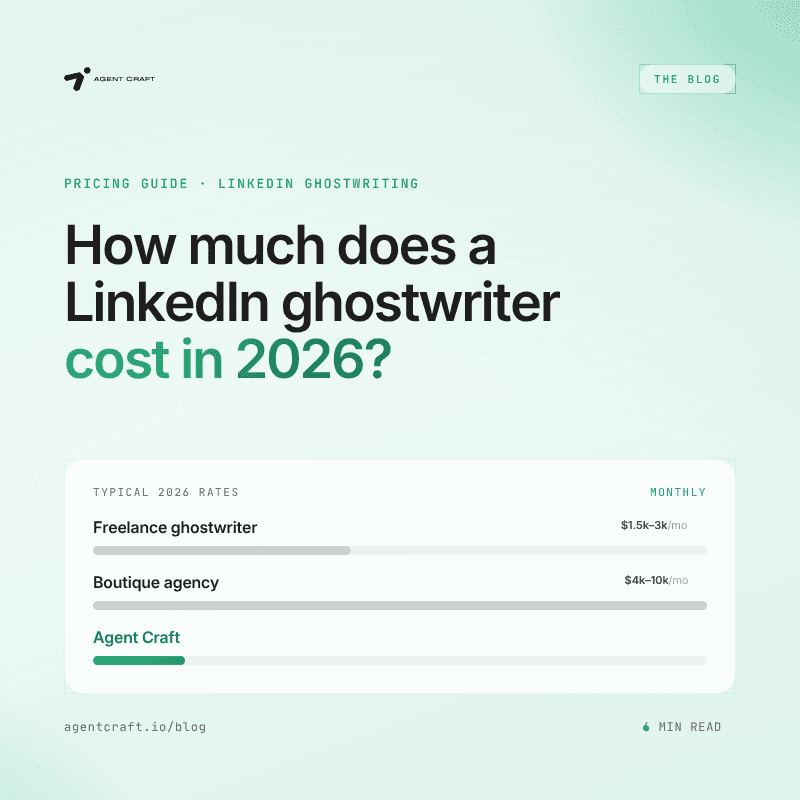
How much does a LinkedIn ghostwriter cost in 2026
Juan Mouton
VP Marketing
A LinkedIn ghostwriter costs between $500 and $3,000 per month for a freelancer, $2,000 to $5,000 per month for a mid-market retainer, and $5,000 to $15,000 or more per month for a full-service agency. Per-post pricing runs from around $50 at the budget end to $500 and beyond for senior writers. Most founders and executives who outsource this seriously land in the $2,000 to $5,000 bracket. The rest of this post breaks down what sits inside each tier, what moves you up and down the range, and the per-post math that providers rarely show you.
The figures come from published 2026 rate guides and service pages across the ghostwriting market, including Foundera, Windmill Growth, Underdog Ghostwriting, NYC Ghostwriting, and Moriah, cross-checked against each other. Where sources disagreed, we used the range they agreed on rather than the most dramatic number available.
The three tiers, and what is inside each
Ghostwriting is one of those markets where the price tells you almost nothing until you know what is inside it. A $600 freelancer and a $6,000 agency are both, technically, selling you LinkedIn posts. They are not selling you the same job.
| Tier | Monthly price | What you get |
|---|---|---|
| Basic freelancer | $500 to $1,500 | 4 to 8 posts, light strategy, basic reporting |
| Mid-market retainer | $2,000 to $5,000 | 8 to 16 posts, positioning and voice development, profile optimization, 3 to 5 hours of engagement per week, weekly reports |
| Full-service agency | $5,000 to $15,000+ | 12 to 20+ posts, full engagement management, video and photography, lead generation support, paid amplification |
The jump between tiers is mostly a jump in scope, not writing quality. A good freelancer can write as well as an agency. What the higher tiers add is everything around the writing: the strategy that decides what to say, the engagement work that builds relationships in your comments and DMs, and the reporting that tells you whether any of it worked.
What moves the price up or down
Within each tier, five things drive your quote:
Writer seniority. A writer who has ghostwritten for recognizable executives charges two to four times the rate of someone building a portfolio. You are paying for pattern recognition: they have seen what works for people like you.
Strategy, included or extra. Some quotes cover writing only. You supply the ideas, the positioning, and the topics; they supply sentences. Real strategy work, the kind where someone helps you decide what you should be known for, either pushes you into the mid-market tier or appears as a separate project fee, often from $750 upward.
Engagement hours. Commenting, replying, and network cultivation are sold by the hour and add up fast. This is also the part of the job with the most leverage on LinkedIn right now, which is why the tiers that include it cost what they do.
Volume. Providers price by post count, so doubling your cadence roughly doubles the retainer. There is no bulk discount worth mentioning, because every post costs them the same labor.
Your industry. Technical, regulated, or jargon-heavy fields cost more. The writer spends longer learning your world before they can fake fluency in it.
The per-post math providers rarely show
Retainers hide the unit cost, so it is worth doing the division yourself.
A basic retainer at $1,000 per month for 6 posts works out to about $167 per post. A mid-market retainer at $3,500 for 12 posts is roughly $292 per post. A premium engagement at $8,000 for 16 posts lands near $500 per post.
That number matters because the cost scales with your ambition. If the cadence that builds momentum on LinkedIn is 40 to 50 posts over 90 days, and it is, then at mid-market rates you are looking at $12,000 to $15,000 per quarter before anyone has commented on anything. The retainer model recharges you for every unit of consistency, and consistency is the whole game.
The ramp period you pay full price for
One cost that never appears on a rate card: a ghostwriter takes one to three months to learn your voice. The early drafts will read like a competent stranger doing an impression of you, because that is what they are. You pay the full retainer during this period, and you spend your own hours on feedback calls and edit rounds to train them.
This is normal and providers are upfront about it when asked. Budget for it anyway. The first quarter of a ghostwriting engagement costs the sticker price plus a real slice of your calendar.
The cost that only presents when they leave
Ghostwriting has a quiet structural problem. Everything the writer learns about you, your stories, your phrasing, the topics that land, lives in their head and their notes. When they raise rates, get busy, or move on, it leaves with them, and the next writer starts the ramp period from zero.
Nobody itemizes this on an invoice. It is worth pricing in, because average engagements turn over and senior operators tend to learn this one the expensive way.
When each tier makes sense
An honest read of the market, including the cases where hiring the human is the right call:
Hire a basic freelancer if you already know your positioning, generate your own ideas, and need execution only. This tier works when you bring the strategy and they bring the sentences.
Hire mid-market if you want strategy and consistency handled and the retainer is a comfortable line item. This is the tier most serious founders and executives choose, and at its best it delivers real results.
Hire an agency if you need the full production layer: video, photography, events, paid amplification. No tool or freelancer replaces this scope, and pretending otherwise wastes your money.
Do it yourself if the retainer stings at every tier. The method is not secret. Budget two to four hours per week, every week, for a quarter before momentum arrives: deciding what to say, writing it, formatting it, posting it, and repeating the whole loop 40 to 50 times whether or not you feel like it. The work is not hard. The schedule is what beats people, and it beats most of them around week three.
Working out your own number
The ranges above are the market. Your number depends on your cadence, how much strategy you need, and whether engagement is part of the deal. We built a free calculator that takes those three inputs and shows you the annualized cost at each tier, with the sources behind every figure.
[CTA block: Ghostwriter Cost Calculator. Interim link: /compare/ghostwriter]
Where Agent Craft sits in this
Everything above prices the human market. Agent Craft is the fourth option: the mid-market retainer's job, run as a system. Strategy is built in, shaped by best practice and a marketing VP with twenty-plus years leading global brands. A two-minute voice note becomes content in your voice, published to LinkedIn, X, TikTok, and YouTube, which no retainer on this page offers. And a personal brand CRM collects the leads your content earns, qualifies them, and moves them into email nurture. Software pricing. The calculator below shows the gap.
Frequently asked questions
How much does a LinkedIn ghostwriter charge per post?
Between $50 and $500 for most of the market, with senior specialists above that. Mid-tier writers commonly charge $150 to $500 per post. Retainers usually work out cheaper per post than one-off arrangements.
What is the cheapest way to hire a LinkedIn ghostwriter?
A per-post arrangement with a newer freelancer, from around $50 to $150 per post. Expect to supply the ideas and positioning yourself at that price, and expect more editing on your side.
Do ghostwriters handle comments and engagement too?
Some do, usually from the mid-market tier upward, billed as hours per week. Many stop at writing. Ask specifically, because engagement is where much of LinkedIn's current leverage sits and it is the part most often left out of a quote.
How long before a ghostwriter sounds like me?
One to three months is typical. The ramp involves feedback rounds and edit cycles on your side, and you pay the full rate while it happens.
Share
Related Articles
How to Build a Personal Brand on LinkedIn From Zero (2026)
The sequence from zero is four steps in strict order: position (decide what you want to be known for), optimize (make your profile findable and legible), publish (put real thinking in public on a weekly rhythm), and engage (be present in the conversations around your subject). Run them in order because each one wastes without the one before it: publishing without a position produces noise, and a beautiful profile nobody arrives at is a brochure in a drawer. The honest timeline for the whole arc is a quarter, and the quarter is non-negotiable in a way this post will be specific about, because the timeline is where zero-starters actually fail.
How to Turn a Voice Note Into a Week of LinkedIn Content, By Hand
The method is this: record yourself talking for two minutes about something you know, transcribe it, find the two or three posts hiding inside the rambling, give each one a hook, cut it to length, format it for LinkedIn, re-form it for X if you use both, and schedule the lot. The two minutes of talking produce the whole week's raw material. The desk work after the talking takes about forty-five minutes per post. This post walks every step so you can run the entire method yourself, with the honest timing attached to each.
Personal Branding for Consultants: Turning Expertise Into Inbound
For a consultant, personal branding reduces to one move: showing your thinking in public, because your thinking is the product and buyers cannot want what they have not seen. Every other profession sells something separable from the person; consulting sells judgment, and judgment can only be evaluated by watching it operate. A consultant who publishes their reasoning is running free product demos at scale. A consultant who does not is asking strangers to buy an invisible service on the strength of a headshot, which is roughly the market's hardest sale, and explains most of the profession's cold-outreach misery.