Personal Brand Examples: What Good Looks Like (Executives, Founders)
Juan Mouton
VP Marketing
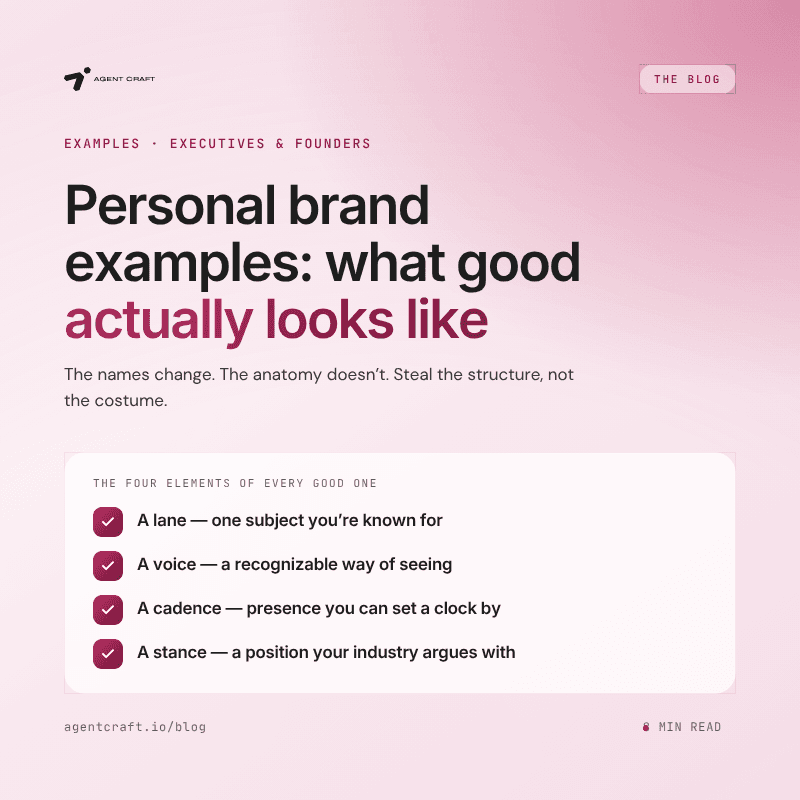
Every good personal brand, examined closely, is built from the same four elements: a lane (one subject the person is known for), a voice (a recognizable way of seeing), a cadence (presence you could set a calendar by), and a stance (at least one position their industry argues with). The names change; the anatomy does not. So rather than a list of famous accounts to envy, here are six archetypes drawn from how the pattern actually plays out for executives and founders, each with the mechanism exposed so you can steal the structure rather than the costume.
The pattern-spotter (the operator-executive done right)
A senior operator who publishes one observation a week from the patterns their seat exposes: the mistake every struggling team makes, the metric that lies, the practice everyone defends and nobody examines. No announcements, no motivation, no personal saga. Their lane is narrow, their register is dry, and their comment sections are full of peers, which is the tell that it is working: the audience is the two hundred people who matter, not the twenty thousand who do not. The mechanism: seniority is largely pattern recognition, so publishing patterns is simply doing the job in public. Steal: the register. Do not copy: the specific patterns, which only work because they are earned.
The builder-in-public (the founder version)
A founder narrating the real construction of the company: the pricing decision and its logic, the hire that went wrong, the metric they are staring at this quarter. The trust mechanism is exposure: readers who watch someone decide under uncertainty for a year have run a diligence process no landing page could survive. The discipline that separates the good version from the messy one is a sharing rule, lessons and process go public, leverage and other people's confidences never do. Steal: the honesty about process. Do not copy: the confessional volume; the good version shares decisions, not diaries.
The reformed insider
The person whose lane is the gap between how their industry presents itself and how it actually works: the agency veteran on what retainers really buy, the ex-banker on what the pitch deck hides. The stance is built in, which makes the voice automatic, and the credibility is biographical, they were in the room. The risk is built in too: the line between insight and bitterness is thin, and the good ones stay on the generous side of it, exposing mechanisms rather than settling scores. Steal: the insider lens on your own field, since you have one. Do not copy: the spice level of someone with different burn risk than yours.
The translator
An expert who makes one difficult domain legible to the people who need it: the security leader who writes for boards, the finance operator who writes for founders. The lane is the audience as much as the subject, and the voice is defined by what it refuses, no jargon, no gatekeeping. This archetype compounds unusually well because every piece is reference material: it keeps being sent to people years later, each send a referral. Steal: the audience-first framing. Do not copy: the domain, obviously; the move is finding who needs yours translated.
The student in public
The senior person publishing what they are figuring out rather than what they have concluded: open questions, half-formed frameworks, honest updates on what changed their mind. Counterintuitively the highest-status register of the six, because only the secure can afford visible uncertainty, and readers know it. Also the lowest barrier to entry, since it requires no conclusions, only genuine curiosity and specificity. Steal: this one entirely; it is the correct starting archetype for almost everyone hesitant.
The quiet authority
Low volume, high density: one substantial piece a month, nothing between, each one saved and shared for years. Works only when the work is genuinely dense and the lane is genuinely narrow, and fails as an excuse for inconsistency, the cadence is low but metronomic. Steal: the permission that volume is not the mechanism. Do not copy: the cadence, until you have proven you can hold any cadence at all.
What all six share, and what none of them do
Run the anatomy across all six: a lane held for years, a voice that survives the byline being removed, a cadence kept through busy quarters, a stance someone could disagree with. And note the shared absences, because they are the actual lesson: none perform success, none manufacture emotion, none post about posting, and none chase subjects outside the lane because something was trending. Good personal brands are mostly defined by what they decline to publish.
Where Agent Craft sits in this
The four elements above are exactly what Agent Craft holds and enforces. The lane and the stance live in your Brand Book, set once with a strategy layer built on best practice and twenty-plus years of global brand leadership. The voice is learned from your own spoken material. The cadence is the system's job, across LinkedIn, X, TikTok, and YouTube, through every quarter your calendar would have broken it. The archetype is the one decision left to you, which is as it should be.
Frequently asked questions
What makes a good personal brand example worth studying?
The anatomy, not the fame: a held lane, a recognizable voice, a reliable cadence, and a genuine stance. Study how those four operate in an account you respect, and ignore the follower count entirely.
Should I model my personal brand on a famous one?
Model the structure, never the costume. A voice and a stance only work when they are actually yours; borrowed ones collapse under the first real question.
What is the best personal brand archetype for a beginner?
The student in public: publishing what you are genuinely figuring out. It requires no conclusions, carries no cringe, and builds trust faster than borrowed authority.
Share
Related Articles
How to Build a Personal Brand on LinkedIn From Zero (2026)
The sequence from zero is four steps in strict order: position (decide what you want to be known for), optimize (make your profile findable and legible), publish (put real thinking in public on a weekly rhythm), and engage (be present in the conversations around your subject). Run them in order because each one wastes without the one before it: publishing without a position produces noise, and a beautiful profile nobody arrives at is a brochure in a drawer. The honest timeline for the whole arc is a quarter, and the quarter is non-negotiable in a way this post will be specific about, because the timeline is where zero-starters actually fail.
How to Turn a Voice Note Into a Week of LinkedIn Content, By Hand
The method is this: record yourself talking for two minutes about something you know, transcribe it, find the two or three posts hiding inside the rambling, give each one a hook, cut it to length, format it for LinkedIn, re-form it for X if you use both, and schedule the lot. The two minutes of talking produce the whole week's raw material. The desk work after the talking takes about forty-five minutes per post. This post walks every step so you can run the entire method yourself, with the honest timing attached to each.
Personal Branding for Consultants: Turning Expertise Into Inbound
For a consultant, personal branding reduces to one move: showing your thinking in public, because your thinking is the product and buyers cannot want what they have not seen. Every other profession sells something separable from the person; consulting sells judgment, and judgment can only be evaluated by watching it operate. A consultant who publishes their reasoning is running free product demos at scale. A consultant who does not is asking strangers to buy an invisible service on the strength of a headshot, which is roughly the market's hardest sale, and explains most of the profession's cold-outreach misery.