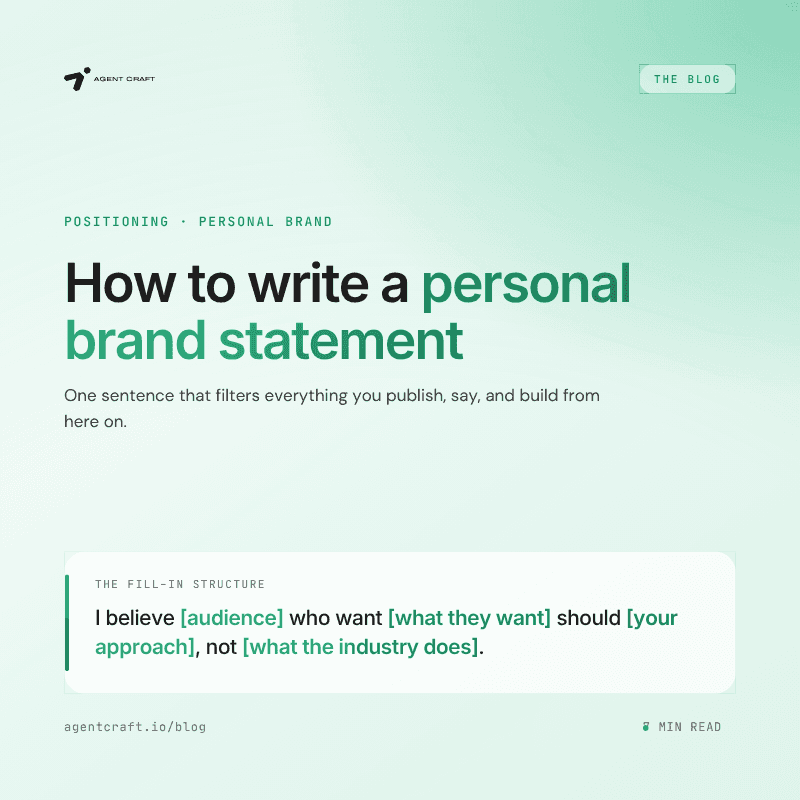
How to Write a Personal Brand Statement (Structure + Examples)
Juan Mouton
VP Marketing
A personal brand statement is one sentence that captures what you believe about your space and who you believe it for. The structure that works: I believe [audience] who want [what they want] should [your approach], not [what the industry does instead]. Fill those four slots honestly and you have the sentence that filters everything you publish, say, and build from here on. This post explains each slot, gives you five worked examples, and covers the three mistakes that produce statements which sound fine and do nothing.
Why this structure and not a slogan: a brand statement is not for your audience to read. It is for you to decide with. Its job is to be the test every piece of content either passes or fails, which is why it has to contain a genuine belief and a genuine rejection. "Helping businesses grow through innovative marketing" fails as a statement not because it is badly written but because it cannot reject anything; every marketer on earth could sign it, so it filters nothing. The fill-in structure forces the two ingredients a decision tool needs: a stance, and the stance it replaces.
Slot one: the audience
Who, specifically, is this belief for? Not "businesses" or "professionals." A statement for everyone decides nothing. Good audience slots name a situation as much as a category: founders raising their first round, consultants tired of feast-and-famine, executives one restructuring away from a cold start. The test: could the person read the audience slot and think "that is me"? If a stranger could not self-identify from it, narrow it.
The fear here is always the same, that narrowing the audience shrinks the opportunity. It is backwards. A statement aimed at everyone reaches no one hard enough to be remembered, and being remembered by a narrow group is worth more than being vaguely familiar to a wide one.
Slot two: what they want
The outcome your audience is actually chasing, in their words rather than your industry's. Not "optimize their marketing funnel"; they never said that. They said "get customers without cold outreach" or "stop being invisible" or "land on my feet if this job disappears." Write the desire the way they would say it across a dinner table, because the statement is only true if the desire is.
Slot three: your belief
The approach you genuinely hold, the one you would defend without notes. This is the load-bearing slot and the one people fake. The test is uncomfortable and reliable: would you still argue this position if it cost you an engagement? If the belief is just a description of your services wearing conviction, the statement will read fine and steer nothing, because you do not actually believe your service list, you believe something underneath it. Dig for the underneath.
Slot four: the industry default you reject
What most of your field does that you think is wrong. This slot is what gives the statement edges, and edges are what make it usable. A belief with no rejection is a platitude; "quality matters" filters nothing until it becomes "quality matters, not volume," at which point it starts making decisions: you now do not publish the volume play, ever, and everyone can see the line.
The rejection must be real, meaning some reasonable people in your field genuinely practice the thing you are rejecting. Rejecting a straw man ("I believe in results, not laziness") is the platitude sneaking back in through the side door.
Five worked examples
- I believe founders who want inbound customers should build trust before reach, not chase virality.
- I believe executives who want career security should own their reputation before they need it, not rent standing from their employer's brand.
- I believe consultants who want better clients should give their thinking away in public, not guard it behind discovery calls.
- I believe operators who want to modernize should fix the process before adding the software, not buy tools to avoid decisions.
- I believe finance leaders who want influence should teach the business to read the numbers, not gatekeep them.
Notice what all five share: a specific someone, a desire in plain words, a defensible position, and a rejection that a real faction of the industry would argue back against. That last quality, the fact that someone could disagree, is not a bug. A statement nobody could disagree with is a statement that says nothing.
The three mistakes
The platitude. No real rejection, so no edges, so no decisions. Fix: sharpen slot four until a specific colleague would push back.
The service list in disguise. Slot three describes what you sell rather than what you believe. Fix: ask why you sell it that way, twice, and put the second answer in the slot.
The borrowed stance. A contrarian position adopted because it sounds distinctive rather than because you hold it. This one fails slowly: you will not be able to argue it under pressure, and your content will drift back to what you actually think, leaving the statement orphaned. Fix: only write what you would defend at dinner, unpaid.
Once written, the statement goes to work as rule number one: every post, talk, and piece either ladders up to it or does not ship. Expect to revise it once or twice in the first months as publishing teaches you what you actually believe; that is the tool sharpening, not failing.
Where Agent Craft sits in this
The structure above is the closing exercise of our positioning workbook, given away whole, and it works on paper. Inside Agent Craft it becomes rule one of your Brand Book: every draft the system writes is checked against it before you see it, which is the difference between a sentence you wrote once and a sentence that runs your output. The strategy layer enforcing it was built on best practice and twenty-plus years leading global brands. Write the sentence first. Then give it teeth.
Frequently asked questions
What is a personal brand statement?
One sentence stating what you believe about your space and for whom: I believe [audience] who want [desire] should [your approach], not [the industry default]. It is a decision filter for everything you publish, not a public slogan.
How long should a personal brand statement be?
One sentence. If it needs two, the belief is not yet clear enough. Length is usually the platitude trying to hide.
Should I put my brand statement in my LinkedIn profile?
It can inform your headline and About section, but its primary job is private: filtering what you create and say. Some people publish it verbatim; most translate it.
How is this different from a mission statement?
A mission statement describes what you do. A brand statement stakes what you believe, including what you reject, which is what makes it able to filter decisions. The rejection is the working part.
Share
Related Articles
LinkedIn Profile Optimization for Executives: Field by Field
An executive profile has one job: when someone arrives checking you out, a recruiter, an investor, a board member, an acquirer running quiet diligence, it answers their question in seconds and gives them a reason to keep reading. Optimizing it is a single afternoon's work, done field by field in priority order: headline, About, experience, banner and photo, featured, skills. Each field below comes with the characteristic executive mistake and its fix, because at senior levels the profiles are rarely empty. They are full of the wrong register: written for the org chart instead of for the stranger deciding whether to trust you.
What to Post on LinkedIn When You Have Nothing to Say
When you have nothing to post, the problem is almost never a shortage of material. It is a shortage of prompts. You spent this week solving problems, noticing patterns, answering questions, and holding opinions, any of which would make a post, but none of it is filed in your head under "content." A prompt is the retrieval key: a question specific enough to pull one of those things out. Below are ten that work, plus the three places your material has been hiding all along.
Is It Cringe to Post on LinkedIn as an Executive? An Honest Answer
An observational post is about the work, and it gives something instead of wanting something. "Here is a mistake I keep seeing and what it costs." "Here is a problem we untangled last month and the wrong assumption underneath it." "Here is what I got wrong about this five years ago." The poster appears in these, but as the lens, not the subject. Nobody has ever cringed at a sharp observation clearly earned by experience. It is the same reason nobody cringes when you say something insightful in a meeting: substance, offered plainly, is not a performance, whatever the venue.