Personal Brand Statement Examples: Founder, Consultant, Executive
Juan Mouton
VP Marketing
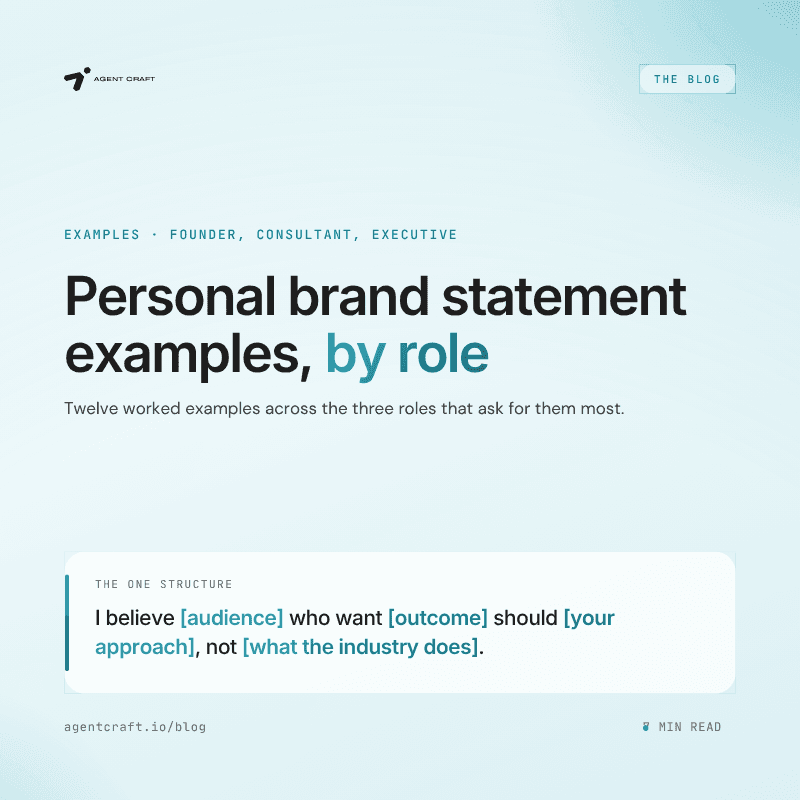
A working personal brand statement follows one structure: I believe [audience] who want [outcome] should [your approach], not [what the industry does instead]. Below are twelve worked examples across the three roles that ask for them most, founders, consultants, and executives, each with a short teardown of the moving parts, because the useful thing about examples is never the words. It is seeing where the edge sits, so you can find your own. If you want the slot-by-slot method first, the companion how-to covers it; this page is the gallery.
One rule before the gallery: a statement you could sign without ever having thought about it is not yours. Every example below contains a rejection some reasonable colleague would argue with. If none of your colleagues would argue with yours, it is a platitude wearing the structure.
Founder statements
"I believe early-stage founders who want customers should build trust before reach, not chase virality." The rejection has a real constituency: plenty of respected growth advice says the opposite. That is what gives the statement edges, and edges are what let it make decisions: this founder never runs the engagement-bait play, and everyone can see the line.
"I believe technical founders who want to sell should show the product thinking in public, not hide it behind polished marketing." Audience slot is precise (technical founders, not founders), which sharpens everything downstream. The stance also assigns the content strategy automatically: build in public, decisions over announcements.
"I believe bootstrapped founders who want durable companies should price for profit from day one, not buy growth they cannot keep." Note the desire slot: durable companies, in the buyer's own words, not "optimize unit economics." Plain desire, defensible stance, visible enemy.
"I believe founders raising capital should treat investors like customers to be understood, not judges to be pleased." The rejection here is a posture, not a tactic, which is fine: postures filter content just as hard.
Consultant statements
"I believe consultants who want better clients should give their thinking away in public, not guard it behind discovery calls." The classic of the genre because the rejection attacks the field's own default economics, which takes visible nerve, and visible nerve is credibility.
"I believe operations consultants who want lasting results should fix the process before recommending the software, not sell tools to avoid hard decisions." A two-part edge: it rejects a practice and quietly indicts the incentive behind it. Statements that name the incentive cut deepest.
"I believe fractional CFOs who want influence should teach founders to read their own numbers, not gatekeep the model." Adaptation worth noticing: the audience is the consultant's peer group, but the desire (influence) belongs to the reader, which keeps the statement generous rather than preachy.
"I believe brand consultants who want to matter should measure their work in revenue conversations, not in decks the client frames." The dry joke in the rejection is doing real work: it proves the writer has been in the rooms.
Executive statements
"I believe executives who want career security should own their reputation before they need it, not rent standing from their employer's brand." The security motive stated without a single influence word, which is exactly the register that audience accepts.
"I believe supply chain leaders who want resilience should design for the disruption they cannot predict, not optimize for the quarter they can." Domain-specific, board-legible, and the rejection is the entire orthodoxy of cost-optimized supply chains. A statement this arguable generates a year of content on its own.
"I believe CHROs who want retention should fix the manager layer, not decorate the culture deck." Blunt, and bluntness is available to executives in a way it is not to vendors: they have no one to flatter.
"I believe finance leaders who want influence should make the numbers legible to the whole business, not hold them as a source of authority." The rejection names a quiet real practice nobody defends aloud, which is the safest kind of sharp: everyone recognizes it, no one is personally accused.
How to adapt without copying
Three moves, in order. Swap the audience slot for yours and check it still self-identifies: could your reader say "that is me" from the slot alone. Then interrogate the belief slot: is this actually your position, or one you admired on this page? The test is unchanged from the how-to: would you defend it at dinner, unpaid, at some professional cost. Finally, sharpen the rejection until a specific colleague you respect would push back, because a rejection nobody holds is the platitude sneaking back in. If your adapted statement survives all three, it stopped being an adaptation somewhere in the process, which was the point.
Where Agent Craft sits in this
Every example above runs on the structure from our positioning workbook, free and complete. Inside Agent Craft, your finished statement becomes rule one of the Brand Book, enforced on every draft across everything the system publishes, LinkedIn, X, TikTok, and YouTube alike. The strategy layer holds the line so the statement keeps filtering long after the afternoon you wrote it. The believing part is still yours. It always was.
Frequently asked questions
What is a good personal brand statement example?
One with a precise audience, a desire in plain words, a genuinely held approach, and a rejection some reasonable peer would argue with. "I believe early-stage founders who want customers should build trust before reach, not chase virality" carries all four.
Can I use one of these statements as my own?
Use the structure freely; the belief has to be yours. A borrowed stance collapses the first time someone pushes on it, and readers push.
How specific should the audience be?
Specific enough that a stranger could read the slot and think "that is me." "Professionals" filters nothing; "bootstrapped founders" and "supply chain leaders" filter everything downstream.
Share
Related Articles
How to Build a Personal Brand on LinkedIn From Zero (2026)
The sequence from zero is four steps in strict order: position (decide what you want to be known for), optimize (make your profile findable and legible), publish (put real thinking in public on a weekly rhythm), and engage (be present in the conversations around your subject). Run them in order because each one wastes without the one before it: publishing without a position produces noise, and a beautiful profile nobody arrives at is a brochure in a drawer. The honest timeline for the whole arc is a quarter, and the quarter is non-negotiable in a way this post will be specific about, because the timeline is where zero-starters actually fail.
How to Turn a Voice Note Into a Week of LinkedIn Content, By Hand
The method is this: record yourself talking for two minutes about something you know, transcribe it, find the two or three posts hiding inside the rambling, give each one a hook, cut it to length, format it for LinkedIn, re-form it for X if you use both, and schedule the lot. The two minutes of talking produce the whole week's raw material. The desk work after the talking takes about forty-five minutes per post. This post walks every step so you can run the entire method yourself, with the honest timing attached to each.
Personal Branding for Consultants: Turning Expertise Into Inbound
For a consultant, personal branding reduces to one move: showing your thinking in public, because your thinking is the product and buyers cannot want what they have not seen. Every other profession sells something separable from the person; consulting sells judgment, and judgment can only be evaluated by watching it operate. A consultant who publishes their reasoning is running free product demos at scale. A consultant who does not is asking strangers to buy an invisible service on the strength of a headshot, which is roughly the market's hardest sale, and explains most of the profession's cold-outreach misery.