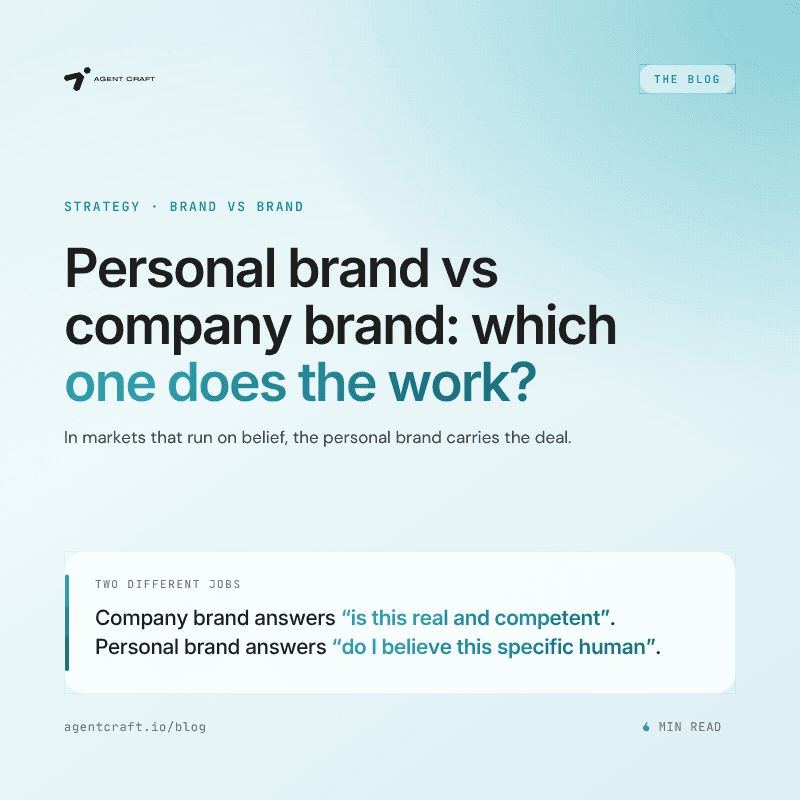
Personal Brand vs Company Brand: Which One Does the Work
Juan Mouton
VP Marketing
The short answer: people trust people, so the personal brand does the trust-building work while the company brand does the reassurance work, and confusing the two jobs wastes both. A company brand answers "is this a real, competent organization." A personal brand answers "do I believe this specific human." In markets where the sale runs on belief, expertise, services, early-stage products, anything bought before it can be fully verified, the personal brand carries the deal and the company brand catches it.
Why the personal version out-pulls the corporate one
Not mystique, mechanics. A face is accountable in a way a logo is not: a person who says something wrong in public pays for it personally, which is exactly why their claims carry weight, while a company account is understood by every reader to be marketing, reviewed, sanded, and accountable to no one in particular. A person can hold an opinion; a brand account holding an opinion is a committee performing one. And a person accumulates history: readers who have watched a founder think in public for a year have run a due-diligence process no company page could survive, because company pages do not think in public, they announce.
The practical consequence appears in every feed: the founder's observation travels, the company's announcement of the same news sits politely. Readers skip past logos and stop for humans, and they are being rational when they do it.
What each brand is actually for
The company brand is infrastructure for the moment after interest exists: the credible website, the coherent story, the proof that the organization behind the person is real, staffed, and likely to exist next year. It converts and reassures. It rarely originates.
The personal brand originates: it creates the interest, the trust, and the reason to look the company up at all. It also does jobs the company brand structurally cannot: it survives the company (pivots, sales, failures leave the founder's reputation intact and portable), it opens doors companies cannot knock on (people take meetings with interesting humans, not with logos), and it recruits, because talent joins people it believes before it joins firms it has evaluated.
The interplay, run well, is a relay: the person builds belief, the company receives it. Which also names the failure mode of over-investing in the corporate side early: a polished brand with no believed human attached is a beautiful catchment for traffic that never arrives.
When to invest in which
Founder-stage and services businesses: personal first, decisively. The founder's reputation is the company's largest marketing asset and the cheapest one to build, since the raw material is thinking the founder already does. Growth-stage: both, with the company brand absorbing the repeatable claims (category, proof, product) while the founder and executives keep the opinion-bearing work, the stances a committee could never sign. Large enterprises: the company brand dominates by necessity, which is precisely why individual executives inside them who publish real thinking stand out so sharply; scarcity does the work.
One caution for the founder-heavy version, honestly stated: a company whose entire trust rests on one person has key-person risk in its marketing, the same as anywhere else. The mature move is not to dilute the founder's voice but to multiply it, letting other senior voices build their own standing, so the trust portfolio has more than one asset in it.
The test for your own situation
Ask where belief enters your sale. If customers arrive already trusting, trace where the trust came from; it is nearly always a person, a referral from a person, or content a person made. Then ask what your marketing spend is pointed at. The common mismatch, and it is very common, is trust that enters through people while the budget polishes the logo. The correction costs little: the people your market would believe are already on payroll, already have the thinking, and mostly lack the system to publish it.
Where Agent Craft sits in this
Agent Craft is built for the personal side of the relay. It turns a founder's or executive's spoken thinking into the consistent public evidence that builds belief, in their voice, under their name, across LinkedIn, X, TikTok, and YouTube, with the strategy built in. And the belief it creates does not evaporate between post and pipeline: the personal brand CRM collects the inbound, qualifies it, and nurtures it by email until the company is ready to receive it. The relay, run end to end.
Frequently asked questions
Why do personal brands perform better than company brands?
Accountability and history: a person's claims carry personal risk, which gives them weight, and a person who thinks in public accumulates a track record readers can audit. Company accounts are understood to be marketing, and read accordingly.
Should a founder build a personal brand or the company brand first?
Personal first in nearly every early case: it is cheaper, faster to trust, and portable. The company brand's job is to receive and convert the belief the founder creates.
What is the risk of founder-led branding?
Concentration: trust resting on one person is key-person risk. The fix is multiplying voices as the company grows, not silencing the one that works.
Share
Related Articles
How to Build a Personal Brand on LinkedIn From Zero (2026)
The sequence from zero is four steps in strict order: position (decide what you want to be known for), optimize (make your profile findable and legible), publish (put real thinking in public on a weekly rhythm), and engage (be present in the conversations around your subject). Run them in order because each one wastes without the one before it: publishing without a position produces noise, and a beautiful profile nobody arrives at is a brochure in a drawer. The honest timeline for the whole arc is a quarter, and the quarter is non-negotiable in a way this post will be specific about, because the timeline is where zero-starters actually fail.
How to Turn a Voice Note Into a Week of LinkedIn Content, By Hand
The method is this: record yourself talking for two minutes about something you know, transcribe it, find the two or three posts hiding inside the rambling, give each one a hook, cut it to length, format it for LinkedIn, re-form it for X if you use both, and schedule the lot. The two minutes of talking produce the whole week's raw material. The desk work after the talking takes about forty-five minutes per post. This post walks every step so you can run the entire method yourself, with the honest timing attached to each.
Personal Branding for Consultants: Turning Expertise Into Inbound
For a consultant, personal branding reduces to one move: showing your thinking in public, because your thinking is the product and buyers cannot want what they have not seen. Every other profession sells something separable from the person; consulting sells judgment, and judgment can only be evaluated by watching it operate. A consultant who publishes their reasoning is running free product demos at scale. A consultant who does not is asking strangers to buy an invisible service on the strength of a headshot, which is roughly the market's hardest sale, and explains most of the profession's cold-outreach misery.