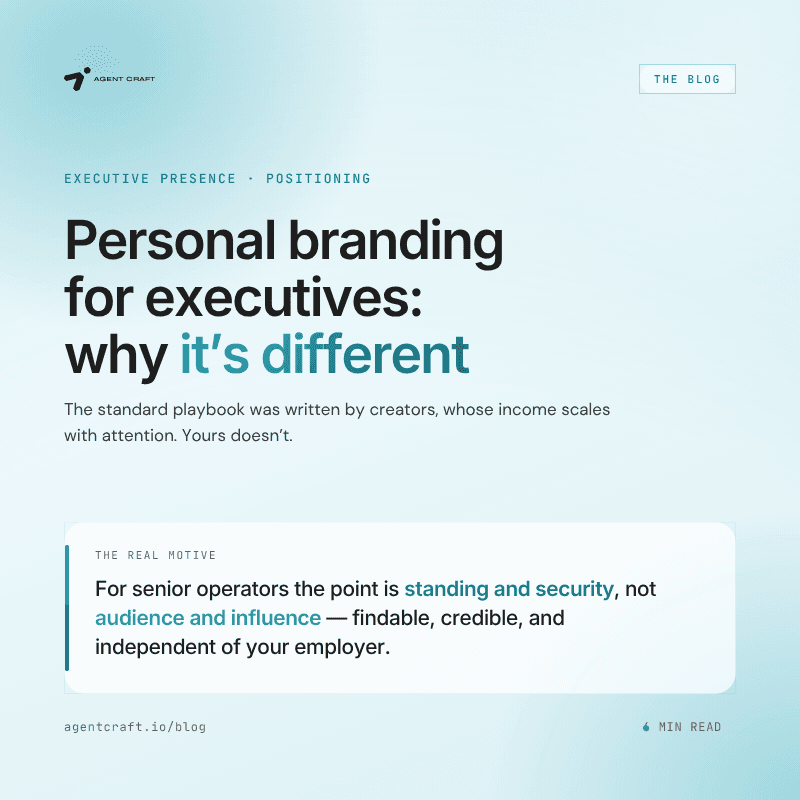
Personal Branding for Executives: Why It Is Different
Juan Mouton
VP Marketing
Executive personal branding is different because the motive is different: for most senior operators the point is standing and security, not audience and influence. That single difference invalidates most of the advice in circulation, because the standard playbook was written by and for creators, people whose income scales with attention. An executive's reputation does a quieter job: it makes them findable, credible, and independent of their employer's brand, so that opportunity finds them and setbacks cannot erase them. Build for that job and the whole approach changes.
Why creator advice fails at senior levels
The creator playbook optimizes for reach: post daily, chase trends, engineer hooks, grow followers. Applied to an executive it produces two failures at once. It looks wrong, because a CFO performing engagement-bait reads as a status error to the exact peers whose opinion constitutes their standing. And it measures wrong, because an executive with four hundred followers, sixty of whom are investors, operators, and potential acquirers, has a more valuable audience than a creator with forty thousand strangers. Reach is the creator's asset. Being known by the right two hundred people is the executive's.
What the executive version optimizes instead
Findability over frequency. When someone searches your specialty, in a hiring process, a diligence process, or a quiet reference check, you surface, and what surfaces answers the question. This is mostly a profile problem and it is largely solved in an afternoon: a headline in the words your field searches, an About section whose first line says who you help and with what, experience entries written as outcomes.
Evidence over presence. Senior audiences do not want a stream, they want a record: proof of how you think, findable when they go looking. One substantial observation a week outperforms daily noise, because the reader is not scrolling for entertainment, they are checking for judgment. This is also why the executive cadence is sustainable where the creator cadence is not: the job is depth on a schedule, not volume on a treadmill.
Independence over amplification. The quiet structural fact of employed seniority: your calls get returned partly because of the logo next to your name, and that coverage is borrowed. The executive brand's core job is transferring that equity to your own name before the day the logo changes. Everything you publish under your own name, on surfaces you control, is equity that survives the badge.
The three subjects that carry an executive brand
Senior content works in a narrow register, and it happens to be the register senior people already speak in privately. The lesson from the work: one real situation, what it revealed, what you would now do differently. The pattern: the recurring mistake, the overrated practice, the quiet shift you are watching, which is the natural voice of seniority since pattern recognition is largely what seniority is. And the open question: what you are currently trying to work out, which reads as confidence, because only the secure publish their uncertainty.
Notice what is absent: announcements about yourself, motivational content, and anything performed. The executive register is observational, and observation carries no cringe at any level.
The honest costs
Two, stated plainly. The maintenance is perpetual: roughly an hour a week of publishing and network touches, indefinitely, because standing decays the moment upkeep stops. And the start is uncomfortable: the first three posts feel exposed, the next ten feel unread, and the compounding is only visible in the second and third month. Most senior people quit inside that window, which, viewed coldly, is why the ones who do not are so visible: the bar is consistency, and almost nobody senior clears it.
Where Agent Craft sits in this
Agent Craft runs the executive version of this playbook as a system. The strategy is built in, findability, positioning, and the weekly evidence, and a two-minute voice note becomes content in your voice across LinkedIn, X, TikTok, and YouTube, every week, gated by your approval. The record builds whether or not the calendar cooperated. And when the standing starts producing inbound, the personal brand CRM catches it, qualifies it, and keeps it warm by email. The judgment stays yours. So does the equity.
Frequently asked questions
Do executives really need a personal brand?
They need what it produces: findability, a warm network, and a reputation independent of their employer. The people deciding whether to hire, fund, or acquire increasingly check what you have said publicly, and silence reads as absence at exactly that moment.
How is executive personal branding different from thought leadership?
Thought leadership is one output of it. The executive brand's full job includes findability and career security, which matter even for someone with no ambition to lead any public conversation.
How much time does it take at a senior level?
About an hour a week once the profile foundation is set: one substantial post and a few genuine network touches. The constraint is never the hours. It is doing it every week.
Share
Related Articles
How to Build a Personal Brand on LinkedIn From Zero (2026)
The sequence from zero is four steps in strict order: position (decide what you want to be known for), optimize (make your profile findable and legible), publish (put real thinking in public on a weekly rhythm), and engage (be present in the conversations around your subject). Run them in order because each one wastes without the one before it: publishing without a position produces noise, and a beautiful profile nobody arrives at is a brochure in a drawer. The honest timeline for the whole arc is a quarter, and the quarter is non-negotiable in a way this post will be specific about, because the timeline is where zero-starters actually fail.
How to Turn a Voice Note Into a Week of LinkedIn Content, By Hand
The method is this: record yourself talking for two minutes about something you know, transcribe it, find the two or three posts hiding inside the rambling, give each one a hook, cut it to length, format it for LinkedIn, re-form it for X if you use both, and schedule the lot. The two minutes of talking produce the whole week's raw material. The desk work after the talking takes about forty-five minutes per post. This post walks every step so you can run the entire method yourself, with the honest timing attached to each.
Personal Branding for Consultants: Turning Expertise Into Inbound
For a consultant, personal branding reduces to one move: showing your thinking in public, because your thinking is the product and buyers cannot want what they have not seen. Every other profession sells something separable from the person; consulting sells judgment, and judgment can only be evaluated by watching it operate. A consultant who publishes their reasoning is running free product demos at scale. A consultant who does not is asking strangers to buy an invisible service on the strength of a headshot, which is roughly the market's hardest sale, and explains most of the profession's cold-outreach misery.