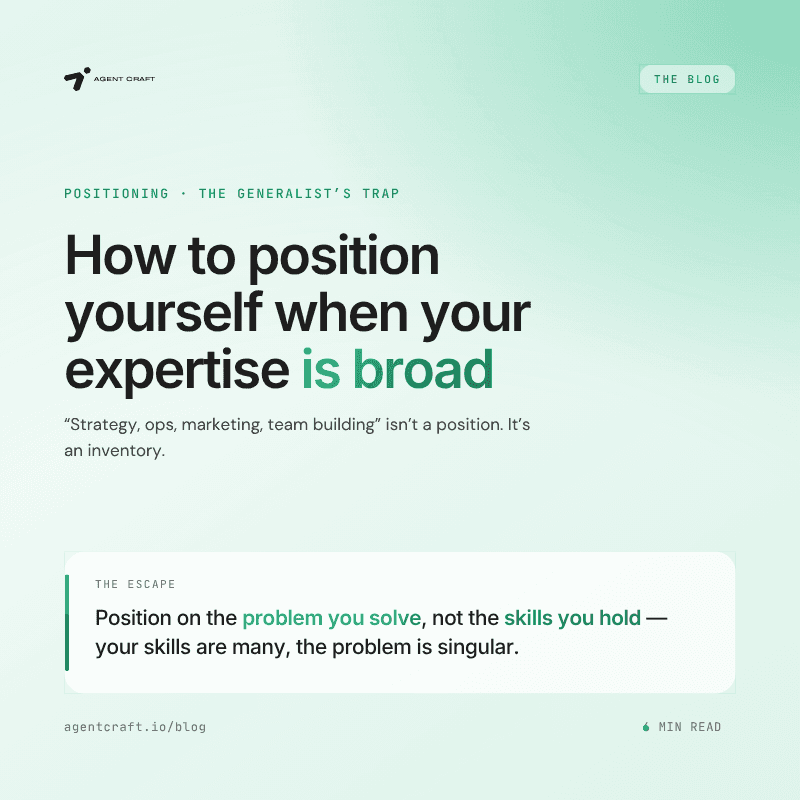
How to Position Yourself When Your Expertise Is Broad
Juan Mouton
VP Marketing
Position on the problem you solve, not the skills you hold. That is the escape from the generalist's trap, because while your skills are many, the problem your particular mix of skills is unusually good at solving is nearly always singular, and a position built on it uses everything you have without listing anything. The listing is the failure mode: "strategy, operations, marketing, and team building" is not a position, it is an inventory, and inventories are what audiences skim past on the way to someone who sounds specific.
Why breadth reads as vagueness, unfairly but reliably
The injustice deserves naming before the fix: broad operators are often the most capable people in the room, precisely because problems in the wild do not respect functional boundaries. But an audience meeting you cold has no access to your capability, only to your description of it, and a description that covers everything gives them nothing to remember you by. Memory needs a hook, referral needs a sentence, and search needs words. "She can do a bit of everything" survives none of those three journeys. "She untangles operations at companies that grew faster than their systems" survives all of them, and notice: the second sentence quietly contains all the skills the first one listed.
The reframe that unlocks the whole exercise: narrowing your position does not narrow your work. It narrows your door. People arrive through the specific door and discover the range once inside, which is how it has always worked for every trusted generalist you know; you just never saw their door from the inside.
The narrowing exercise
Four questions, answered honestly with a pen.
Which problems do people actually bring you? Not what you can do, what you get asked for. The market has been positioning you for years through its requests; read the data. If three different people have brought you the same shaped problem, that shape is a candidate.
Where does your breadth become the advantage? Somewhere in your history is a class of problem that defeats specialists precisely because it spans their boundaries: the launch that is equal parts product, ops, and politics; the turnaround that is finance wearing a culture problem. That class is your natural lane, because there you are not a generalist competing with specialists, you are the only correctly shaped key.
Which of your wins do you retell? The stories you volunteer at dinner are your positioning speaking before you chose one. Listen to which problems star in them.
What would you happily be the first call for? Because that is what a position is: being someone's first call for one thing. Choose the thing you want the phone to ring about, since the exercise will produce ringing either way.
Where the four answers overlap, write the position as a problem sentence: I help [who] with [the problem], typically when [the situation]. No skill list survives into the final sentence; the skills are all implied by the problem being solvable.
Keeping the range without breaking the lane
Three permissions for the recovering generalist. Your lane is the problem, so any subject that illuminates it is in-lane: the ops-untangler can write about hiring, tooling, and finance whenever the through-line runs back to the problem, which for a real generalist is nearly always. Your range is a credential inside the lane, deployed as evidence ("this pattern breaks the same way in supply chains and in sales teams") rather than as a menu. And the position is renewable: a lane held for two years can be widened or traded; the sentence is a decision, not a tattoo. Generalists resist positioning because it feels like amputation. It is closer to choosing which hand to lead with.
The tell that it is working
Before: people describe you with adjectives (smart, versatile, gets things done). After: they describe you with a problem ("talk to her, this is exactly her thing"). The second description is a referral engine running unattended, and it is the entire commercial point of the exercise. Adjectives are compliments. Problems are pipelines.
Where Agent Craft sits in this
The narrowing exercise above comes from our positioning workbook, and Agent Craft is where the result goes to work. Your lane becomes standing context: every draft is checked against it, and drift, the generalist's chronic condition, gets flagged before it publishes rather than regretted after. The strategy layer, built on best practice and twenty-plus years of global brand leadership, holds the door you chose across LinkedIn, X, TikTok, and YouTube. The range still walks through it. That was the design.
Frequently asked questions
How do I position myself if I have many skills?
On the problem your particular combination solves best, stated as a sentence: I help [who] with [what problem]. Skills go unlisted; a well-chosen problem implies all of them.
Does narrowing my positioning limit the work I can take?
No. It narrows the door people arrive through, and arrivals discover the range afterward. Trusted generalists all have a specific first-call reputation; the breadth operates behind it.
Can I change my positioning later?
Yes, and you should expect to refine it within the first year as publishing teaches you what you actually want to be known for. A position is a working decision, not a permanent identity.
Share
Related Articles
How to Build a Personal Brand on LinkedIn From Zero (2026)
The sequence from zero is four steps in strict order: position (decide what you want to be known for), optimize (make your profile findable and legible), publish (put real thinking in public on a weekly rhythm), and engage (be present in the conversations around your subject). Run them in order because each one wastes without the one before it: publishing without a position produces noise, and a beautiful profile nobody arrives at is a brochure in a drawer. The honest timeline for the whole arc is a quarter, and the quarter is non-negotiable in a way this post will be specific about, because the timeline is where zero-starters actually fail.
How to Turn a Voice Note Into a Week of LinkedIn Content, By Hand
The method is this: record yourself talking for two minutes about something you know, transcribe it, find the two or three posts hiding inside the rambling, give each one a hook, cut it to length, format it for LinkedIn, re-form it for X if you use both, and schedule the lot. The two minutes of talking produce the whole week's raw material. The desk work after the talking takes about forty-five minutes per post. This post walks every step so you can run the entire method yourself, with the honest timing attached to each.
Personal Branding for Consultants: Turning Expertise Into Inbound
For a consultant, personal branding reduces to one move: showing your thinking in public, because your thinking is the product and buyers cannot want what they have not seen. Every other profession sells something separable from the person; consulting sells judgment, and judgment can only be evaluated by watching it operate. A consultant who publishes their reasoning is running free product demos at scale. A consultant who does not is asking strangers to buy an invisible service on the strength of a headshot, which is roughly the market's hardest sale, and explains most of the profession's cold-outreach misery.