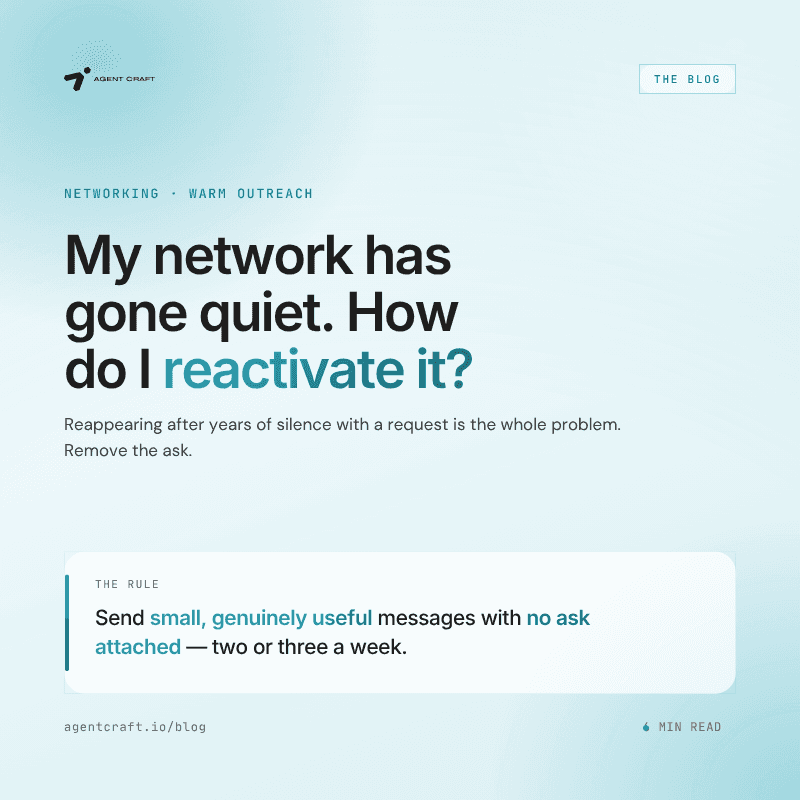
How to Reactivate a Dormant Professional Network Without Being Awkward
Juan Mouton
VP Marketing
The way to reactivate a dormant network is to send small, genuinely useful messages with no ask attached, two or three a week, and to become quietly visible in public so the rest of your network rewarms passively. The awkwardness you are dreading comes from one specific mistake: reappearing after years of silence with a request. Remove the request and the awkwardness goes with it. Everything below is the mechanics.
First, permission to relax: a quiet network is not a character flaw. Networks decay by default, the way any unmaintained thing does. People change jobs, attention narrows to the current company, and one day you realize the only professional contact you have had in a year is with people who share your office WiFi. Nothing is wrong with you. Something is wrong with your maintenance schedule, and schedules can be fixed.
The one rule: no asks until the relationship is warm again
A relationship that has been silent for three years has roughly the temperature of the last interaction, minus decay. Arriving in that context with "would love to pick your brain" or "keeping me in mind for opportunities" forces the other person to do the emotional accounting of your entire silence in one message. That is the needy read, and people can smell it through the screen.
The no-ask message works because it reverses the ledger. You show up as a giver after a long silence, which is disarming, memorable, and completely comfortable to receive.
What a no-ask message looks like
The structure is short: a specific reason you thought of them, something of value or genuine warmth, and a full stop where the ask would go. Three patterns that work, yours to adapt:
The saw-this-and-thought-of-you. "Saw this piece on [thing squarely in their world] and thought of you. No agenda, just reminded me of that project we did at [company]. Hope things are good." The link is doing the work. You are giving attention, not requesting it.
The congratulations with substance. "Saw the news about [their promotion, launch, move]. Genuinely great, and it makes complete sense given [specific thing you remember about them]. Happy for you." The specific memory is what separates this from the hundred hollow congrats they got from strangers.
The honest resurface. "It has been a while, which is entirely my doing. I was talking about [topic] this week and your take on it from [context] came up in my head, still one of the sharper things I have heard on it. How have you been?" Naming the silence yourself defuses it. Blaming yourself lightly and moving on is charming; over-apologizing is not.
Send two or three of these a week. Not a blitz. A blitz reads as a campaign, and people can smell campaigns too. The total cost is fifteen minutes a week, which is worth stating plainly because the barrier here was never time. It was the awkwardness, and the no-ask structure removes it.
What reads as needy, so you can avoid it
The reappear-and-request, covered above. The mass template, where fifteen people get the same "checking in!" and at least two of them compare notes. The vague coffee ask with no reason attached, which hands the other person the labor of inventing a purpose for the meeting. And the immediate pivot, where a warm reply to your no-ask message gets answered with the ask you were holding the whole time. That last one retroactively poisons the first message. If you had an ask, the rule is simple: it waits until the relationship has had at least a few genuine exchanges, and often it becomes unnecessary, because warm relationships volunteer things cold requests never extract.
The passive half: become findable and visible
Direct messages rewarm relationships one at a time. Publishing rewarms them in bulk. One public post a week about your actual work, a lesson, a pattern you are seeing, a question you are sitting with, puts you back in the peripheral vision of hundreds of dormant contacts at once. People you have not spoken to in five years will quietly read for months, and then a comment arrives, and then a message, none of which required you to contact them individually. Add genuine comments on other people's work most weeks and the effect compounds: you are being useful in public, which is networking without the networking.
The maintenance schedule, honestly
Reactivation is a project. Staying warm is a practice, and the practice is small: two or three no-ask touches a week, one public post a week, comments where you genuinely have something to add, indefinitely. Call it forty-five minutes a week, forever. That "forever" is the honest part. Networks are not built and then owned. They are rented from your own consistency, and the rent is low but it is due every week.
Where Agent Craft sits in this
The messages above are yours to send. The passive half is ours to run: Agent Craft turns a voice note into the consistent public presence that rewarms the wider network while you handle the three touches a week, published in your voice across LinkedIn, X, TikTok, and YouTube. And when the rewarmed network starts producing conversations, the personal brand CRM collects them, qualifies them, and keeps them moving by email. The warmth stays human. The visibility runs on a system.
Frequently asked questions
How long does it take to rewarm a dormant network?
Individual relationships can rewarm in one good exchange. The network as a whole takes a quarter of consistent touches and public visibility before inbound starts arriving on its own.
Is it too late if I have been silent for five years or more?
No. Long silences are normal between professionals and almost nobody holds them against you. The reappearance just needs to carry value or warmth rather than a request.
Should I reconnect by email or on LinkedIn?
Wherever the relationship lived. LinkedIn is fine for most professional contacts and has the advantage that your visible activity there keeps working on the relationship between messages.
What if someone does not reply?
Nothing. A no-ask message requires no reply to succeed; it registered, and that was its job. Do not follow up asking whether they saw it, which converts a gift into a demand.
Share
Related Articles
How to Build a Personal Brand on LinkedIn From Zero (2026)
The sequence from zero is four steps in strict order: position (decide what you want to be known for), optimize (make your profile findable and legible), publish (put real thinking in public on a weekly rhythm), and engage (be present in the conversations around your subject). Run them in order because each one wastes without the one before it: publishing without a position produces noise, and a beautiful profile nobody arrives at is a brochure in a drawer. The honest timeline for the whole arc is a quarter, and the quarter is non-negotiable in a way this post will be specific about, because the timeline is where zero-starters actually fail.
How to Turn a Voice Note Into a Week of LinkedIn Content, By Hand
The method is this: record yourself talking for two minutes about something you know, transcribe it, find the two or three posts hiding inside the rambling, give each one a hook, cut it to length, format it for LinkedIn, re-form it for X if you use both, and schedule the lot. The two minutes of talking produce the whole week's raw material. The desk work after the talking takes about forty-five minutes per post. This post walks every step so you can run the entire method yourself, with the honest timing attached to each.
Personal Branding for Consultants: Turning Expertise Into Inbound
For a consultant, personal branding reduces to one move: showing your thinking in public, because your thinking is the product and buyers cannot want what they have not seen. Every other profession sells something separable from the person; consulting sells judgment, and judgment can only be evaluated by watching it operate. A consultant who publishes their reasoning is running free product demos at scale. A consultant who does not is asking strangers to buy an invisible service on the strength of a headshot, which is roughly the market's hardest sale, and explains most of the profession's cold-outreach misery.