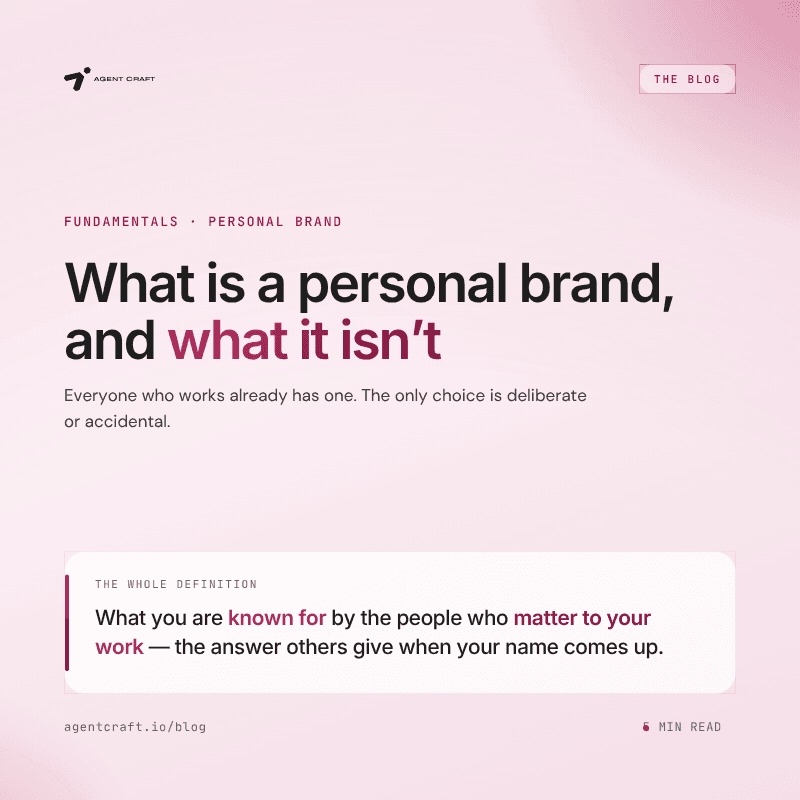
What Is a Personal Brand? A Definition Without the Hype
Juan Mouton
VP Marketing
A personal brand is what you are known for by the people who matter to your work. That is the whole definition. It is the answer others give when your name comes up: she is the pricing person, he is the one who fixes broken supply chains, they are sharp on early-stage hiring. Everyone who works already has one, because being known for something, or for nothing, is not optional. The only choice available is whether the reputation is deliberate or accidental, and personal branding, stripped of its baggage, is simply the deliberate version.
What it is not, because the baggage is real
The term has been damaged by its loudest practitioners, so the exclusions matter as much as the definition.
It is not self-promotion. Promotion is telling people you are good; a brand is them concluding it from evidence you made available. The mechanics are nearly opposite: promotion performs, evidence demonstrates, and audiences reliably distinguish the two.
It is not an audience. Follower counts measure reach, and reach is a creator's asset, someone whose income scales with attention. For most professionals the valuable version is being known well by a few hundred of the right people: the ones who hire, fund, refer, and acquire. Two hundred right people beat twenty thousand strangers for every job a professional reputation actually does.
It is not a persona. The invented character, the manufactured vulnerability, the keynote voice nobody booked, these are performances, and performance is precisely what sophisticated readers punish. The workable material is what you genuinely know, believe, and have seen, which conveniently is also the only material you can sustain for years.
And it is not new. Reputation has always decided who gets the call. What changed is that reputation became searchable: the people making decisions about you now check, and what they find, or fail to find, is the brand functioning without you in the room.
The two things a personal brand produces
Everything a deliberate reputation delivers reduces to two products, and knowing which one you are building for changes what you build.
Standing. Security and optionality: being findable when someone searches your specialty, a network warm enough to respond when circumstances change, a body of evidence that answers the quiet diligence people run before hiring, funding, or trusting you. Standing is reputation as insurance, and its defining property is that it must exist before the moment it is needed.
Inbound. Pipeline: the customers, clients, and opportunities that arrive because your visible thinking sold them before any conversation started. Inbound is reputation as a channel, and it compounds: every piece of evidence keeps working for years after it was made.
Most people who set out to build deliberately want one of the two more than the other, and the split matters, because the standing-seeker and the pipeline-seeker should publish differently, measure differently, and ignore different advice.
How one actually gets built
The mechanism is unglamorous: a clear position (what you want to be known for, chosen rather than drifted into), evidence in public (observations, lessons, and patterns from your real work, published where your people can find them), and consistency over quarters (because reputations form by repetition, and the market's memory requires many exposures before your name attaches to your subject). Position, evidence, repetition. Every legitimate method in the field is a variation on those three, and every scammy shortcut is an attempt to skip the third.
The honest cost lives in the third element too: an hour or two a week, indefinitely. The reputations that look effortless are the ones whose maintenance you did not watch.
Where Agent Craft sits in this
Agent Craft is the mechanism above, built as a system. The position is held permanently in your Brand Book, set with a strategy layer shaped by best practice and twenty-plus years of global brand leadership. The evidence generates from two-minute voice notes, in your voice. The repetition runs across LinkedIn, X, TikTok, and YouTube on a schedule your calendar cannot break. And the inbound the reputation produces lands in a personal brand CRM that qualifies and nurtures it by email. Choose the position. The system does the rest.
Frequently asked questions
What is a personal brand in simple terms?
What you are known for by the people who matter to your work: the answer others give when your name comes up. Everyone has one; the only choice is whether it is deliberate.
What is the difference between a personal brand and self-promotion?
Promotion is claiming you are good. A brand is others concluding it from evidence you published. Audiences reliably tell the difference, which is why promotion damages the thing it tries to build.
Do I need a big following to have a personal brand?
No. For most professionals the valuable version is being known well by a few hundred of the right people. Reach is a creator's metric; being known for something specific is a professional's.
Share
Related Articles
How to Build a Personal Brand on LinkedIn From Zero (2026)
The sequence from zero is four steps in strict order: position (decide what you want to be known for), optimize (make your profile findable and legible), publish (put real thinking in public on a weekly rhythm), and engage (be present in the conversations around your subject). Run them in order because each one wastes without the one before it: publishing without a position produces noise, and a beautiful profile nobody arrives at is a brochure in a drawer. The honest timeline for the whole arc is a quarter, and the quarter is non-negotiable in a way this post will be specific about, because the timeline is where zero-starters actually fail.
How to Turn a Voice Note Into a Week of LinkedIn Content, By Hand
The method is this: record yourself talking for two minutes about something you know, transcribe it, find the two or three posts hiding inside the rambling, give each one a hook, cut it to length, format it for LinkedIn, re-form it for X if you use both, and schedule the lot. The two minutes of talking produce the whole week's raw material. The desk work after the talking takes about forty-five minutes per post. This post walks every step so you can run the entire method yourself, with the honest timing attached to each.
Personal Branding for Consultants: Turning Expertise Into Inbound
For a consultant, personal branding reduces to one move: showing your thinking in public, because your thinking is the product and buyers cannot want what they have not seen. Every other profession sells something separable from the person; consulting sells judgment, and judgment can only be evaluated by watching it operate. A consultant who publishes their reasoning is running free product demos at scale. A consultant who does not is asking strangers to buy an invisible service on the strength of a headshot, which is roughly the market's hardest sale, and explains most of the profession's cold-outreach misery.