Created from a single voice note with Agent Craft
Everyone expects AI content tools to work the same way. Paste an…
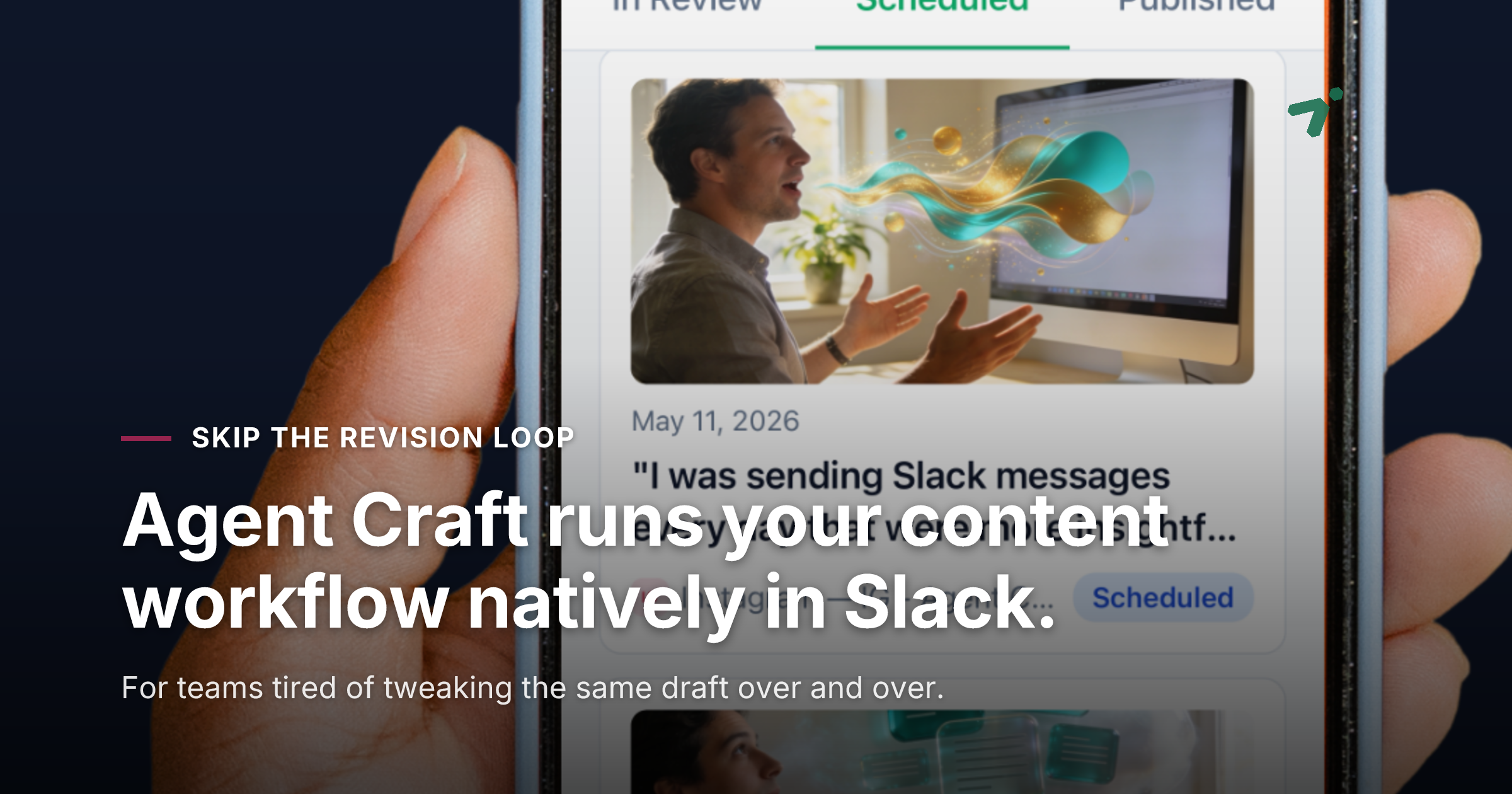
Everyone expects AI content tools to work the same way. Paste an input, read the output, tweak it, paste again, tweak again, and keep going until the thing finally sounds like you. That loop is the whole reason most teams give up on these tools. Agent Craft was built to skip the loop. The difference is that your brand DNA, your strategy, and your campaign context all get set up before you ever ask for a single post. So when Craft produces something, it's already aligned with your voice and objectives, not after dozens of rounds of correction, but from the start. Here's how that plays out in practice. A contributor gets a prompt tied to a campaign, drops a quick voice note on the spot, and Craft handles the rest. On-brand content, shipped to every destination the org is connected to. Meanwhile the VP of marketing sees all of it in one dashboard. That's why it feels less like a tool you operate and more like a workflow that runs with you. What part of your current content process eats the most time?
More content from Agent Craft
- InstagramTwo things move the needle on social. Authenticity and consistency. Cut either one and the whole thing stalls. So here's the question worth arguing about: if you could only fix one this quarter, which would it be? Pick authenticity and you're betting that posts reading like genuine takes from real people inside the company beat polished, ad-like content every time. Even if those posts go out less often. Even if the cadence is messy. Pick consistency and you're betting that showing up across multiple channels every week wins, that reach comes from volume and rhythm, and that "good enough and frequent" outruns "brilliant and rare." We've watched a manufacturing client sit exactly on this fork. They were posting agency-made content once or twice a week that read like an ad. The moment their founders and execs started contributing real voice, posted consistently across channels, quality and reach jumped. But that answer needed both levers working together. Which is easy to say and hard to run when the exec who has the authentic take also has zero time to write anything. So we're genuinely curious where you land. If your calendar forced the choice tomorrow, authenticity or consistency? And what's the actual reason behind your pick, not the safe one?
- X (Twitter)I ignored the expert who told me I was setting myself up to fail. The product went on to dominate its market. There are certain people who will be skeptical and negative about every idea you put in front of them. I call them the naysayers. They're important. If everybody was a yes-sayer, there'd be no opportunities left for those of us bold enough to go against the grain. Think about the insider who told me my target customers would never open their wallets, that I was chasing a market that didn't exist. I built for that market anyway, and charged accordingly. He was a naysayer. He was also dead wrong. Building: AgentCraft (dot) ai Grow your personal brand in minutes per day with voice notes
- X (Twitter)A community events startup in Cape Town is outpacing Meta and Strava in its own city right now, without out-spending either. The number one predictor that a company folds when its market turns competitive isn't budget. It's the missing systems. And the first place that shows up, every time, is the organic content operation. Content is the cheapest, most visible signal of whether a company can execute without heroics. No system, and you see it immediately. Posting drops off. The profile can't decide what it is. The algorithm has no idea who to show it to, so it shows it to no one. That's not a budget problem. Operator-marketers get sold the wrong diagnosis constantly. You can't out-spend Meta, sure, but you also can't out-expertise them by throwing your founder's evenings at a content calendar. There aren't enough evenings. So the question stops being how do we compete on volume and becomes how do we compete on what they won't do. That Cape Town startup went and sat with their top contributors, watched them run the product start to finish, saw where it broke, and fixed the things incumbents are too far from the ground to notice. Local growth now runs past the platforms everyone said couldn't be beaten. Consistency made it possible. Sustained output, week after week, long enough for the algorithm and the market to figure out what you are. And consistency is a systems problem. If your content depends on a person finding time, it stops the week that person gets busy. And that person always gets busy. What does the system that survives your busiest week actually look like?
- X (Twitter)Here's a little practice that might help if you're a founder struggling to keep motivated . Every morning when you get up, say this to yourself. I do it in the shower. I have everything I need to be successful. I have all the resources I need. I have the intelligence I need. I have the network. I know exactly what to do. The opportunity in front of me has never been greater, and there's nothing stopping me from succeeding. All I have to do is get out there and do the work. That's it. Say it every day. Believe it. Then go do the work. I guarantee you will succeed. Building: AgentCraft (dot) ai Grow your personal brand in minutes per day with voice notes
- ThreadsReal question for the room: does your marketing AI wait for you to type a prompt, or does it live in your Slack, watching what lands and drafting on its own? One's a search box. The other's a colleague that never clocks out. Which one are you actually running?
- X (Twitter)A Cape Town startup is outpacing Meta and Strava on growth in its own city. Its entire strategy was sitting down and watching its top users run the product start to finish. A community event startup in Cape Town sat down with their top contributors. The people posting the events, the ones others sign up for and actually show up to. They watched them run the whole thing start to finish. Where the friction was. Where a step made no sense. What the end user hit before they gave up. That was the strategy. And right now that startup is beating legacy lifestyle media with budgets that dwarf theirs. Here's why it works. Most brands try to engineer perception. They sit in a room deciding what the market should think of them, then push it out in polished campaigns that all look like ads. The problem is you don't control the translation. Consumers don't take what you say and store it as fact. They collect moments. Little organic ones. And they piece together their own picture of your brand from those pieces. So the job is to be authentic and consistent, over and over, until enough real moments exist for people to build the right picture on their own. The Cape Town startup gets that. Sitting with contributors is a loop. Watch the experience, fix the friction, and let the improved product generate its own content. The product gets better and the story gets truer at the same time. That loop is what I build for growth-stage companies. Not the strategy deck. The execution underneath it. I build content systems around concept categories. Each category makes the customer's actual use case visible, shows what their life looks like with the product, and shows what the ideal outcome is. Sales pressure stays out of it entirely, because pressure is exactly what breaks the trust those organic moments are supposed to build. Yeti does this. Its campaigns build lifestyle relevance instead of pushing product, and it's visibly working. One client running this approach saw a 26% increase in conversions in 2025. From a tighter loop between what the product actually does and what the market gets to see. Most operator-marketers can't run this themselves. Not because they lack the smarts. They lack the time. You can't sit with your power users, watch every experience, draft across four channels, and run the business at once. So it stays a plan that never ships. That's the piece I work on with founders and CEOs at product-market-fit stage. A content system that ships without you living inside it, tied back to margin and payback so you can show a board what the spend is actually returning. The startups that win don't manufacture their message. They earn it, one real moment at a time.