
Created from a single voice note with Agent Craft
Power users of Agent Craft tend to notice something after the first…
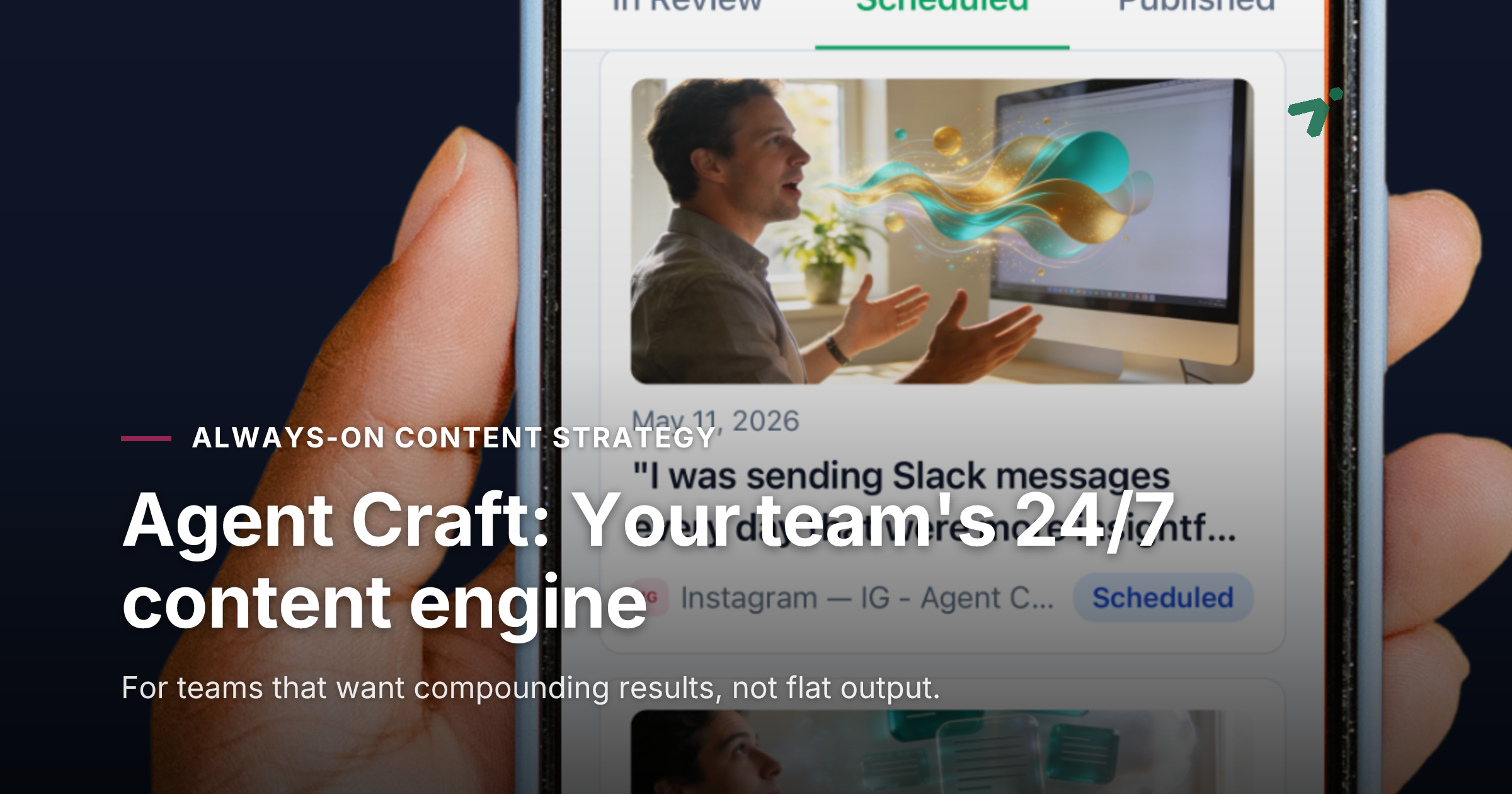
Power users of Agent Craft tend to notice something after the first few weeks: the agent doesn't stop working when they do. While the team is in meetings or off the clock, the agent is still running. Researching competitors. Testing what's resonating. Refining the content strategy based on what's actually working. That continuous attention is what separates a compounding content program from one that just stays flat. The other thing power users lean into is the team layer. Agent Craft isn't a solo tool for one person managing their personal LinkedIn. It's built to pull an entire content marketing team into the same workflow, through Slack or Microsoft Teams, so the output reflects the whole organization, not just one contributor's voice. And the content itself isn't generic. It matches both the brand voice and the individual writer's voice before anything ships. That combination, always-on strategy plus team-wide deployment plus authentic voice, is what makes the habit stick.
More content from Agent Craft
- InstagramVoice is the thing most AI tools destroy on contact. You paste in your draft, it comes back cleaner, tighter, and completely stripped of the way you actually speak. Your audience can feel it. You can feel it. And so you either fix it manually or you stop publishing. Agent Craft is built around a different idea. It takes how you speak, the specific phrasing you reach for, the rhythm of your sentences, the earisms that make your content recognizably yours, and folds all of that into whatever it generates for your personal channels. LinkedIn. Instagram. The output doesn't need editing back into your voice because it started there. This isn't AI bolted onto a content tool. Agent Craft was architected as AI-first from the beginning, which means the voice capture isn't a feature someone added later. It's structural. The result is content that's ready to ship. Campaigns, product announcements, thought leadership posts. Rich, specific, organic-feeling. Not the kind of copy that reads like it came from a prompt. If you've ever posted something and immediately thought "that doesn't sound like me," you already know what Agent Craft is solving. Follow @agentcraftai to see how it works.
- BlueskyThe safety-net neutral pool argument for enterprise AI assumes the safeguards hold. Anthropic's latest models were jailbroken within 24 hours of release. The US government had to step in. "Enterprise-grade" is not a promise. It's a starting point.
- LinkedInReid Hoffman said it a few years ago and it's only getting more true: influence is becoming the most important currency. Most people heard that and nodded. What almost nobody noticed is that the bottleneck has quietly shifted away from ideas and toward something far more mundane. The gap isn't who has the best thinking. It's who has a system that can actually keep up. Here's the underappreciated part. The loudest conversation in AI right now is happening between technically sophisticated people, the ones deep in Claude skills, OpenClaw, and whatever dropped this week. They're genuinely impressed by what's possible. And they should be. But they are not the market. The tens-of-millions of SMB owners and execs who need marketing results? They don't want to become prompt engineers. They want content that sounds like them, published consistently, without carving out two hours every time they have something to say. That's a completely different problem from what the technically curious are solving. This matters because products and conversations built around the technically curious minority will miss almost everyone else entirely. The real shift isn't about raw capability. It's about who bears the cognitive load. A system that captures your voice, your audience, your message architecture once, and then runs, that's what moves the needle for an exec who has an actual company to run. Not the most impressive demo. Not the newest model. Hoffman's prediction is playing out. But the currency is accumulating for the people who figured out how to show up reliably, not the ones who spent the year exploring what's theoretically possible.
- InstagramMost teams don't have a content problem. They have a consistency problem. Random posts from random people, whenever anyone remembers. Or nothing at all, because the platforms feel overwhelming and nobody wants to own it. So here's the debate: is "random but authentic" better than "systematic but branded"? Barrie Hadfield's team was fully in the random camp before Agent Craft. Different people, different messages, most of them ignoring social entirely. Now they run actual campaigns, individual voices intact, everyone pulling in the same direction. The case for random: it feels real. Unpolished. Human. The case for systematic: it actually gets done. Where do you land on this? Authentic chaos or structured consistency?
- LinkedInI have run five different companies. Every single one had a marketing team. And every single one of those teams posted pictures on Facebook and Instagram. When I pushed for thought-leadership content on LinkedIn, something provocative and genuinely useful for our industry, the answer was always the same: we can do it, but you need a consultant or writer. Someone at $5,000 a month who'll interview you, write drafts, send them back for review, and then you post. Slow process. Real money. Every time I heard it, I passed. The frustrating part is that I knew the content was there. I had the opinions, the industry knowledge, the takes worth sharing. It just never made it out of my head and onto LinkedIn. So I build an app for my own needs. It's a technical solution, not a human one, which means it doesn't cost $3,000 to $5,000 a month and it doesn't eat my calendar. What it does instead is use short voice notes, a couple of minutes a day, the kind of thing I record while I'm walking the dog (as I am right now), and turn them into actual thought-leadership content ready to go on LinkedIn and X and other platforms. No consultant. No back-and-forth. No waiting three weeks for a draft. If you're an exec who's been told the same thing I was told five times over, the question worth sitting with is: how much insight have you left off the table while that $5,000/month option stayed too expensive to act on? You can try it free for 30 days, no credit card, at agentcraft dot ai
- ThreadsCompanies winning on content right now aren't publishing more. They've just stopped losing hours to the parts that never needed a human in the first place. Friction was the problem. AI killed it.