Created from a single voice note with Agent Craft
Confession: I spent the first few months building Agent Craft solving…
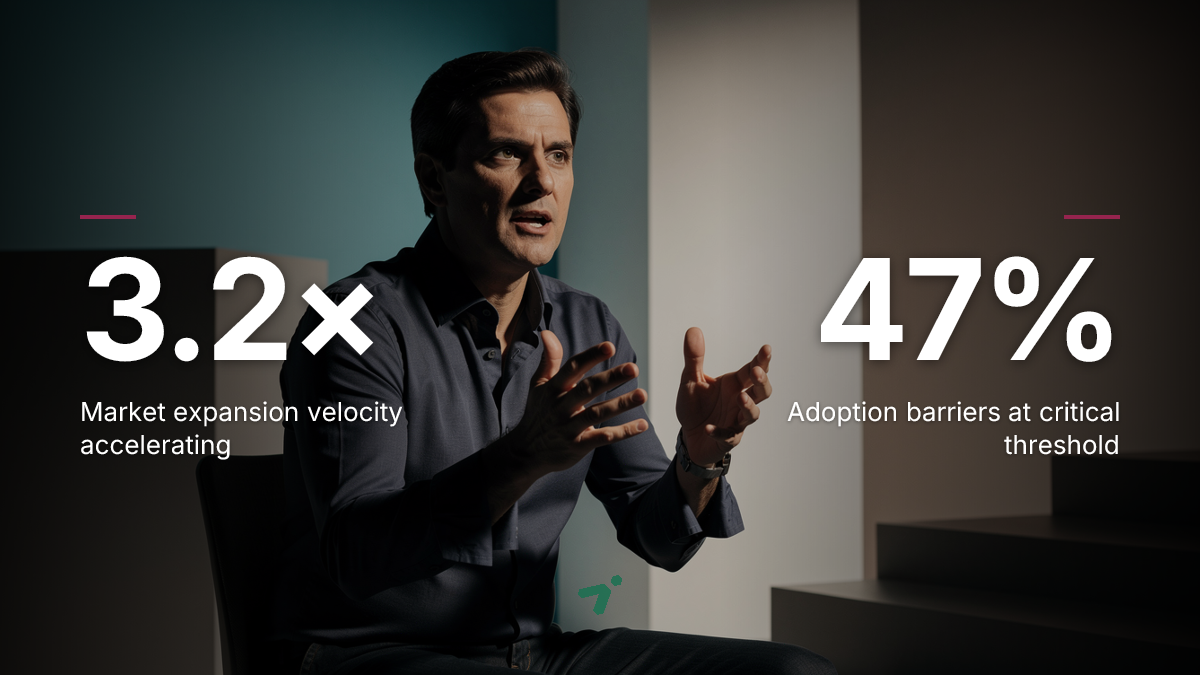
Confession: I spent the first few months building Agent Craft solving the wrong problem. I started with voice-to-content for individuals. Thought leadership posts, personal brand, solo creators. Made sense at the time. Then I talked to enough companies and prospects that the picture shifted completely. The real gap wasn't individuals who wanted to post more. It was teams, and specifically the CEO who wasn't posting at all. Here's the take I'll stand behind: if you're running a company and you're not creating content, you are actively depriving your business of a critical asset. Not a nice-to-have. Not a growth lever you'll get to eventually. A critical asset you're choosing to leave on the table every single week. The conventional wisdom says content is a marketing team's job. Hand it to the agency, or the in-house person, or the consultant who charges you for substandard work and calls it strategy. That's what most SMB leaders do. And it's why most SMB marketing is forgettable. But customers aren't looking for your marketing team. They're looking for the person who built the thing. The one with the actual view on where the market is going, what breaks in practice, what customers get wrong, what it felt like to do this six times and fail at it before getting it right. No one else in your organisation has that. Your marketing manager doesn't have it. Your agency definitely doesn't have it. You do. And it goes to waste every day you don't put it out there. I've founded six companies. The pattern I keep seeing is that the best ones have leaders who are visible and vocal. Not polished. Not performing. Just genuinely sharing what they see from where they sit. Great companies with great CEOs have public-facing leaders with followings because those leaders are actually saying something worth following. Now, I hear the objection. You don't have time. You're already working around the clock trying to keep the business moving. Content feels like one more thing, and the last time you tried it you stared at a blank screen for twenty minutes and gave up. I get it. That's exactly why I built what I built. The thing that changed for me was realising the technical execution isn't where you add value. Prompting isn't where you add value. Scheduling, model selection, workflow management, none of that is your job and it's important to bear in mind you shouldn't be spending a single minute on any of it. The real stuff where you add value is the insight. Your customer stories. Your point of view on what's broken in your industry. Your personal journey, including the wrong turns. That's what Agent Craft is actually for. You contribute 45 seconds to a couple of minutes of voice notes. The agent handles everything else. Not because the technical parts don't matter, but because they're not the thing you should be spending your brain on. The founding insight I kept coming back to, the thing that made me sure this was worth building, is that there's a massive productivity improvement sitting right in front of most SMB executives and they're walking past it every day. The capability is there. The tools exist. The gap is that nobody has put it together in a way that actually fits how a founder or CEO works. You're not going to sit down and learn prompting. You're not going to manage an AI content workflow. But you will send a voice note on the way to a meeting. You will. Every single executive has two minutes. Don't tell me otherwise. What you don't have is a system that turns that two minutes into a content operation that runs without you. That's what I set out to build, and it took getting the initial idea wrong before I could see clearly what the right one was. If you're a CEO reading this and you haven't posted in three months, that's the most expensive content strategy you could possibly have chosen. The window isn't going to stay open.
More content from Agent Craft
- X (Twitter)Agentic AI in production is not a capability problem. It's a blast radius problem. I keep seeing teams rush to deploy coding agents and no-code automation workflows and the conversation is almost always about what the agent can do. Rarely about what happens when it does the wrong thing at scale, automatically, across a dozen systems before anyone notices. That's the part that should keep you up at night. When a human engineer makes a bad call, there's usually a trail. There's a PR, a ticket, a Slack message that says "I'm trying this." The blast radius is bounded by how fast one person can move. When an agent makes a bad call, it moves at machine speed and it doesn't second-guess itself. By the time your alerting catches it, the damage is already replicated. The operational tradeoff between autonomy and control isn't a philosophical question. It's a concrete engineering question. For every autonomous action your agent can take, you need to answer three things: who owns the outcome, what does rollback look like, and at what point does the system stop and ask a human. If you can't answer all three before you ship the workflow, you haven't shipped a feature. You've shipped a future incident with no assigned owner. The guardrails conversation usually gets treated as a compliance checkbox. Security team wants it, product team tolerates it, engineering implements the minimum viable version. That's backwards. The teams I've seen do this well treat rollback paths and ownership boundaries as first-class design requirements, not afterthoughts. No-code tools make this harder, not easier. They lower the bar for who can deploy agentic workflows, which sounds like a win until a business analyst spins up an automation that touches your customer data pipeline and nobody in engineering even knew it existed. Shadow IT at human speed was manageable. Shadow automation at machine speed is a different category of problem. The capability is real. The use cases are genuinely valuable. But you don't get to skip the part where you define failure modes, ownership, and rollback before you turn autonomous execution loose on your production environment.
- LinkedInI used to think testing marketing assumptions was straightforward. Run an A/B test, look at the numbers, move on. Turns out I was testing the wrong things. The assumption most SMB executives never question is whether their content is actually reaching the right people at all. They obsess over the message, the offer, the copy. Meanwhile, the distribution is quietly broken and nobody's checking. Here's what shifted my thinking. A single 45-second voice note generated 45,000 impressions on LinkedIn. Not a carefully crafted campaign. A voice note. When I saw that, I had to reset my clock on what good content methodology actually looks like. The old testing model assumes effort correlates with results. You pour time into a polished post, you expect reach. But that assumption doesn't hold anymore. The executives who produce thought leading content consistently, even imperfectly, are outperforming the ones who wait until they have something "worthy" to say. So what should you actually be testing? Test the format before the message. A rough voice-recorded insight posted Tuesday morning might outperform a professionally written piece that took three hours. If you haven't compared the two, you don't know. Test the source, not just the copy. Content that sounds like a real person, with a specific point of view and a specific situation behind it, performs differently than brand content. Most companies have never isolated that variable. Test whether your executives are visible at all. If the only person posting is someone in marketing, you're running one experiment when you could be running ten. The methodology failure I see most often isn't bad testing. It's testing inside assumptions that were never examined. Be prepared to pivot when the data tells you the assumption itself was wrong, not just the execution. That's where the real gains are.
- X (Twitter)An engineer I know hasn't taken a full weekend off in four months. Not because his company is demanding it. Because he can't justify stopping. That's the thing nobody predicted about AI. The whole narrative going in was simple: AI arrives, automates the tedious stuff, workers get their time back, everybody wins. The beach house fantasy. Shorter hours, same output, better life. It made perfect sense on paper. Except that's not what's actually happening. Take software engineers as the clearest example right now. AI has made them somewhere around 100x more productive. That's not a rounding error. That's a different category of capability entirely. You'd think that means the work gets done faster and people log off early. But the opposite is happening. Engineers are sleeping less. They're working weekends. They can't switch off. Why? Because the opportunity cost of rest just went through the roof. If you can ship in a day what used to take a week, and your peer is doing the same thing, then stopping to relax isn't really rest anymore. It's falling behind. And if you're a type A player, that calculation runs in your head constantly. Why would you coast when you can create something genuinely impressive in the time it used to take just to set up the scaffolding? This is the counter-intuitive part. AI doesn't reduce urgency for high performers. It raises it. The people who thought AI would create mass unemployment or at least a gentle four-day-week for everyone missed something about human nature. Specifically, about the kind of humans who actually drive output in any field. They're not optimizing for leisure. They're optimizing to get ahead, to build things, to see what they're capable of. Give them a faster engine and they don't slow down. They find a bigger road. So instead of the unemployment wave that the doomers predicted, what we're actually heading toward is a productivity explosion alongside a group of people working harder than ever. The shift isn't from employment to no employment. It's from constrained productivity to something much larger, with the people who move quickly to take action capturing almost all of the upside. This pattern isn't going to stay in software. It'll move into marketing, law, finance, design, anywhere that type A people are already pushing hard. The tool changes. The behavior doesn't. The engineers staying up late aren't victims of AI. They're the ones who figured out what it actually means to have a 100x multiplier in their hands. That's not a tragedy. It's just not the story anyone was telling a few years ago.
- X (Twitter)Ads don't build trust. Leaders do. And yet most SMB founders and senior leaders are almost completely absent from social media, even when they privately know it's costing them. That's the pattern I keep running into, and it's worth being honest about what's actually behind it. The easy explanation is that leaders don't see the value, or don't prioritize it, or don't have anything interesting to say. None of those are true. These are the people who built the thing. They are the brainchild of their businesses. The ideas are there, vivid and specific, sitting in their heads. The vision, the reasoning, the conviction behind the whole operation. What breaks down is the conversion. Not the thinking. The writing. Every time a founder carves out 20 minutes to draft something, the calendar moves, the calls run over, the urgent thing surfaces. The draft never gets written. And the insight that would have built genuine credibility with a potential customer, a potential hire, a potential investor just stays locked up. Invisible. In my experience, what's the real reason leaders go quiet on social isn't disinterest. It's that the production process doesn't fit how they actually operate. Writing is a slow, friction-heavy task for someone who runs on momentum and conversation. Sitting down, staring at a blank screen, trying to convert a complicated idea into something that reads well and feels native to a platform? That's a context switch most busy operators can't make cleanly. So they don't. And the silence compounds. Their brand page sits there while they're out doing the actual work. The trust gap this creates is real. Buyers, especially in SMB-to-SMB contexts, make decisions based on whether they trust the person behind the product. Not the logo. Not the ad creative. The person. And if that person is invisible, the trust doesn't get built. A competitor whose founder shows up consistently, shares genuine perspective, demonstrates that they understand the problem, that person pulls ahead. Often without a bigger product or a bigger budget. The fix isn't "make more time for content." Telling a busy founder to just find an extra hour is not a solution. The fix is removing the conversion bottleneck entirely. That's the specific business problem Agent Craft is solving. Record a voice note. The content gets created and published to your destinations. The gap between having the idea and getting it in front of your audience collapses. Your thinking, your voice, the DNA of your content, it comes from you. The infrastructure handles the rest. Kudos to where kudos is due: some leaders have figured this out, usually by hiring a ghostwriter or a content team. But that's expensive and still requires significant back-and-forth to get the voice right. Most don't have that option. The question isn't whether executive voice builds more trust than advertising spend. It does. The question is whether we're willing to admit that the reason most leaders aren't showing up has nothing to do with willingness and everything to do with workflow. Because if the barrier is process, the solution is infrastructure. Not motivation.
- FacebookSLIDE 1 [Bold typographic slide, dark background, single large question in white text, clean sans-serif font, minimal design] Three things SMB owners know they should be doing for marketing, but aren't. Let's fix that. SLIDE 2 [Consistent flat illustration style, warm neutral tones, icon of a calendar with a checkmark, clean layout] Post on a schedule. Iterate your ads. Deliver the same message, every time. These aren't three separate problems. They're one consistency gap, and it shows up everywhere your audience could find you. SLIDE 3 [Same flat illustration style, icon of a phone with a sound wave, warm tones] One minute. That's all it takes. Record a voice note, and AI handles the rest: formats it for the platform, matches your tone, generates the image, publishes it. Your content goes out whether you remembered or not. SLIDE 4 [Same illustration style, icon of interlocking gears or a simple flow diagram, warm neutral tones] Set up the system once. Then let it run. Agent Craft connects AI to your marketing tools, learns your business context, and keeps executing, while you stay focused on everything else. SLIDE 5 [Clean call-to-action slide, brand colors, bold text centered, minimal and direct] Consistency isn't a discipline problem. It's a systems problem. Agent Craft solves it. Start building yours today at agentcraft.ai. Caption: Most SMB owners aren't inconsistent because they don't care. They're inconsistent because the system doesn't exist yet. Content, ads, messaging, trust, reducing friction to buy, these five things have to happen together, all the time. That's a lot to carry manually. Agent Craft was built for this. A voice note takes 60 seconds. The system formats it, images it, schedules it, and publishes it in your voice, without you touching it again. This is what consistent marketing looks like when you stop doing it by hand. agentcraft.ai #AgentCraft #AIMarketing #SMBGrowth #ContentMarketing #MarketingAutomation #SmallBusiness #DigitalMarketing #BusinessGrowth #MarketingStrategy #AIForBusiness
- FacebookMost SMB executives know exactly what they want to say. They built the business. They have the ideas, the perspective, the stories. The problem isn't the thinking. It's the sitting down. So here's the real question for the practitioners in the room: is the bottleneck actually time, or is it something else? Because "I don't have time to post" and "I don't know how to turn what's in my head into a polished post" are two very different problems with two very different fixes. Which one actually describes you or your exec team?