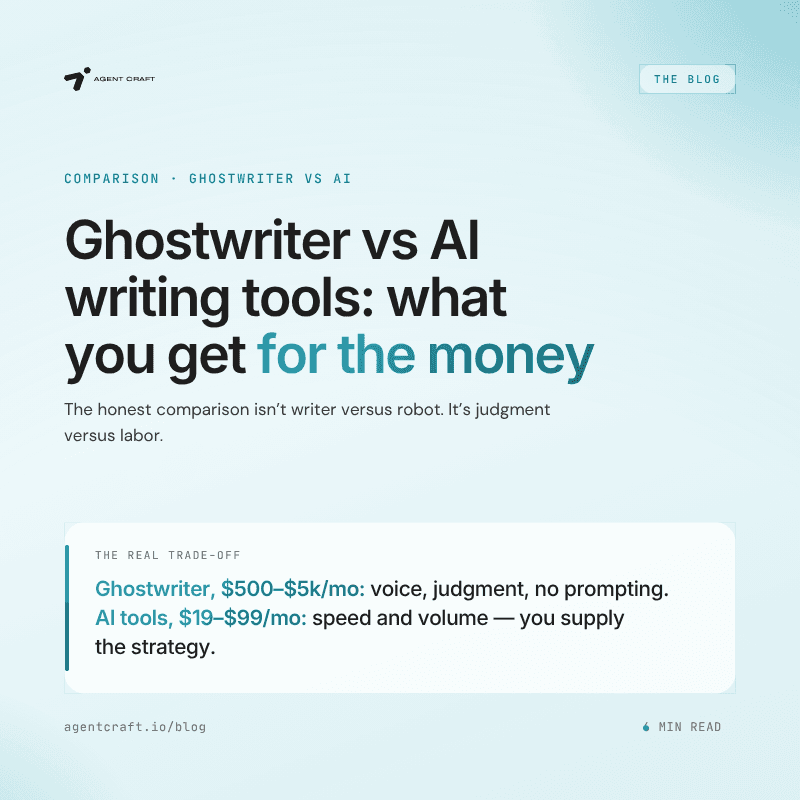
Ghostwriter vs AI Writing Tools: What You Get for the Money
Juan Mouton
VP Marketing
A ghostwriter costs $500 to $5,000 a month and gives you a human who learns your voice, supplies judgment, and needs no prompting. An AI writing tool costs $19 to $99 a month and gives you speed, volume, and availability, with the strategy and the quality control left to you. The honest comparison is not writer versus robot. It is judgment versus labor, and once you see which one you are short of, the decision mostly makes itself.
What the human delivers for the premium
Three things justify the 50x price gap when they are present. Judgment: a good ghostwriter decides what to say and when, hears the post inside your rambling, and steers you away from the weeks of content that would have been fine and forgettable. Accountability: the posts go out because a person you are paying makes them go out, which outperforms your own willpower in month three. And extraction: they interview you, chase you for stories, and pull material you would never have volunteered to a text box.
What the premium does not buy: immunity from the ramp (one to three months before the voice is right, at full price), portability (what they learn leaves with them), or scale (every additional post is billed, because it costs them labor).
What the tool delivers for $19 to $99
Volume without marginal cost: the tenth draft costs the same as the first. Availability: the tool is there at 6am before the board meeting. And speed: a draft in seconds instead of a feedback cycle in days.
What the low price does not buy, and this is where most disappointment lives: the tool has no stake in your positioning. Prompt it cold and it returns the consensus of everything it has read, which is by definition what everyone else sounds like. The generic-AI-content problem is a supervision failure before it is a quality failure: a tool with no strategy attached produces content with no strategy inside. You become the strategist, the editor, and the enforcer of your own voice, and those unpaid jobs are the real cost of the cheap tier.
The comparison, done honestly
| Ghostwriter | AI writing tool | |
|---|---|---|
| Monthly cost | $500 to $5,000 | $19 to $99 |
| Voice fidelity | High, after 1 to 3 months of ramp | As good as its inputs; generic if prompted cold |
| Strategy | Included at mid-market and above | Yours to supply |
| Consistency | Theirs to enforce | Yours to enforce |
| Scale | Billed per post | Effectively free |
| When they leave | Knowledge leaves too | Nothing retained in the first place |
The last row deserves a beat: the freelancer takes your voice knowledge with them, and the basic tool never accumulates it at all. Both are versions of the same problem, which is that nothing compounds.
The question that decides it
Ask what you are actually short of. If you are short of judgment, you do not know your positioning and cannot tell your good material from filler, then a cheap tool will multiply your uncertainty at high speed, and a good human is worth the retainer. If you are short of labor, you know exactly what you want to say and simply cannot spend the hours, then a ghostwriter is mostly selling you typing, and that is an expensive way to buy typing.
If you are short of both, which is the most common honest answer, neither pole fits. That gap, judgment encoded like a consultant's but running at tool economics, is the middle the market has been moving toward.
Where Agent Craft sits in this
The middle described above exists, and we built it. Agent Craft holds your strategy permanently, shaped by best practice and a marketing VP with twenty-plus years on global brands, and drafts from your own spoken material, never a cold prompt. Then it goes further than either column: publishing across LinkedIn, X, TikTok, and YouTube, with a personal brand CRM qualifying the leads your content earns and email nurture keeping them warm. Judgment at tool economics was the whole point.
Frequently asked questions
Is a ghostwriter better than AI for LinkedIn?
Better at judgment, extraction, and accountability; more expensive by 10x to 50x, slower to scale, and the knowledge leaves when they do. The right answer depends on whether your shortage is judgment or labor.
Why does AI-written LinkedIn content sound generic?
Because a tool prompted without positioning returns the average of its training. The fix is input: your own material, your own stance, and a standing definition of your voice, supplied every time or held somewhere permanent.
Can I use both a ghostwriter and AI tools?
Many writers already do, quietly. If you are paying premium rates, it is fair to ask a provider what is human, what is assisted, and what you are paying for at each step.
Share
Related Articles
What Personal Branding Costs in Time If You Do It Yourself
Doing your own personal brand costs two to four hours a week, every week, indefinitely. That covers deciding what to say, writing it, formatting it, publishing it, engaging around it, and maintaining the profile that all of it points back to. The money cost is zero and the method is not secret, which is why the honest question was never whether you can afford to do it yourself. It is whether you will still be paying the hours in week eleven, because the ledger below is due weekly whether or not the week cooperates.
How to Brief a LinkedIn Ghostwriter (and What a Good One Asks)
A proper ghostwriter brief covers four things: your positioning (who you help, what you want to be known for, what you reject), your voice (how you actually talk, with samples), your proof (the stories, wins, and scars they can draw on), and your boundaries (topics, names, and numbers that never go public). Hand over those four and a competent writer can start sounding like you in weeks instead of months. This post gives you the brief structure, and just as usefully, the questions a good ghostwriter will ask you unprompted, because the questions they ask in the first session are the cheapest quality test in the market.
How to Build a Personal Brand on LinkedIn From Zero (2026)
The sequence from zero is four steps in strict order: position (decide what you want to be known for), optimize (make your profile findable and legible), publish (put real thinking in public on a weekly rhythm), and engage (be present in the conversations around your subject). Run them in order because each one wastes without the one before it: publishing without a position produces noise, and a beautiful profile nobody arrives at is a brochure in a drawer. The honest timeline for the whole arc is a quarter, and the quarter is non-negotiable in a way this post will be specific about, because the timeline is where zero-starters actually fail.