How to Brief a LinkedIn Ghostwriter (and What a Good One Asks)
Juan Mouton
VP Marketing
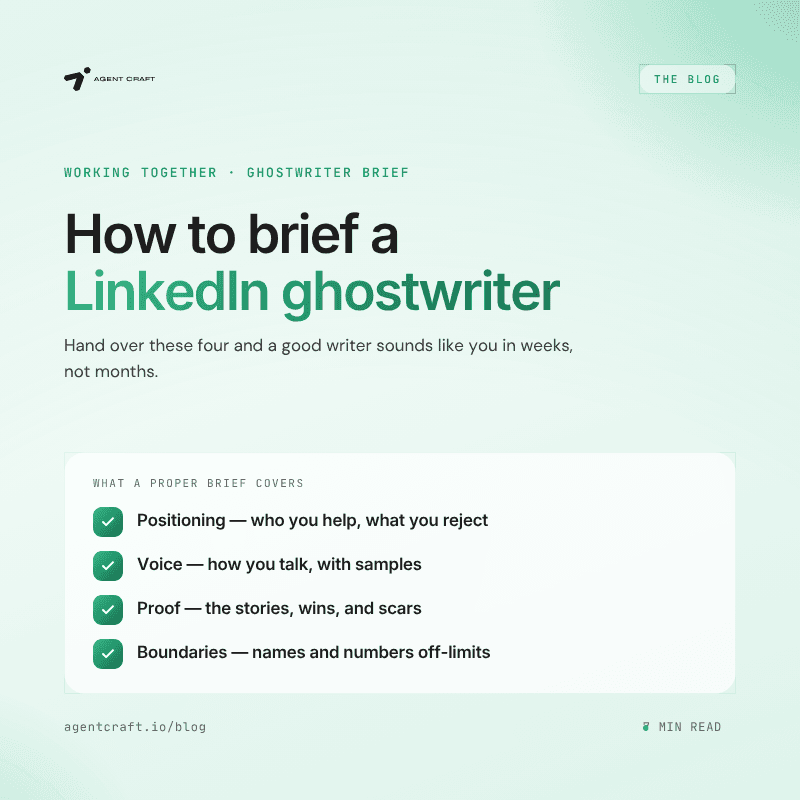
A proper ghostwriter brief covers four things: your positioning (who you help, what you want to be known for, what you reject), your voice (how you actually talk, with samples), your proof (the stories, wins, and scars they can draw on), and your boundaries (topics, names, and numbers that never go public). Hand over those four and a competent writer can start sounding like you in weeks instead of months. This post gives you the brief structure, and just as usefully, the questions a good ghostwriter will ask you unprompted, because the questions they ask in the first session are the cheapest quality test in the market.
The brief, section by section
Positioning, one page. Who you help and with what, in plain words. The two or three subjects you want to be known for, and the one belief you hold that your industry mostly does not. If you cannot fill this page, stop before hiring: a ghostwriter multiplies clarity, and without it they multiply volume. The one-sentence version worth writing at the top: I believe [audience] who want [outcome] should [your approach], not [what the industry does instead].
Voice, samples over adjectives. "Professional but approachable" tells a writer nothing; every client says it. Give them artifacts instead: three emails you wrote that sound like you, a recording of you explaining something you know well, two posts by other people whose tone you would wear and two you never would. The recording is the most valuable item in the entire brief, because your spoken phrasing is the voice they are being paid to reproduce.
Proof inventory. Five wins they can reference, two failures that taught you something, and the client stories that are usable once anonymized. Mark each item green (usable as is), yellow (anonymize first), or red (never). Doing this sorting up front prevents the two failure modes: a writer too cautious to use your best material, or one careless with your worst.
Boundaries. Confidential numbers, unnameable clients, topics you refuse to be associated with, and any employer social media policy in play. Also the practical rules: who approves posts, how fast you turn feedback around, and what happens when you go quiet for a week, because you will.
What a good ghostwriter asks you first
The brief tests you; the first session tests them. A serious writer's opening questions are strategy questions, and they sound like a consultant's discovery session: What do you want this presence to produce, standing or pipeline? Who exactly should be reading, and what do you want them to do? What do you believe that your peers do not? What are you sick of seeing in your industry's content? Where does your best thinking currently happen, calls, memos, the shower? What would make you fire us?
If the first session instead goes straight to logistics, cadence, formats, hashtags, packages, you are talking to a typing service. Nothing wrong with typing services at typing-service prices; the red flag is one charging strategy prices.
Red flags, collected
They ask for almost nothing from you ("just approve the drafts"), which means your feed will be competent filler within a month. They promise virality, which is promising weather. They cannot show writing in two genuinely different client voices, which means every client gets theirs. They resist telling you who actually writes. And they have no answer for what you own when you leave: the voice guide, the positioning work, and the content bank should be contractually yours, because you paid for their creation.
The first month, run properly
Expect a ramp regardless of brief quality: one to three months is normal. Shorten it by front-loading feedback: annotate the first drafts line by line, not "feels off" but "I would never say leverage, and this sentence is missing the caveat I always give." Ten minutes of specific feedback per draft in month one saves the retainer's worth of drift later. And keep supplying raw material weekly, a voice memo or three bullet points, because a starved ghostwriter fills the silence with the generic, and it will be your name on it.
Where Agent Craft sits in this
The brief above is our positioning workbook in miniature, and the first-session questions are the ones Agent Craft's strategy layer asks as a matter of course, built on best practice and twenty-plus years of global brand leadership. If you would rather skip the hiring entirely: the system runs the whole engagement, voice-note input, drafts in your voice, publishing across LinkedIn, X, TikTok, and YouTube, plus the lead capture and email nurture no ghostwriter quotes for. Either way, insist on the questions. They are the quality bar.
Frequently asked questions
What should a LinkedIn ghostwriter brief include?
Positioning (who you help, what you stand for), voice samples rather than adjectives, a sorted proof inventory of wins and stories, and explicit boundaries: confidential material, approval flow, and ownership terms.
What questions should I ask before hiring a ghostwriter?
Who actually writes, what they need from you monthly, the per-post math on your quote, how they measure success beyond impressions, and what you own when you leave.
How long until a ghostwriter sounds like me?
One to three months. Specific, line-level feedback in the first weeks and a steady supply of raw material are the two things that shorten it.
Share
Related Articles
What Personal Branding Costs in Time If You Do It Yourself
Doing your own personal brand costs two to four hours a week, every week, indefinitely. That covers deciding what to say, writing it, formatting it, publishing it, engaging around it, and maintaining the profile that all of it points back to. The money cost is zero and the method is not secret, which is why the honest question was never whether you can afford to do it yourself. It is whether you will still be paying the hours in week eleven, because the ledger below is due weekly whether or not the week cooperates.
Ghostwriter vs AI Writing Tools: What You Get for the Money
A ghostwriter costs $500 to $5,000 a month and gives you a human who learns your voice, supplies judgment, and needs no prompting. An AI writing tool costs $19 to $99 a month and gives you speed, volume, and availability, with the strategy and the quality control left to you. The honest comparison is not writer versus robot. It is judgment versus labor, and once you see which one you are short of, the decision mostly makes itself.
How to Build a Personal Brand on LinkedIn From Zero (2026)
The sequence from zero is four steps in strict order: position (decide what you want to be known for), optimize (make your profile findable and legible), publish (put real thinking in public on a weekly rhythm), and engage (be present in the conversations around your subject). Run them in order because each one wastes without the one before it: publishing without a position produces noise, and a beautiful profile nobody arrives at is a brochure in a drawer. The honest timeline for the whole arc is a quarter, and the quarter is non-negotiable in a way this post will be specific about, because the timeline is where zero-starters actually fail.