
Created from a single voice note with Agent Craft
Threads
Even the failure path is handled. If something breaks inside Craft's…
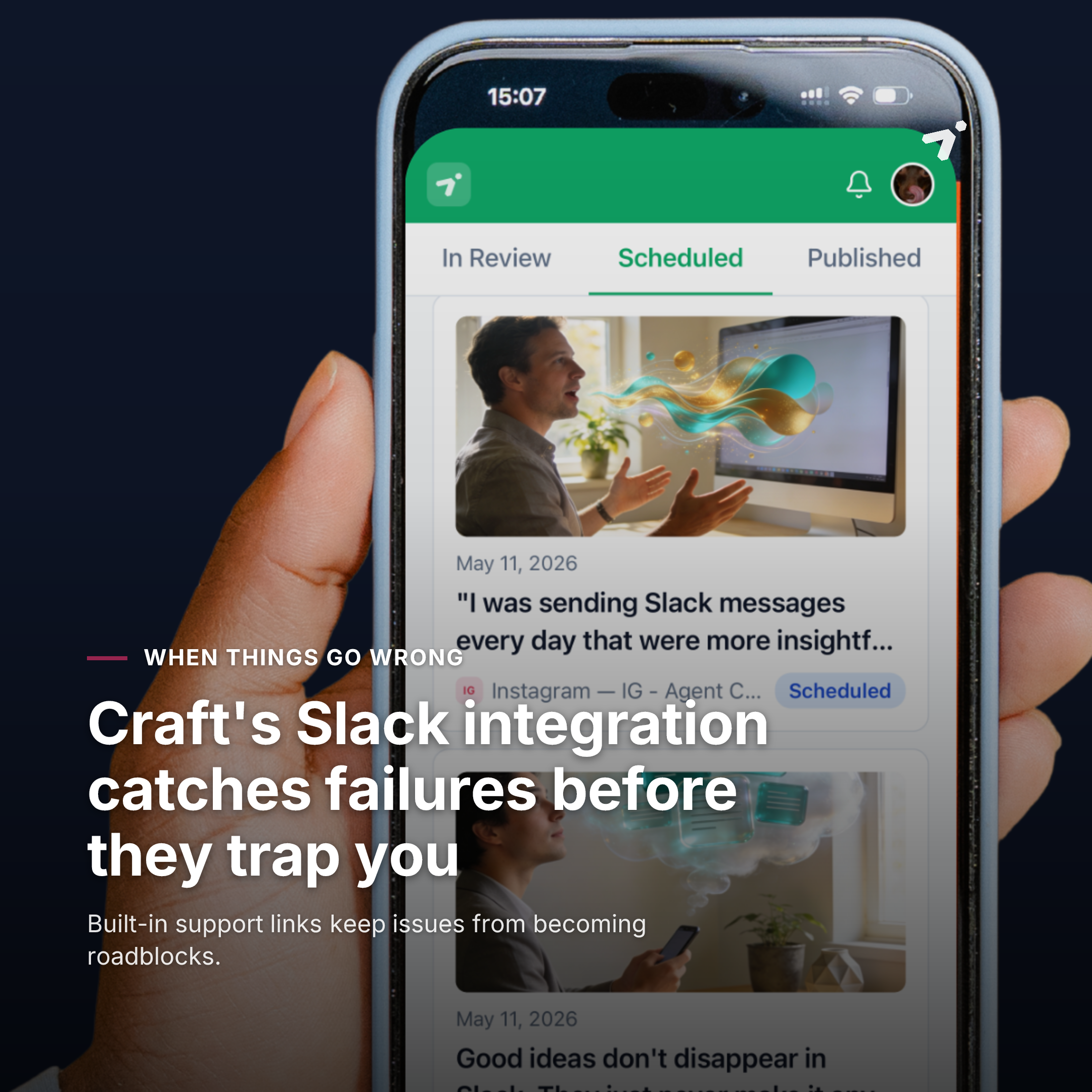
Even the failure path is handled. If something breaks inside Craft's Slack integration, it sends you a support link automatically so the issue gets logged and investigated. No dead ends, no chasing down help. The fallback lives inside the product itself.
More content from Agent Craft
- BlueskyHiring for marketing right now. Two candidates: one with the polished agency résumé, one who'll use AI to make themselves 100x more productive but has none of the traditional credentials. Which do you hire? The answer says a lot about how you'll build the whole team.
- X (Twitter)People don't want Claude prompt guides. They want solutions. Record voice notes daily. Magic comes out the other side. Building: AgentCraft (dot) ai Grow your personal brand in minutes per day with voice notes
- InstagramHere's a way to think about where AI marketing actually breaks down. Most teams assume the hard part is the writing. It isn't. The hard part is that AI can now write code, research topics, run social, and produce coherent campaigns faster than most people predicted a year ago, but the thinking that ties it all together is still uneven. That's the real gap. Picture it as three layers. Strategy sits on top. What the campaign is for, who it speaks to, what the brand actually sounds like. AI doesn't set this on its own. A person does, up front. Production sits in the middle. This is where AI earns its keep. Given a clear brief, it turns raw input into finished, on-brand content at a speed that changes what a small team can ship. Judgment sits underneath both. Sometimes you still need someone who can see a gap in the logic and fix it before it reaches a platform. The work isn't purely linear, and that's the part tools skip over. The reason so much AI content still reads flat is that teams collapse all three layers into one prompt and hope for the best. They skip the strategy layer, lean entirely on production, and drop the judgment. The output is technically fine and completely forgettable. Flip the order. Set the strategy and voice first. Let AI carry the production load. Keep a person on judgment. Do that and the "AI content feels flat" problem mostly goes away, because the flatness was never the model's fault. It was a missing layer. For a CEO or VP of marketing staring at a strategy deck that never becomes actual posts, this is the useful frame. The execution gap isn't a content problem. It's a layer problem, and it's fixable without pulling every executive into a writing session. Which layer is quietly missing on your team right now?
- ThreadsA manufacturing company left their agency with a few dozen followers per account, zero engagement, every post looking like an ad. Now their posts sound like their actual founders and execs. And instead of one or two a week, they're publishing across several channels every week.
- BlueskyThe personal branding industry has it backwards. The best marketing for any company isn't generic posts on the brand account. It's the actual knowledge of the executives and people who do the work. That's the real signal readers trust. The whole space is due for disruption.
- LinkedInA post should cost a voice note, not an afternoon, but most tools eat 90 minutes per post. Most AI content tools hand you a blank box and a cursor. Paste something in, read the output, tweak, paste again. Repeat until it's passable. That loop is why so many executives quietly give up. Agent Craft works differently. The difference sits in what happens before you ever record a word. A team admin, usually a VP of marketing or content manager, loads the brand voice, the strategy, the campaign goals, and the exec's actual opinions into the system first. So when content gets generated, it's drawing on all of that at once. The first draft already fits your brand and your goals, so you're spending your time on review instead of another twenty rounds of edits. That's the whole point. Agent Craft runs the strategy that's already in the exec's head through a workflow, so the output arrives aligned instead of blank. Nine times out of ten it lands close enough that you're reviewing, tightening a line or two, and shipping. The strategy already exists in their heads. The gap is turning it into output without eating that time. An exec records a short voice note between meetings, their real thoughts and personality intact, and the agent turns that into finished content that sounds like them. Close that gap and a post costs a voice note, not an afternoon.