Created from a single voice note with Agent Craft
Five companies across my career. Every single one had the same gap.…
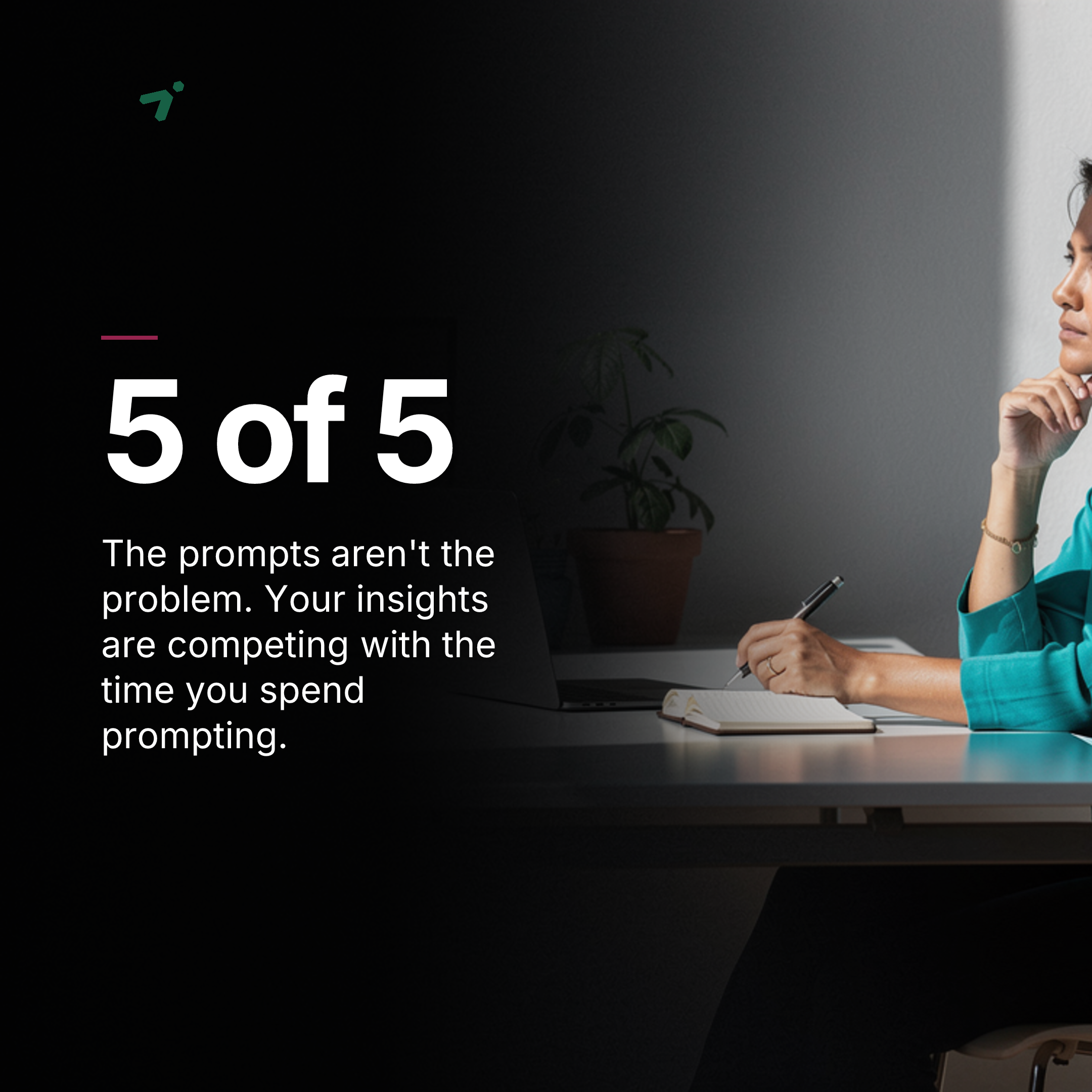
Five companies across my career. Every single one had the same gap. Not design, not budget, not the wrong channels. It was always thought-leading content. Here's where it gets interesting. Most people trying to fix that problem now turn to AI. Good instinct. But then they start collecting prompt templates off X and LinkedIn, saving them to Notion, trying to figure out which one fits which situation. And that's where it falls apart. Sharing better prompts doesn't fix a broken interface. It just makes the broken interface slightly less painful. Business owners don't want to learn prompting. They want results. So here's the actual debate I want to have: If you're using AI for marketing right now, are you spending more time crafting inputs than you are thinking about what actually matters, your customer stories, your real points of view, your expertise? Because those two things are in direct competition. Every minute you spend wrestling with a prompt is a minute you're not spending on the insight that would actually build an audience. Drop your honest answer below. Are prompts eating your time, or have you found a way around it?
More content from Agent Craft
- InstagramMost people who've written off AI for their business made that call based on the chatbot version. Type a question, get an answer, scratch your head about what to do with it. That's not a fair test. The version they haven't seen is an AI employee, if you like, that lives inside your actual workflow. One that knows your content strategy, your audience, your channel mix. One that handles the research, the formatting, the scheduling. You just provide the raw material. Those are two completely different things. And most of the skepticism out there is aimed at the first one. So here's the question: if you've written AI off for marketing, was your experience the chatbot version or the embedded-agent version? Genuinely curious how many people are judging the whole category based on the least capable use case.
- InstagramPlug it in and it gets to work. That's genuinely how Agent Craft operates inside Slack, Microsoft Teams, and Google Chat. Most AI tools ask you to go somewhere new. A new tab, a new login, a new habit. Agent Craft does the opposite. You install it into the work surface you're already in, and it introduces itself to your team like a new hire would. It figures out how people like to work. It starts asking for contributions, crafts prompts suited to each person, and collects voice notes. Then it takes that material and runs with it, turning what your team already knows into content that's ready to publish. Barrie Hadfield put it well: "The key thing is I no longer have to do the typing. We tell agents what to do, and agents write it." That's the real shift. Not a smarter chatbot. An agent that lives in your workflow, works around the clock, and treats your team's knowledge as the raw material for content that actually sounds like your people. The reason adoption tends to fail with AI tools is that the tool sits outside the work. People have to remember to use it. Agent Craft sits inside the conversation your team is already having. That's a different thing entirely. It was built this way from the start. AI first, not bolted on. And if your experience of AI so far has been typing into a chatbot and getting an answer, you're seeing a fraction of what it can do when it's plugged directly into your team.
- TikTokDon't optimize what shouldn't exist. If nobody's using that feature, cut it, you'll build something better without it. #softwaredevelopment #buildinpublic #productthinking #agentcraft #devtips #engineering
- X (Twitter)Working on something for weeks doesn't make it good. I've been building my app for a while now. Careful architecture. Real testing. Work I genuinely put time and thought into. And I just made the call to delete a lot of it. Not because it was bad work. Because the place I'm in now is different from where I started. And not everything that made sense at the beginning still makes sense today. There's a name for the trap I had to avoid. The sunk cost fallacy. The idea that because you invested in something, you have to keep it. That the hours justify the output. They don't. The work doesn't become valuable just because it was hard. So I cut it. And here's the thing: simplicity is almost always better. Not sometimes. Almost always. Complexity creeps in quietly, feature by feature, decision by decision, until you look up and realize you've built something that nobody, including you, fully understands anymore. The clean version is harder to ship because it feels like you're leaving something on the table. You're not. You're leaving the table clear enough to actually eat at. Simplicity is almost always better.
- BlogReal-Time Decision Engines vs. Traditional CRMs: How to Compare Real-Time Decision Engines for Email Segmentation Versus Traditional CRMs (And Why It Actually Matters)
- TikTokYour marketing team isn't your biggest asset, you are. The founder's voice is what people actually want to follow and buy from. #founderpersona #businessmarketing #personalbranding #entrepreneurmindset #marketingstrategy #contentmarketing