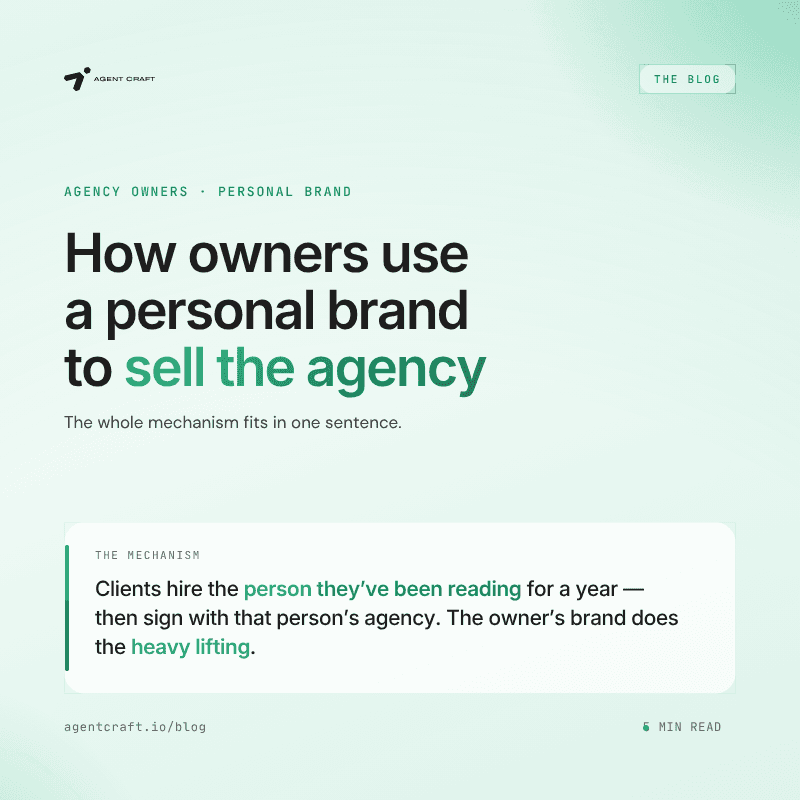
How Agency Owners Use a Personal Brand to Sell the Agency
Juan Mouton
VP Marketing
Clients hire the person they have been reading for a year, and then they sign with that person's agency. That single sentence is the entire mechanism, and it explains a pattern every agency owner has noticed without always naming: the best-fit clients arrive saying "I have been following your stuff," having pre-sold themselves through months of the owner's published thinking, while the agency's own polished channels generate polite inquiries that need convincing from zero. The owner's brand and the agency's brand are both real assets. They just do different jobs, and in a market that sells judgment, the personal one does the heavy lifting.
Why the owner outsells the shingle
Agencies sell an intangible: judgment applied to the client's situation. Buyers cannot inspect it in advance, so they buy proxies, and the strongest proxy available is watching the owner's judgment operate in public over time. An agency site asserts competence; the owner's back catalog demonstrates it, week after week, in a form no case-study page can match, because case studies are marketing and everyone reads them as marketing, while a year of visible thinking is evidence. There is also the accountability mechanic that runs through all founder-led trust: the owner's posts carry personal risk, a name and a standing, which is exactly what gives the claims weight. The agency account, like all brand accounts, is understood to be reviewed, sanded, and attributable to no one, and buyers discount it accordingly.
The practical upshot for pipeline quality is the part that matters commercially: inbound that arrives through the owner's brand arrives pre-aligned, already agreeing with the owner's stances, already sold on the approach, already past the beauty-parade stage. These engagements close faster, price better, and churn less, because the filtering happened in public, for free, before the first call.
The conflict worry, answered
The standard hesitation: if I build my brand, am I competing with my agency's brand, and will clients want me instead of the team? The worry is backwards on both counts. The two brands are a relay, not rivals: the owner creates belief, the agency receives and converts it, and every strong personal post is top-of-funnel for the firm. As for clients wanting the owner personally, they already do, that is the nature of buying judgment, and the owner's content is precisely where you manage the expectation, by publishing about the systems, the team's thinking, and the method, so that what you become known for is an approach the whole agency runs rather than a pair of hands. Owners who publish about their method scale their trust. Owners who publish only their own heroics build a bottleneck with an audience.
The genuinely mature version, as the agency grows, is multiplication: senior people building their own standing alongside the owner's, so the trust portfolio holds several names. That is a later chapter with its own mechanics; the sequence still starts with the owner, because someone has to prove the channel first, and the owner has the most material and the most at stake.
What an agency owner should publish
Four formats, all byproducts of running the shop.
The diagnosis across clients. The pattern you keep seeing in briefs, the mistake half your prospects arrive making, the metric your industry worships that lies. Diagnosis is the most persuasive display an advisory business can make, and the owner sits on more of it than anyone on the team.
The method, given whole. How your agency actually approaches a class of problem, complete enough to execute by hand. Complete beats teased, always: the teaser reads as bait, the whole method reads as confidence, and the readers who run it alone were never buyers, they are distribution.
The stance. What your corner of the industry does by default that you refuse, and what you do instead. For an agency this is content and qualification in one move: it repels the clients who would have been wrong anyway, which is the cheapest churn prevention available.
The inside of the business. Pricing logic, hiring lessons, the engagement that went sideways and what changed after, anonymized where needed. Agency buyers are business owners too; watching you run yours honestly is its own credential.
The cadence is the standard professional one, two or three posts a week, and the standard warning applies double for owners: the practice must survive the busy quarters, because the pipeline being built in public is the one you will be living on two quarters out, and agency pipelines have long memories of quiet periods.
Where Agent Craft sits in this
Agent Craft runs the owner's practice above as a system: two minutes of spoken diagnosis between client calls becomes drafted posts in your voice, method and stances enforced by the Brand Book, published across LinkedIn, X, TikTok, and YouTube. The pipeline the brand builds gets professional treatment too: a personal brand CRM collects the inbound, qualifies it, and nurtures it by email, which is more than most agencies do for their own leads. Next quarter's pipeline stops depending on this quarter's spare hours.
Frequently asked questions
Should an agency owner build a personal brand or the agency's brand?
The owner's first, decisively: agencies sell judgment, and buyers trust judgment they have watched operate. The agency brand's job is receiving and converting the belief the owner creates.
Will my personal brand make clients want me instead of my team?
Only if you publish heroics instead of method. Owners who publish their agency's approach and thinking become known for a system the team runs, which scales the trust rather than bottlenecking it.
What should agency owners post on LinkedIn?
Diagnoses across clients, complete methods, genuine stances on industry defaults, and honest lessons from running the business. All four are byproducts of the work; the practice is capture, not creation.
Share
Related Articles
How to Build a Personal Brand on LinkedIn From Zero (2026)
The sequence from zero is four steps in strict order: position (decide what you want to be known for), optimize (make your profile findable and legible), publish (put real thinking in public on a weekly rhythm), and engage (be present in the conversations around your subject). Run them in order because each one wastes without the one before it: publishing without a position produces noise, and a beautiful profile nobody arrives at is a brochure in a drawer. The honest timeline for the whole arc is a quarter, and the quarter is non-negotiable in a way this post will be specific about, because the timeline is where zero-starters actually fail.
How to Turn a Voice Note Into a Week of LinkedIn Content, By Hand
The method is this: record yourself talking for two minutes about something you know, transcribe it, find the two or three posts hiding inside the rambling, give each one a hook, cut it to length, format it for LinkedIn, re-form it for X if you use both, and schedule the lot. The two minutes of talking produce the whole week's raw material. The desk work after the talking takes about forty-five minutes per post. This post walks every step so you can run the entire method yourself, with the honest timing attached to each.
Personal Branding for Consultants: Turning Expertise Into Inbound
For a consultant, personal branding reduces to one move: showing your thinking in public, because your thinking is the product and buyers cannot want what they have not seen. Every other profession sells something separable from the person; consulting sells judgment, and judgment can only be evaluated by watching it operate. A consultant who publishes their reasoning is running free product demos at scale. A consultant who does not is asking strangers to buy an invisible service on the strength of a headshot, which is roughly the market's hardest sale, and explains most of the profession's cold-outreach misery.