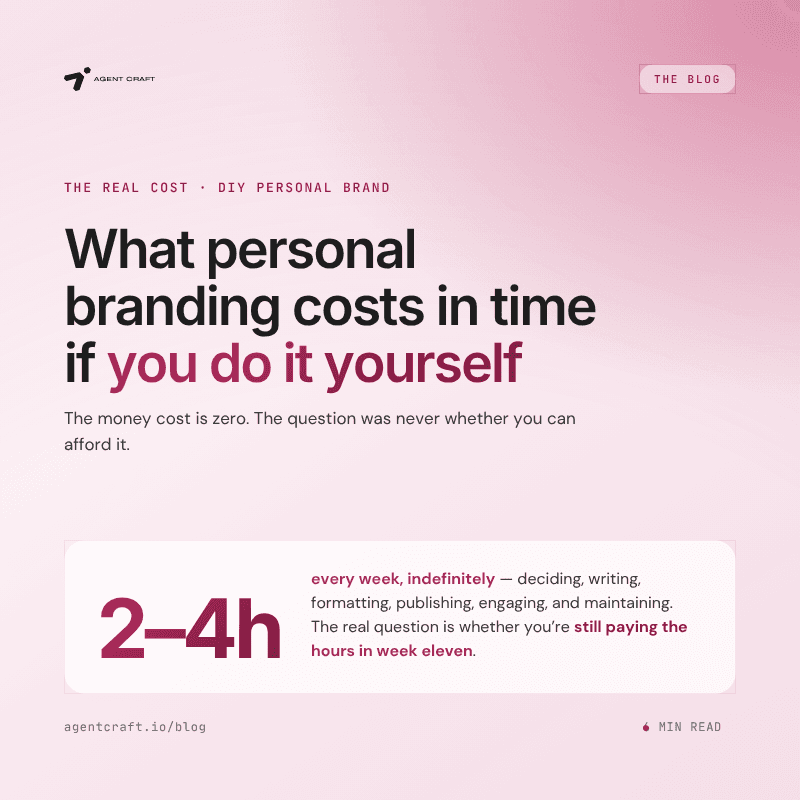
What Personal Branding Costs in Time If You Do It Yourself
Juan Mouton
VP Marketing
Doing your own personal brand costs two to four hours a week, every week, indefinitely. That covers deciding what to say, writing it, formatting it, publishing it, engaging around it, and maintaining the profile that all of it points back to. The money cost is zero and the method is not secret, which is why the honest question was never whether you can afford to do it yourself. It is whether you will still be paying the hours in week eleven, because the ledger below is due weekly whether or not the week cooperates.
The task ledger, itemized
Deciding what to say: 30 to 60 minutes a week. The blank-page tax. Reviewing the week for material, choosing angles, and matching them to what you want to be known for. This is the hour that quietly kills most DIY efforts, because it is pure judgment with no visible output, and it feels skippable right up until there is nothing to post.
Writing: 30 to 45 minutes per post. Draft, hook, cut a third, read aloud. At three posts a week, call it 90 minutes to two and a quarter hours. Faster with practice, never free.
Formatting and publishing: 10 minutes per post. Paragraph breaks, white space, scheduling. Add another pass if you publish to a second platform properly, because reposting the same text is visible and re-forming it is work.
Engagement: 60 to 90 minutes a week. Replying to comments on your posts and commenting genuinely on other people's. This is the least skippable line on the ledger and the first one everyone skips: posts without engagement are broadcasting, and broadcasting builds far less than conversation does.
Profile and record maintenance: 15 minutes a week, averaged. Headline currency, About freshness, adding wins to the public record.
Total, at a serious three-post cadence: roughly three to four hours a week. At the momentum cadence of 40 to 50 posts a quarter, budget the top of that range for the first quarter, which is when the habit either sets or dies.
The tax nobody budgets: the every-week clause
The hours above are honest but they are not the hard part. The hard part is the schedule's shape: the work is never finished, only current. A report you finish stays finished. A personal brand is a standing subscription paid in attention, and it decays the moment payments stop: reach fades within weeks, the network cools within months, and restarting costs more than continuing would have. Most DIY efforts do not fail on quality. They fail in week three, on a Tuesday, when the calendar was full and the post was due anyway.
This is worth pricing consciously, because it is the real comparison against outsourcing. A $3,500 retainer is not buying writing you could not do. It is buying the every-week clause enforced by someone other than your willpower.
Making the hours smaller, honestly
Three compressions that work, none of which remove the work entirely. Batch the deciding: one 30-minute session with good prompts produces a fortnight of angles, and the blank-page tax is paid once instead of daily. Talk before you write: answering a prompt out loud for two minutes gives you a transcript full of usable sentences, and writing becomes arranging rather than inventing, which roughly halves the per-post time. And template the engagement window: fifteen minutes, twice a day, beats an open-ended scroll that eats an hour and produces three comments.
With all three compressions running, a practiced DIY operator gets the ledger to about two hours a week. That is the floor. Claims of a genuinely hands-off personal brand, from any method or vendor, are describing either a lower cadence or someone else's hours.
Where Agent Craft sits in this
The ledger above is exactly what Agent Craft absorbs. Your side stays at two minutes: the voice note. The system runs the finding, drafting, formatting, and publishing across LinkedIn, X, TikTok, and YouTube, then keeps working after you post: a personal brand CRM collects the leads, qualifies them, and moves them into email nurture. Strategy is built in rather than left on your desk. If the two-hour weekly floor suits your discipline, take it, the compressions above are free. The system exists for everyone who has met week three.
Frequently asked questions
How many hours a week does personal branding take?
Two to four hours at a serious cadence: deciding, writing, formatting, engaging, and maintaining the profile. Practiced operators with good systems reach about two; below that, something on the ledger is being skipped.
What takes the most time?
Deciding what to say and engaging around what you post. Writing is the visible work, but the judgment and the conversation are the hours that compound, and the ones most often cut first.
Can I do it in 30 minutes a week?
At one post a week with light engagement, roughly, and one post a week is a maintenance cadence rather than a building one. It preserves presence; it rarely grows it.
Share
Related Articles
How to Brief a LinkedIn Ghostwriter (and What a Good One Asks)
A proper ghostwriter brief covers four things: your positioning (who you help, what you want to be known for, what you reject), your voice (how you actually talk, with samples), your proof (the stories, wins, and scars they can draw on), and your boundaries (topics, names, and numbers that never go public). Hand over those four and a competent writer can start sounding like you in weeks instead of months. This post gives you the brief structure, and just as usefully, the questions a good ghostwriter will ask you unprompted, because the questions they ask in the first session are the cheapest quality test in the market.
Ghostwriter vs AI Writing Tools: What You Get for the Money
A ghostwriter costs $500 to $5,000 a month and gives you a human who learns your voice, supplies judgment, and needs no prompting. An AI writing tool costs $19 to $99 a month and gives you speed, volume, and availability, with the strategy and the quality control left to you. The honest comparison is not writer versus robot. It is judgment versus labor, and once you see which one you are short of, the decision mostly makes itself.
How to Build a Personal Brand on LinkedIn From Zero (2026)
The sequence from zero is four steps in strict order: position (decide what you want to be known for), optimize (make your profile findable and legible), publish (put real thinking in public on a weekly rhythm), and engage (be present in the conversations around your subject). Run them in order because each one wastes without the one before it: publishing without a position produces noise, and a beautiful profile nobody arrives at is a brochure in a drawer. The honest timeline for the whole arc is a quarter, and the quarter is non-negotiable in a way this post will be specific about, because the timeline is where zero-starters actually fail.