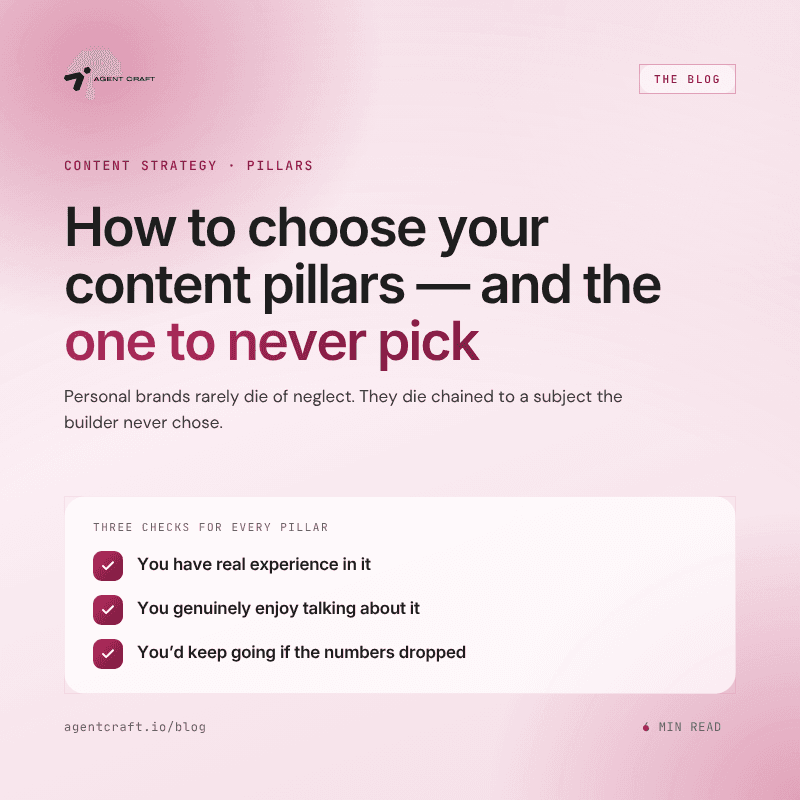
How to Choose Content Pillars (and the Topic to Never Pick)
Juan Mouton
VP Marketing
Choose one to three subjects, no more, and put each through three reality checks: you have real experience in it, you genuinely enjoy talking about it, and you would keep talking about it if the numbers dropped. Any subject passing all three is a pillar. Then run the exercise almost nobody runs: identify the one topic that would slowly make you resent your own brand if you were chained to it, and formally ban it, because the most common way personal brands die is not neglect. It is the builder waking up one day imprisoned by a subject they never chose.
Why one to three, and not the buffet
A pillar is a promise of repetition: this is what you will hear from me, reliably, for years. The promise only works narrow. An audience can attach your name to one subject easily, to three with effort, and to seven not at all; past three you are not known for things, you are merely active. Narrowness also compounds on your side of the ledger: fifty posts inside one lane build on each other, each assuming the last, going deeper than any newcomer can fake, while fifty posts across seven lanes are fifty first posts.
The generalist's objection arrives on schedule here: three subjects cannot hold everything I know. Correct, and they are not meant to. Pillars are doors, not walls; the range walks through them as evidence. What pillars constrain is what you are for, which is exactly the thing an audience needs constrained.
The three reality checks
Real experience. You have done the thing, not studied the thing. The test is whether your posts can contain specifics no observer would know: the number that surprised you, the step everyone skips, the way it actually failed. Borrowed-experience pillars produce content with correct opinions and no fingerprints, and readers register the absence even when they cannot name it.
Real enjoyment. You will visit this subject a hundred-plus times a year in your own head. The test is conversational: is this something you already bring up unprompted, at dinner, off the clock? Subjects chosen strategically but joylessly produce a very specific output, competent posts with dead eyes, and the deadness is visible by month two.
Survives a drop in views. The subject must be one you would keep working even if nobody clapped for a quarter, because there will be quarters when nobody claps. This check is the sustainability screen, and it quietly disqualifies most trend-chasing candidates, which is its job.
The dread topic, and the viral handcuff
Now the negative exercise. Complete this sentence honestly: if I had to talk about one topic publicly for the next three years, the one that would slowly make me resent the whole project is ______. Write the answer down and treat it as banned, permanently, including, especially, when it is trending and adjacent to your lane.
The ban exists because of a trap with a mechanism worth understanding: the viral handcuff. A post performs unusually well, the numbers whisper "more of this," you comply, the next one performs too, and eighteen months later you are the person known for a subject you privately dread, posting through gritted teeth to an audience assembled for the wrong you. Nobody chooses this; everyone who ends up there was optimizing one post at a time. The only defense is the ban written down in advance, when you are sober about what you actually want, because in the moment the numbers are persuasive and your future resentment is silent.
The diagnostic, if you suspect you are already partway in: have you ever had a post perform well and felt a small dread at its success? That feeling is the handcuff clicking. Ask whether you want to be known for that subject in two years, and if the answer is no, stop feeding it now, while the cost is a dip in reach rather than an identity.
Locking the pillars in
Write the final set as three lines, each with its check marks, plus the banned topic beneath them, dated. Then apply the weekly filter: every post either serves a pillar or does not ship, with the deliberate exception of the occasional human-layer post that keeps you a person rather than a channel. Revisit the sheet twice a year; pillars are decisions, and decisions earn review. What they do not earn is silent renegotiation one trending topic at a time, which is just the handcuff wearing a different sleeve.
Where Agent Craft sits in this
The exercise above is our workbook's Brand Prison Test, complete on paper. Inside Agent Craft, your pillars and your banned topic live in the Brand Book: off-lane drafts get flagged before they ship, and the dread topic is never suggested, even when it trends, which is precisely when your own resolve is cheapest. The strategy layer remembers the choice on the days the numbers argue against it. The choosing was always yours.
Frequently asked questions
How many content pillars should I have?
One to three. An audience can attach your name to one subject easily and three at most; beyond that you are active rather than known, and your own content stops compounding.
How do I know if a pillar is right for me?
Three checks: you have real hands-on experience in it, you already talk about it unprompted, and you would keep going through a quarter of silence. Any subject passing all three qualifies.
What is a dread topic?
The subject that would make you resent your own brand if you were bound to it for years. Naming and banning it in advance is the only reliable defense against drifting into it one well-performing post at a time.
Share
Related Articles
How to Build a Personal Brand on LinkedIn From Zero (2026)
The sequence from zero is four steps in strict order: position (decide what you want to be known for), optimize (make your profile findable and legible), publish (put real thinking in public on a weekly rhythm), and engage (be present in the conversations around your subject). Run them in order because each one wastes without the one before it: publishing without a position produces noise, and a beautiful profile nobody arrives at is a brochure in a drawer. The honest timeline for the whole arc is a quarter, and the quarter is non-negotiable in a way this post will be specific about, because the timeline is where zero-starters actually fail.
How to Turn a Voice Note Into a Week of LinkedIn Content, By Hand
The method is this: record yourself talking for two minutes about something you know, transcribe it, find the two or three posts hiding inside the rambling, give each one a hook, cut it to length, format it for LinkedIn, re-form it for X if you use both, and schedule the lot. The two minutes of talking produce the whole week's raw material. The desk work after the talking takes about forty-five minutes per post. This post walks every step so you can run the entire method yourself, with the honest timing attached to each.
Personal Branding for Consultants: Turning Expertise Into Inbound
For a consultant, personal branding reduces to one move: showing your thinking in public, because your thinking is the product and buyers cannot want what they have not seen. Every other profession sells something separable from the person; consulting sells judgment, and judgment can only be evaluated by watching it operate. A consultant who publishes their reasoning is running free product demos at scale. A consultant who does not is asking strangers to buy an invisible service on the strength of a headshot, which is roughly the market's hardest sale, and explains most of the profession's cold-outreach misery.