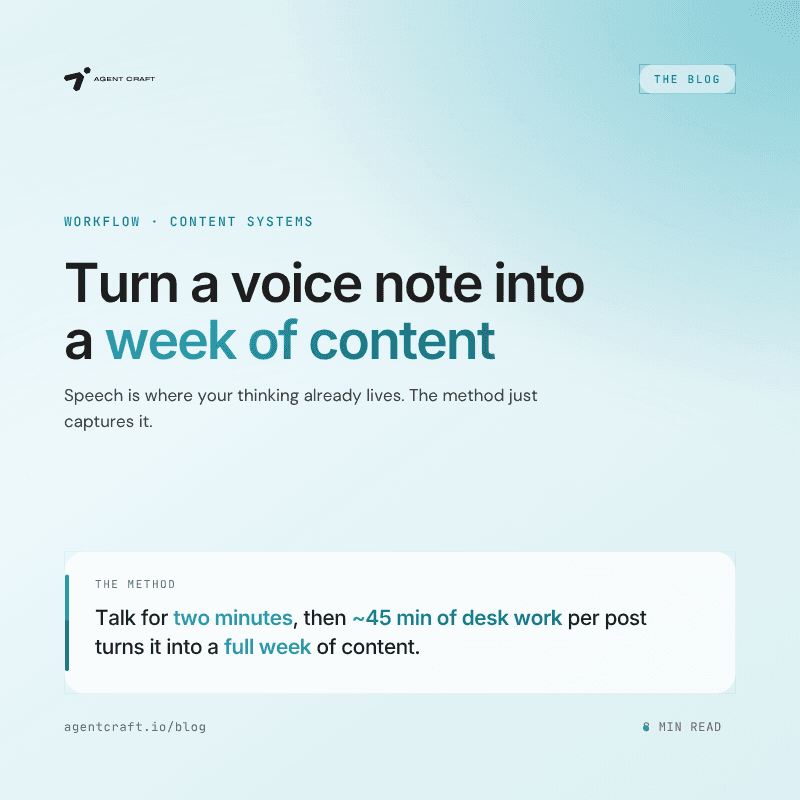
How to Turn a Voice Note Into a Week of LinkedIn Content, By Hand
Juan Mouton
VP Marketing
The method is this: record yourself talking for two minutes about something you know, transcribe it, find the two or three posts hiding inside the rambling, give each one a hook, cut it to length, format it for LinkedIn, re-form it for X if you use both, and schedule the lot. The two minutes of talking produce the whole week's raw material. The desk work after the talking takes about forty-five minutes per post. This post walks every step so you can run the entire method yourself, with the honest timing attached to each.
Why the method works before how: the hardest part of publishing consistently was never the writing. It was having something worth saying, and you already say worthwhile things constantly, in meetings, on calls, in answers to questions. Speech is where your actual thinking lives, in your actual phrasing, with your actual stories attached. The method just captures thinking you were going to do anyway and refines it into posts. Writing from a blank page asks you to think and type simultaneously. Talking first separates the jobs.
Step one: record two minutes (2 minutes)
Pick one prompt and answer it out loud into your phone. Not a speech, an answer, the way you would give it to a colleague who asked. Good prompts pull opinions and stories rather than facts: what is the most expensive mistake you see people in your field make, walk through the last client problem you solved, what do you believe about your industry that most peers do not. Ramble freely. Tangents are where the best material hides, and nobody hears this recording but you.
Step two: transcribe it (5 minutes)
Any transcription route works: your phone's built-in dictation, a free transcription app, or the voice typing in a document. Accuracy matters less than you think, because you are mining this text, not publishing it. You will get 300 to 400 messy words.
Step three: find the posts inside the rambling (10 minutes)
Read the transcript looking for three kinds of ore: a claim you made with conviction, a story with a before and after, and a specific detail a listener would not know. A two-minute ramble usually contains two or three of these, and each one is a post. Copy each out separately. Everything else in the transcript, the throat-clearing, the "you know"s, the setup, gets left in the mine.
This is the step that feels like the skill, and it is, but it is a learnable one: you are looking for the sentence you would repeat if someone asked you to sum up what you just said.
Step four: write the hook (10 minutes per post)
The hook is the first line or two, the only part most people will read, and its single job is to make the next line necessary. Take the strongest sentence from your extracted material and move it to the top. Do not warm up to it. "I want to share some thoughts on hiring" is a warm-up; "the most expensive hire I ever made interviewed perfectly" is a hook, and it was probably sitting in the middle of your transcript waiting to be promoted.
Then the body: the claim, the story or evidence for it, and what it means for the reader, in short paragraphs of one to three lines, written the way you talked. You already have all of this; step four is arranging, not inventing.
Step five: cut and format for LinkedIn (10 minutes per post)
Cut a third. Whatever you wrote, a third of it is scaffolding, and the post reads twice as well without it. Then format for the platform: short paragraphs, white space, no walls of text, and read it aloud once, which catches everything your eyes forgive.
Step six: re-form for X, if you use both (10 minutes per post)
Do not paste the LinkedIn post into X. The platforms reward different shapes, and a LinkedIn post on X reads exactly like what it is. Re-form it: the hook becomes the first tweet, the body becomes two to four short follow-ups, each able to stand alone, and the tone tightens. Same thinking, different garment.
Step seven: schedule and log (5 minutes)
Schedule the posts across the week rather than publishing in a burst. Keep a simple log of what went out and what got a response, because over a month it teaches you which of your material lands, and that steers the next voice notes.
The honest total
One two-minute voice note yields two to three posts. The desk work per post, steps three through seven, runs about forty-five minutes once you are practiced. So a week of content costs roughly two minutes of thinking and two hours of processing, and a quarter at the momentum cadence, forty to fifty posts, costs about one hour of thinking and thirty-plus hours of desk work. The thinking was the valuable part. Everything after it is labor, and it is labor of the specific kind that fails around week three, not because it is difficult but because it is due again every week whether or not the week cooperated.
Where Agent Craft sits in this
This exact workflow is our product, so the disclosure writes itself: this very post began as a voice note and was produced the way it teaches. Agent Craft runs steps two through seven as a system, drafts in your voice, checked against a strategy layer built on best practice and twenty-plus years of global brand leadership, published across LinkedIn, X, TikTok, and YouTube, with a personal brand CRM catching what the content earns. The method above is complete and free. We automated the thirty hours, not the two minutes that mattered.
Frequently asked questions
How long should the voice note be?
Two to three minutes. Shorter tends to stay on the surface; much longer and the mining step balloons. One focused question answered conversationally is the sweet spot.
What if I hate the sound of my own voice?
You never publish the audio and nobody else hears it. The recording is raw material for text, and the discomfort fades within a week of doing it.
How many posts does one voice note produce?
Two or three usable posts from a two-minute recording is typical once you can spot the ore: a conviction, a story, a specific detail.
Can I skip the transcript and just write from memory?
You can, but you lose the phrasing, and the phrasing is the point. Your spoken wording is more distinct than your written wording, and the transcript preserves it before your inner editor sands it down.
Share
Related Articles
How to Build a Personal Brand on LinkedIn From Zero (2026)
The sequence from zero is four steps in strict order: position (decide what you want to be known for), optimize (make your profile findable and legible), publish (put real thinking in public on a weekly rhythm), and engage (be present in the conversations around your subject). Run them in order because each one wastes without the one before it: publishing without a position produces noise, and a beautiful profile nobody arrives at is a brochure in a drawer. The honest timeline for the whole arc is a quarter, and the quarter is non-negotiable in a way this post will be specific about, because the timeline is where zero-starters actually fail.
Personal Branding for Consultants: Turning Expertise Into Inbound
For a consultant, personal branding reduces to one move: showing your thinking in public, because your thinking is the product and buyers cannot want what they have not seen. Every other profession sells something separable from the person; consulting sells judgment, and judgment can only be evaluated by watching it operate. A consultant who publishes their reasoning is running free product demos at scale. A consultant who does not is asking strangers to buy an invisible service on the strength of a headshot, which is roughly the market's hardest sale, and explains most of the profession's cold-outreach misery.
How Agency Owners Use a Personal Brand to Sell the Agency
Clients hire the person they have been reading for a year, and then they sign with that person's agency. That single sentence is the entire mechanism, and it explains a pattern every agency owner has noticed without always naming: the best-fit clients arrive saying "I have been following your stuff," having pre-sold themselves through months of the owner's published thinking, while the agency's own polished channels generate polite inquiries that need convincing from zero. The owner's brand and the agency's brand are both real assets. They just do different jobs, and in a market that sells judgment, the personal one does the heavy lifting.