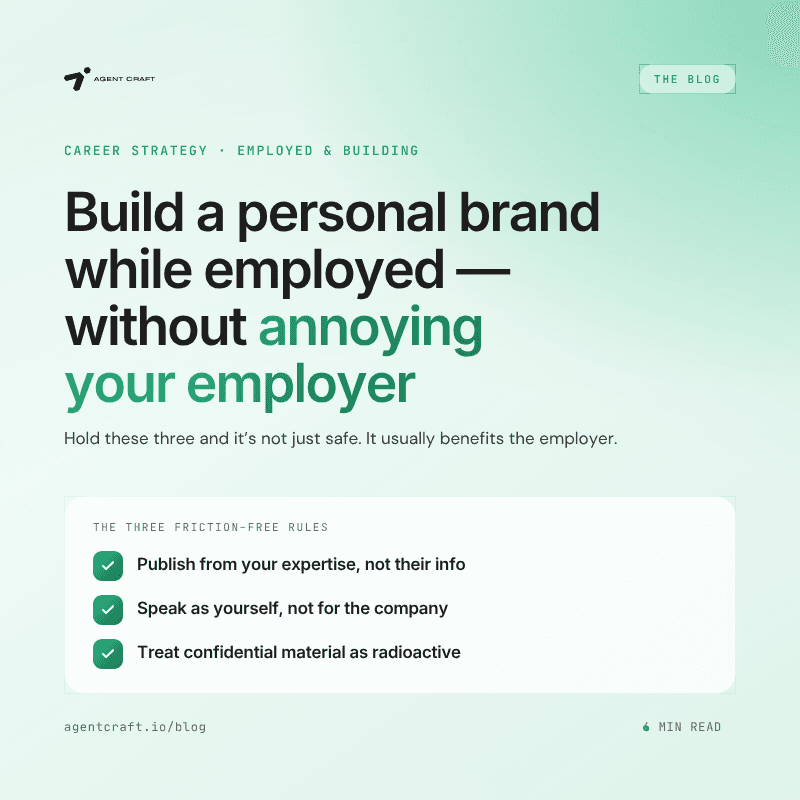
How to Build a Personal Brand While Employed (Without Friction)
Juan Mouton
VP Marketing
The rules that keep an employed personal brand friction-free are three: publish from your expertise rather than your employer's information, speak clearly as yourself rather than for the company, and treat confidential material as radioactive without exception. Hold those three and the arrangement is not merely safe, it usually benefits the employer, which is why so many companies now actively encourage it. The anxiety most employed professionals feel about this is directional, worrying about the wrong risks, so it is worth mapping where the real lines sit.
The reframe: your expertise is yours
The uneasy feeling that publishing professionally is somehow disloyal rests on a confusion between two different assets. Your employer owns its information: strategy, numbers, client identities, unannounced plans, internal drama. You own your craft: the judgment, patterns, and lessons accumulated across your whole career, of which this job is one chapter. Publishing from the second is not leakage from the first. A supply chain VP writing about supplier-risk patterns is spending her own asset; she would hold those views at any employer, and holding them visibly is what makes her valuable to this one.
That distinction, information versus craft, resolves most cases on its own. When a post idea comes up, ask which asset it draws on. Craft publishes. Information does not, ever, and not in disguise either: "a company I know recently discovered..." fools nobody in your industry when the timeline matches.
The three rules, in practice
Stay in the lane of your expertise. Write about your function and field, the things you would discuss on a conference panel. Steer wide of your employer's competitive posture, commentary on rivals, and anything reading as a company position on public controversy. The panel test is a reliable line: if you would say it on stage at an industry event with your affiliation on the name card, it publishes.
Own the voice explicitly. Your profile can and should name your role, but your content speaks as you. Never announce for the company, never scoop its news even positively, and never let a post read as an official statement. Where ambiguity is possible, a plain "views mine" disclaimer costs nothing. The failures in this category are almost all accidental spokesmanship: the enthusiastic post about an unannounced launch, the hot take that screenshots as "Meridian executive says."
Treat confidential as radioactive. Numbers, clients, colleagues, plans, and anything under NDA. When a story needs telling, anonymize it properly: names become company types, figures become ranges, timelines blur. Proper anonymization is a skill worth building because your best material lives behind it, and done well it protects everyone while keeping the lesson intact.
Check the policy, then relax
Many companies have a social media policy; read yours once, and if one does not exist, the three rules above are stricter than any policy you are likely to encounter. If your role is unusually sensitive, listed-company officer, regulated function, one conversation with whoever owns communications buys permanent peace. Most people who have that conversation discover the company is actively pleased: visible, credible employees are recruiting collateral and market presence the employer gets for free.
Which is the quiet second half of this arrangement: it is not a favor you are extracting. Employers benefit from employees with standing, right up until the day the employment ends, and the equity you built under your own name walks out with you. That is the entire point, and it is entirely legitimate: you are converting years of craft into a reputation that no restructuring can delete. The professionals who feel guilty about this are typically the ones who least need to; the guilt tracks conscientiousness, not risk.
The starting cadence for the cautious
If the whole area still feels exposed, start in the lowest-risk register and let evidence recalibrate the anxiety. Weeks one and two: genuine comments on others' work in your field, which builds presence with zero authorship risk. Weeks three and four: one observational post from craft, a pattern or a lesson, nothing about the current employer at all. From there, one post a week. Within a month the anticipated awkwardness has usually failed to arrive, a colleague has said something kind, and the calibration is done.
Where Agent Craft sits in this
Agent Craft is built for the employed case. Drafts come only from your own spoken material, which keeps content in the craft lane by construction, and every post passes your approval before anything publishes, on LinkedIn, X, TikTok, or YouTube. The strategy layer holds your lane and your boundaries as standing rules rather than weekly willpower. The equity accrues under your name, which was the entire point of the exercise.
Frequently asked questions
Can my employer stop me from posting on LinkedIn?
Policies govern confidential information, speaking for the company, and some regulated roles; they very rarely restrict publishing your own professional expertise. Read your policy once, then apply the stricter personal rules above.
Should I tell my employer I am building a personal brand?
Usually unnecessary if you follow the three rules, though in sensitive roles one short conversation with communications buys permanent comfort. Most employers respond positively; visible employees serve them too.
What should employed professionals never post?
Confidential numbers and plans, client and colleague identities, commentary on the employer's competitors, and anything that reads as speaking for the company. Everything drawn from your own craft remains yours to publish.
Share
Related Articles
How to Build a Personal Brand on LinkedIn From Zero (2026)
The sequence from zero is four steps in strict order: position (decide what you want to be known for), optimize (make your profile findable and legible), publish (put real thinking in public on a weekly rhythm), and engage (be present in the conversations around your subject). Run them in order because each one wastes without the one before it: publishing without a position produces noise, and a beautiful profile nobody arrives at is a brochure in a drawer. The honest timeline for the whole arc is a quarter, and the quarter is non-negotiable in a way this post will be specific about, because the timeline is where zero-starters actually fail.
How to Turn a Voice Note Into a Week of LinkedIn Content, By Hand
The method is this: record yourself talking for two minutes about something you know, transcribe it, find the two or three posts hiding inside the rambling, give each one a hook, cut it to length, format it for LinkedIn, re-form it for X if you use both, and schedule the lot. The two minutes of talking produce the whole week's raw material. The desk work after the talking takes about forty-five minutes per post. This post walks every step so you can run the entire method yourself, with the honest timing attached to each.
Personal Branding for Consultants: Turning Expertise Into Inbound
For a consultant, personal branding reduces to one move: showing your thinking in public, because your thinking is the product and buyers cannot want what they have not seen. Every other profession sells something separable from the person; consulting sells judgment, and judgment can only be evaluated by watching it operate. A consultant who publishes their reasoning is running free product demos at scale. A consultant who does not is asking strangers to buy an invisible service on the strength of a headshot, which is roughly the market's hardest sale, and explains most of the profession's cold-outreach misery.