
Created from a single voice note with Agent Craft
Two ways to make AI content. One works. The other keeps you stuck in…
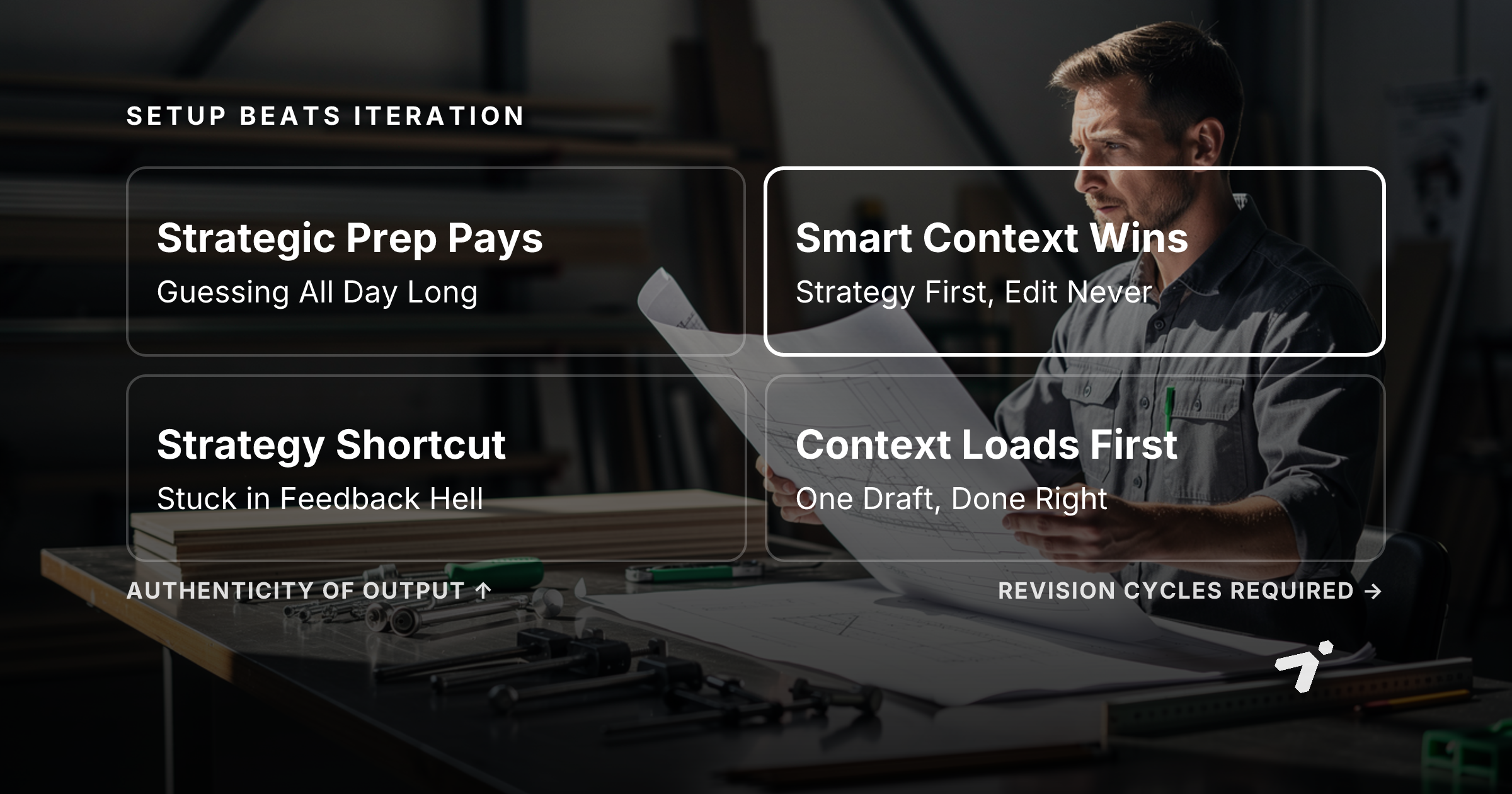
Two ways to make AI content. One works. The other keeps you stuck in a revision loop you'll grow to hate. Way one: paste a prompt, read the draft, fix what's off, paste again, repeat. You're the editor now. The tool guesses at your voice every single time because it knows nothing about you, your goals, or the campaign the post belongs to. Ten rounds later you have something passable and a wasted afternoon. Way two flips the order. Before a single post gets written, the brand voice, the DNA, the strategy, and the campaign goals are all loaded in. So when content gets generated, it pulls from every piece of that context at once. The first draft already sounds like you and already points at the goal. Nine times out of ten there's nothing to iterate on. That's the difference between a tool and a workflow, and it's why one exec told us he can't reliably tell his own writing apart from what Agent Craft produced for his personal brand. The setup does the heavy lifting so you don't. Which side of that would you rather live on?
More content from Agent Craft
- LinkedInLinkedIn bans people for AI signals in their posts, then ships its own native AI writing tools. Pick a lane. The platform blocks accounts for AI signals in comments, DMs, and posts. It locks down its API so nobody can create content programmatically. And then it builds AI writing straight into the product. So which is it? AI content is a threat worth banning people over, or a feature worth building into the product? Both, apparently. LinkedIn is trying to win both sides of the same argument. But the accounts LinkedIn treats as suspicious are often the ones doing the real work of turning a rough thought into something worth reading. The problem an executive actually has isn't whether a machine touched the draft. It's that the thought never leaves their head in the first place. I wanted a high-authority account for years. I knew it would be a valuable asset, the kind that follows you when you leave a company. But hiring a ghostwriter meant handing off the voice along with the work, and managing an agency meant adding another vendor relationship to an already full plate. The ideas were already there. What was missing was a way to get them down consistently, between meetings, without booking an afternoon for it. That friction used to be the whole game. It's solvable now. So when LinkedIn flags the tools people use to close that gap, it's punishing the exact thing that makes the feed worth reading. Every executive at a reasonably sized company should be publishing there. The barrier was never ability or ideas. It was getting the thoughts down. If your competitors are still staying quiet because a post might follow them into their next review, you already know what to do about it.
- TikTokThe old playbook, college, corporate job, pension, is gone. Here's what actually prepares you for what's coming. #ai #futureofwork #careertips #ainative #genz #agentcraft
- X (Twitter)Company six. The first five taught me one thing: talk to enough teams and they'll tell you where the real value is. I talked. I pivoted. Agent Craft is live. Juan Mouton, Fractional CMO preparing you for Series A Personal Brand Powered by Agent Craft
- TikTokThe cultural difference in how people react to your startup ambitions is very real. Some places back you. Some places… scratch your car. #startupculture #entrepreneurship #businessmindset #founders #startuplife #agentcraft
- BlueskyReid Hoffman called it: influence is the new currency. Anyone can ship a product now. Distribution is the hard part. So the executives who put their real insights on social will pull ahead of the peers who stay invisible. That's the whole game.
- FacebookA mentor recently gave the Agent Craft team high praise for the Claude AI workflow behind the platform. Nice to hear. But the feedback that actually matters comes from the people running businesses who use it. Take the manufacturing company that reached out to us. They'd been paying an agency to handle their social accounts, and the results spoke for themselves: a handful of followers per platform, no engagement worth mentioning, and posts that read exactly like what they were. Ads. Nobody wants to follow an ad. Their founders and executives had real opinions and real expertise. None of it was showing up online, because getting busy leaders to sit down and write content almost never happens. So they switched to Agent Craft. The executives record short voice notes tied to a campaign, and the platform turns those into content that sounds like them. Not generic filler. Their actual takes, shipped across multiple channels every week instead of one or two posts scraped together. The content quality jumped. The people behind the company finally sounded like themselves. That's the part we care about. What would your team's real voice sound like if it made it online consistently?