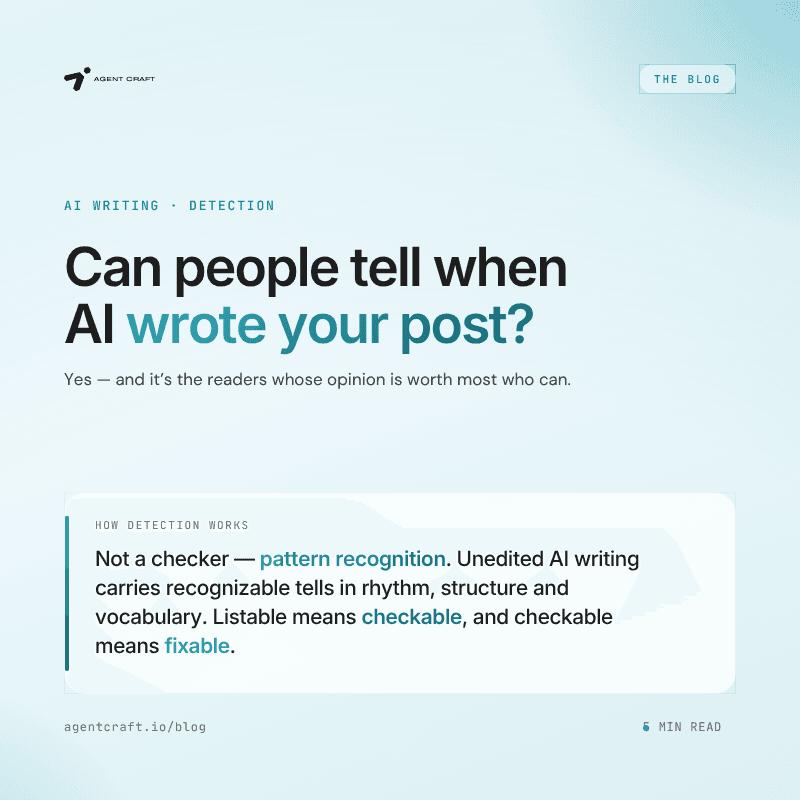
Can People Tell When AI Wrote Your LinkedIn Post? Yes. Here's How
Juan Mouton
VP Marketing
Yes, sophisticated readers usually can, and they are precisely the readers whose opinion of you is worth anything. Detection does not work the way people imagine, no one is running your post through a checker; it works by pattern recognition, because unedited AI writing carries a set of recognizable tells, habits of rhythm, structure, and vocabulary that repeat across millions of posts. Readers who spend time in professional feeds have absorbed the pattern the way you absorb any dialect, and once absorbed it cannot be unheard. The tells are listable, which is good news: listable means checkable, and checkable means fixable. Here is the list, why it matters more the more senior you are, and where the actual fix lives.
The tells, collected
The rhythm tells: the em dash everywhere, splicing clauses the writer could not commit to punctuating; the parallel triad ("faster, smarter, and more effective") deployed with metronomic reliability; sentence lengths so evenly varied they feel conducted.
The structure tells: the negation reframe ("It's not about X. It's about Y."), which has become the single loudest AI signature on the platform; the setup opener that clears its throat before saying anything; the tidy moral summarizing a post that was already clear; section-perfect symmetry no human drafting under time pressure produces.
The vocabulary tells: game-changer, deep dive, unlock, leverage as a verb, delve, elevate, seamless, "in today's fast-paced world," and the whole lexicon of words that mean nothing but sound like meaning. Each is survivable alone. In clusters they are a fingerprint.
The substance tell, which outranks all the others: nothing in the post that only this person could know. No number that surprised anyone, no step everyone skips, no client conversation with fingerprints on it. Generic machinery produces generic cargo, and readers register the absence of lived detail even when they cannot name a single stylistic tell. This is the detection that matters, because it survives even careful editing of the surface.
Why detection costs senior people more
For a junior poster, a detected AI post costs a shrug. For an executive, founder, or consultant, the cost compounds through what the reader infers, and the inference is brutal in its logic: this person's entire value is their judgment, they chose to publish judgment-shaped content containing none of theirs, and they assumed I would not notice. Three messages in one post: the thinking is outsourced, the standards are low, and the audience is underestimated. Sophisticated readers rarely comment on it. They just quietly reclassify the byline, and reclassification is silent, permanent, and invisible in your analytics, which will show a perfectly normal post that cost you standing you cannot see.
The fix is input, not prompting
The instinctive fix, better prompts, more "write in a casual professional tone," attacks the wrong layer. Prompted-from-nothing content is generic because the machine was given nothing but the request, so it returns the consensus of everything it has read, which is by definition what everyone sounds like. Style instructions repaint the consensus; they cannot add what was never supplied.
The fix that works is supplying the thing detection actually checks for: your material. Your spoken explanation of the problem you solved this week contains your phrasing, your emphasis, your specifics, the exact cargo whose absence is the deepest tell. Content built from your own raw material passes the substance check natively, and the surface tells become a mechanical edit: strip the em dashes, kill the triads, delete the reframes, cut the vocabulary list. In that order of importance, too. A post with real cargo and one stray "leverage" survives. A post with flawless style and no fingerprints does not.
The self-check
Two passes on your last five posts, ten minutes. Pass one, the swap test: change the byline to anyone in your field and see if anything breaks; if nothing breaks, the post fails regardless of who or what wrote it, which is the honest point, this was never really about AI, AI just industrialized a genericness humans were already producing by hand. Pass two, the tell scan: count em dashes, triads, negation reframes, and lexicon words. More than a couple per post and you are wearing the uniform, whatever your process was.
Where Agent Craft sits in this
Agent Craft was designed around the input position argued above: drafts are built only from your own spoken material, never a cold prompt, and every draft is screened against the tell list before you see it, because we treat could-have-come-from-anyone as a defect. The strategy layer keeps the substance yours; the screen keeps the surface clean, across LinkedIn, X, TikTok, and YouTube. The checklist is free and works on any content from any source. Ours included, which is rather the point.
Frequently asked questions
How can you tell if a LinkedIn post was written by AI?
Clustered tells: em dashes everywhere, parallel triads, the "it's not X, it's Y" reframe, hollow vocabulary like game-changer and delve, and above all the absence of any detail only the author could know. One tell means little; clusters are a fingerprint.
Does it matter if people can tell?
For senior professionals, materially: readers infer outsourced thinking and low standards, and quietly discount the byline. The cost never appears in analytics, which makes it easy to keep paying.
How do I use AI without it being obvious?
Change the input, not the prompt: build content from your own spoken or written raw material so it carries your specifics natively, then edit out the surface tells. Style instructions alone repaint generic; they cannot make it yours.
Share
Related Articles
LinkedIn Profile Optimization for Executives: Field by Field
An executive profile has one job: when someone arrives checking you out, a recruiter, an investor, a board member, an acquirer running quiet diligence, it answers their question in seconds and gives them a reason to keep reading. Optimizing it is a single afternoon's work, done field by field in priority order: headline, About, experience, banner and photo, featured, skills. Each field below comes with the characteristic executive mistake and its fix, because at senior levels the profiles are rarely empty. They are full of the wrong register: written for the org chart instead of for the stranger deciding whether to trust you.
Does AI-Generated Content Hurt Your Reach on LinkedIn?
AI-generated content hurts your reach when it is detectably generic, and the mechanism requires no inside knowledge of any algorithm to understand: feeds distribute what earns genuine engagement, readers disengage from content that reads like everyone else's, and unedited AI output reads like everyone else's by construction, because it is built from the average of everything. The damage, in other words, arrives through your audience before it arrives through any ranking system, which also points at the real fix: the question was never "AI or not AI." It is whether the post could have come from anyone, and that question has the same answer mechanics whether a machine or a tired human produced the genericness.
Building in Public: What to Share and What to Keep
The rule set fits in one line: share lessons and process, keep leverage and other people's confidences. Building in public, narrating the real construction of a company or a career as it happens, is the highest-trust content format available, because watching someone decide under uncertainty is a due-diligence process no marketing survives. But the format has failure modes that its cheerleaders skip past, and they all trace to the same error: sharing the wrong category of thing. The categories are knowable in advance, which is what this post is for, the sharing rules, the failure modes, and a decision test that resolves the ambiguous cases in ten seconds.