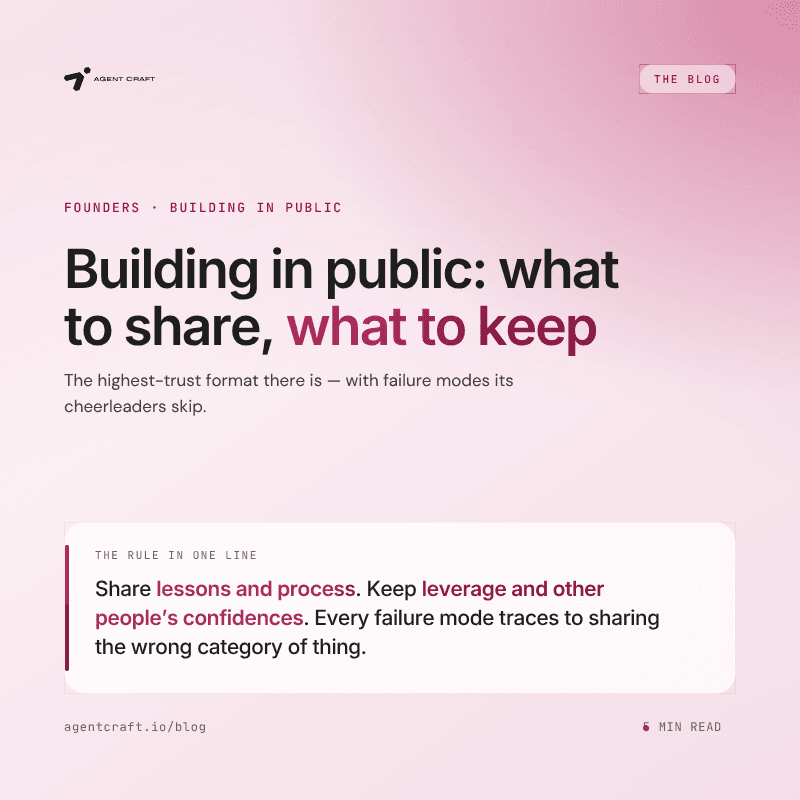
Building in Public: What to Share and What to Keep
Juan Mouton
VP Marketing
The rule set fits in one line: share lessons and process, keep leverage and other people's confidences. Building in public, narrating the real construction of a company or a career as it happens, is the highest-trust content format available, because watching someone decide under uncertainty is a due-diligence process no marketing survives. But the format has failure modes that its cheerleaders skip past, and they all trace to the same error: sharing the wrong category of thing. The categories are knowable in advance, which is what this post is for, the sharing rules, the failure modes, and a decision test that resolves the ambiguous cases in ten seconds.
Why the format works at all
The trust mechanism deserves one paragraph, because it explains the rules. Polished content shows outcomes; building in public shows judgment operating, the decision weighed, the trade-off named, the mistake owned, the revision made, and judgment operating is the exact thing every buyer, hire, investor, and partner is trying to assess before they commit. A year of watching someone build honestly answers questions no case study can, which is why in-public builders accumulate belief at a rate polished accounts cannot match. The corollary sets up everything below: the value comes from honesty about process, which means the format's power and its risks come from the same source, and managing the risk without killing the honesty is the entire craft.
Share freely: the four green categories
Lessons, especially paid-for ones. What went wrong, what it cost, what changed after. The failure-first material is the highest-trust content in the genre, because it is the hardest to fake and the most useful to the reader.
Process and reasoning. How you priced, how you chose the market, what you weighed in the hire, why you killed the feature. Reasoning is the judgment-display the format runs on, and sharing it costs almost nothing competitively, since reasoning without your context is education, not a blueprint.
Open questions. What you are deciding right now, genuinely unresolved. The student register, and the format's most engaging move, since it invites the audience into the build rather than narrating at them.
Numbers you have decided are strategic to share. Some builders publish revenue, growth, or churn deliberately, and it works when it is a decision with a purpose, credibility, accountability, category-building, rather than a default. The key word is decided: chosen numbers, chosen cadence, chosen stopping point, all in advance.
Keep: the three red categories
Leverage. Anything an active counterparty could use against you: negotiation positions, upcoming moves before they are secured, the pipeline mid-deal, weaknesses a competitor could exploit this quarter, anything mid-fundraise. The test for leverage is specific: is someone currently, or imminently, on the other side of a table where this information changes the terms? Then it waits, usually just until the table clears, at which point it converts into a green-category lesson. Most leverage is temporary; the story is patient.
Other people's confidences. Clients, employees, investors, partners: their identities, their numbers, their conflicts, their exits, none of it is yours to spend, and the in-public builders who burn this category burn the trust the format was building. The anonymized composite, names to company types, numbers to ranges, timelines blurred, keeps the lesson and returns the confidence, and doing it honestly, facts removed rather than invented, is a core skill of the genre.
The undecided-as-decided. Announcing directions still in flux reads as momentum and manufactures a public commitment you may need to walk back, which converts a normal pivot into a visible reversal. Share the deciding, which is a green-category open question, not the premature decision.
Where it goes wrong, beyond the categories
Two drift patterns, both about the format consuming its user. The performance drift: the narration starts shaping the decisions, choices made because they will post well, milestones manufactured for the feed, and at that point the format has inverted, you are no longer building in public, you are performing a build. The tell is dread: if a business decision is being influenced by its announceability, the audience has become a stakeholder it was never meant to be. And the confession drift: honesty escalating into oversharing, the founder-as-content sliding into the founder's mental state as content, which reliably reads as instability to exactly the buyers and backers the honesty was meant to reassure. The format wants a professional builder being honest, not a diary with a company attached.
The ten-second decision test, for every ambiguous case: is this mine to share, is it settled or clearly framed as unsettled, and would I be comfortable with a counterparty, a competitor, and a future acquirer all reading it this quarter? Three yeses ships. Anything else waits, and waiting is usually all it takes, since today's red leverage is next quarter's green lesson.
Where Agent Craft sits in this
Agent Craft runs building in public as a sustainable practice rather than a willpower project. The week's decisions and lessons get captured in two-minute voice notes and come back as drafted posts in your voice, anonymization handled, positioning enforced by the Brand Book, published across LinkedIn, X, TikTok, and YouTube. The red-category judgment, what is leverage, what is someone else's, what is not yet settled, stays yours on every draft, gated by your approval before anything ships. And the belief the building accumulates lands somewhere useful: the personal brand CRM collects the inbound it produces, qualifies it, and nurtures it by email. Build the thing. Narrate it honestly. The system carries the narration.
Frequently asked questions
What should you share when building in public?
Lessons including failures, your reasoning and process, genuinely open questions, and any numbers you have strategically decided to publish. The common thread is honesty about judgment, which is what the format's trust runs on.
What should you never share when building in public?
Active leverage (anything a current counterparty could use), other people's confidences (clients, employees, investors), and undecided directions framed as decisions. Most of it is temporary: leverage becomes lesson once the table clears.
Does building in public help get customers?
Yes, through pre-sold trust: watching someone build and decide honestly over months is diligence the buyer runs on you before ever making contact. The inbound arrives already believing, which changes every conversation after it.
Share
Related Articles
LinkedIn Profile Optimization for Executives: Field by Field
An executive profile has one job: when someone arrives checking you out, a recruiter, an investor, a board member, an acquirer running quiet diligence, it answers their question in seconds and gives them a reason to keep reading. Optimizing it is a single afternoon's work, done field by field in priority order: headline, About, experience, banner and photo, featured, skills. Each field below comes with the characteristic executive mistake and its fix, because at senior levels the profiles are rarely empty. They are full of the wrong register: written for the org chart instead of for the stranger deciding whether to trust you.
Why Your LinkedIn Posts Get No Reach (and What Fixes It)
When your posts consistently get no reach, the cause is almost always one of four things: the content is generic enough to be skippable, your subject matter is too scattered for anyone to know what you are for, your openings fail before the substance arrives, or you are measuring the wrong thing and the reach is actually fine. Each has a distinct signature and a distinct fix, and none of them is the fix people reach for first, which is posting more. Volume multiplies whatever is already true, so diagnose before you scale.
How to Write LinkedIn Hooks: The Four Formats That Work
A hook is the first line or two of a post, and it has exactly one job: make the next line necessary. Nearly every hook that works is one of four formats: the dense hook (a complete provocative claim), the punchy-plus-context hook (a short jab followed by one grounding line), the single-line bomb (one sentence, standing alone), or the stacked list (three or four parallel fragments building to a turn). Below are all four with their rules, ten worked examples, and the banned moves, because hooks fail by formula more often than they fail by weakness, and the formulas that kill them are recognizable.