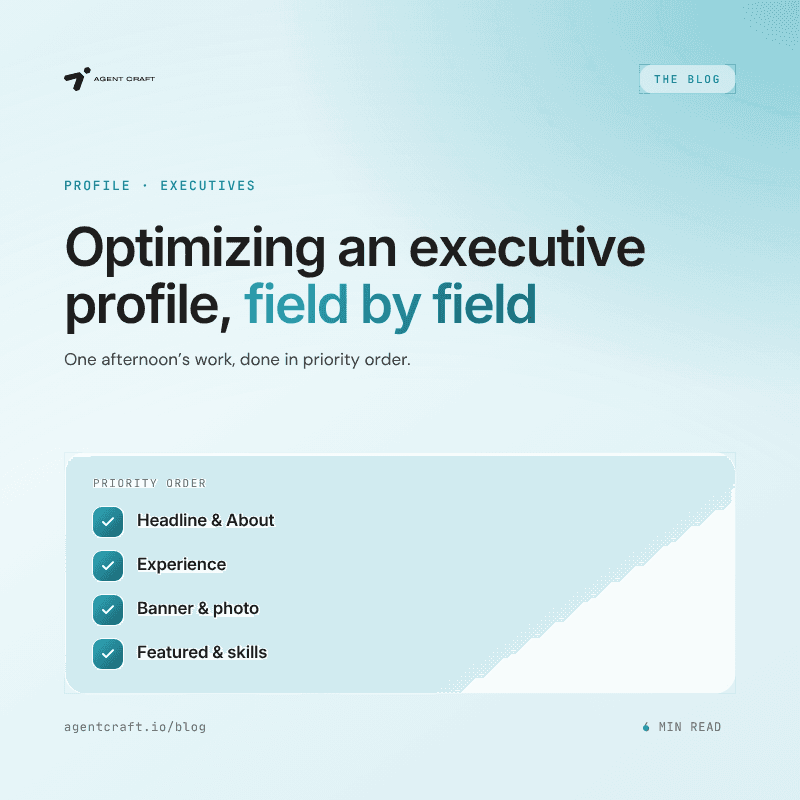
LinkedIn Profile Optimization for Executives: Field by Field
Juan Mouton
VP Marketing
An executive profile has one job: when someone arrives checking you out, a recruiter, an investor, a board member, an acquirer running quiet diligence, it answers their question in seconds and gives them a reason to keep reading. Optimizing it is a single afternoon's work, done field by field in priority order: headline, About, experience, banner and photo, featured, skills. Each field below comes with the characteristic executive mistake and its fix, because at senior levels the profiles are rarely empty. They are full of the wrong register: written for the org chart instead of for the stranger deciding whether to trust you.
Headline: the twenty-minute rewrite
The mistake: the title plate. "Chief Operating Officer, Meridian Group" is accurate, dignified, and useless to every search and every skimmer, because it describes your position rather than your value. The fix: what you do, for whom, in words your market searches, front-loaded, with the title demoted to the rear. "Operations leader | I untangle companies that grew faster than their systems | COO, Meridian" survives truncation, matches searches, and tells the arriving stranger what to hire you for. This field repays more per minute than anything else on the profile; if the afternoon collapses to twenty minutes, spend them here.
About: the first two lines decide it
The mistake: the third-person career summary, the one that opens "A seasoned executive with over twenty years of experience across..." and loses the reader at "seasoned." Nobody senior enough to check you out reads past that opening, because it is the sound of a profile written to impress no one in particular. The fix: first person, and a first line that states who you help and with what. Then three short movements: the problem you are known for solving, the evidence (two or three outcomes with numbers or named scale), and what you are focused on now. Two hundred words total is plenty. The About is not your biography; it is the answer to "why am I looking at this person," delivered before the reader has to work for it.
Experience: outcomes, not custody
The mistake: responsibility inventories. "Oversaw global commercial function, managing a team of 200" describes what you were in charge of, which every reader knows is not the same as what happened because you were there. The fix: each role gets two to four outcome lines, what changed, in what direction, at what scale, written with the domain words your market searches. "Repriced the core portfolio; expansion revenue became the largest growth line" carries evidence and search terms in one sentence. Senior readers, who have written enough performance reviews to know the difference, read responsibility language as evasion whether or not it is.
Photo and banner: the two-minute credibility check
The mistake: neglect, the twelve-year-old photo, the default blue banner, which reads as absence, and absence reads as a person not alive to their own presence. The fix clears a low bar: a current, well-lit photo that looks like the person who will show up to the meeting, and a banner that says something, a line of positioning, an affiliation, even a clean brand color. Nobody was ever hired for their banner; people are quietly discounted for the default one.
Featured: curate the diligence file
The mistake: leaving it empty, or letting it hold whatever got pinned in 2023. The fix: treat Featured as the exhibit list for your quiet diligence process. Three to five items, refreshed quarterly: your best piece of visible thinking, a talk or interview, something that proves the headline's claim. The person deciding whether to trust you will click at most two things; choose which two.
Skills: ten unfashionable minutes
The mistake: fifty accumulated skills, half from a previous career, none curated. The fix: prune to the terms your market actually searches, lead with the ones that match your headline's claim, and stop. This field is nobody's favorite and it is indexed all the same; ten minutes of weeding is free coverage.
The pass, sequenced, and the maintenance clause
The afternoon in order: headline (20 minutes), About (45), experience for the last two or three roles (45), photo and banner (as needed), Featured (15), skills (10). Then the clause that makes it durable: profiles go stale silently, so the pass repeats in miniature quarterly, headline still true, About still current, Featured still your best. A profile is not a document. It is a surface, and surfaces need wiping. One honest limit to close on: a perfect profile is a well-labeled door, and the diligence reader who arrives will also look for what is behind it, your visible thinking, your activity, your record. The profile gets you considered. The record gets you trusted. Optimize the first this afternoon, and start the second this week.
Where Agent Craft sits in this
The pass above is manual, free, and finished by dinner; do it regardless of what you buy. Agent Craft's territory is the closing sentence's second half, the record behind the door: your spoken thinking becomes the consistent visible evidence the optimized profile points to, in your voice, across LinkedIn, X, TikTok, and YouTube, guided by a strategy layer that knows what the diligence reader is looking for. An excellent profile in front of an empty record is a lovely door to an unfurnished room. We furnish rooms.
Frequently asked questions
What is the most important part of a LinkedIn profile for executives?
The headline, then the first two lines of About: they are what searches match and what arriving readers judge in seconds. Both are rewritable in under an hour.
How should executives write their About section?
First person, opening with who you help and with what, followed by the problem you solve, two or three concrete outcomes, and your current focus. Two hundred words; no third-person summaries.
How often should I update my LinkedIn profile?
A full pass once, then a quarterly fifteen-minute check: headline still accurate, About still current, Featured still your best material. Profiles decay silently; the maintenance is small and the neglect is visible.
Share
Related Articles
Can People Tell When AI Wrote Your LinkedIn Post? Yes. Here's How
Yes, sophisticated readers usually can, and they are precisely the readers whose opinion of you is worth anything. Detection does not work the way people imagine, no one is running your post through a checker; it works by pattern recognition, because unedited AI writing carries a set of recognizable tells, habits of rhythm, structure, and vocabulary that repeat across millions of posts. Readers who spend time in professional feeds have absorbed the pattern the way you absorb any dialect, and once absorbed it cannot be unheard. The tells are listable, which is good news: listable means checkable, and checkable means fixable. Here is the list, why it matters more the more senior you are, and where the actual fix lives.
Building in Public: What to Share and What to Keep
The rule set fits in one line: share lessons and process, keep leverage and other people's confidences. Building in public, narrating the real construction of a company or a career as it happens, is the highest-trust content format available, because watching someone decide under uncertainty is a due-diligence process no marketing survives. But the format has failure modes that its cheerleaders skip past, and they all trace to the same error: sharing the wrong category of thing. The categories are knowable in advance, which is what this post is for, the sharing rules, the failure modes, and a decision test that resolves the ambiguous cases in ten seconds.
What Makes a Good LinkedIn Headline (With 10 Examples)
A good LinkedIn headline says what you do, for whom, in the words your market would search, front-loaded, inside the 220-character limit. That is the entire formula, and almost nobody's headline follows it, because the default habit is to use the field as a title plate: role, company, done. A title plate wastes the most-read line you own. Your headline travels everywhere your name does, search results, comment threads, connection requests, other people's notifications, and in most of those places it is truncated to its first few words, which is why the front-loading matters as much as the content. Below: the formula unpacked, ten before-and-afters, and the four mistakes that account for most weak headlines.