How Recruiters Actually Find Executives on LinkedIn
Juan Mouton
VP Marketing
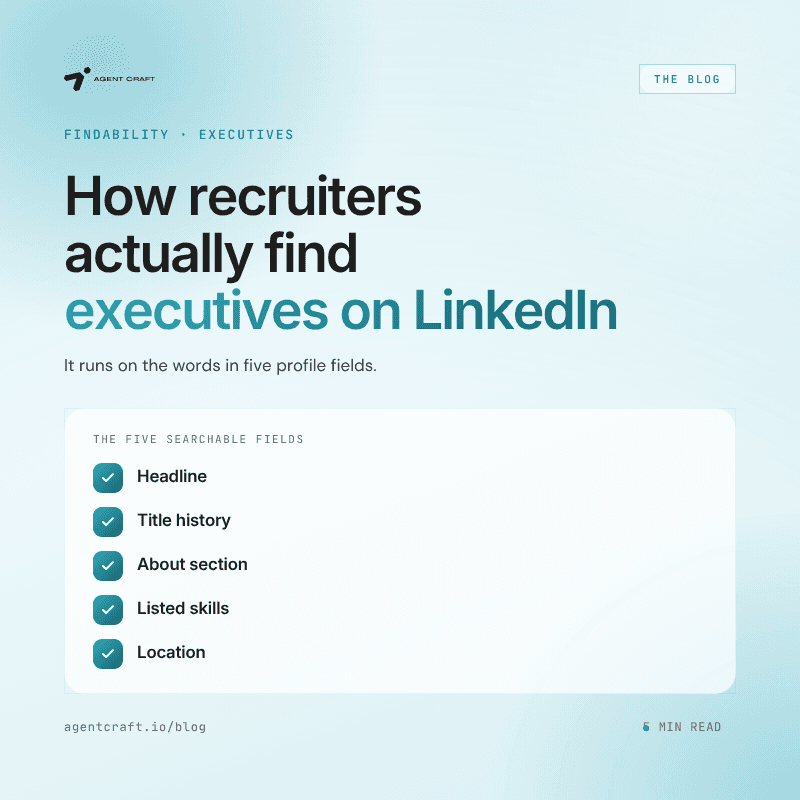
Recruiters find executives by searching, and the search runs on words in a handful of profile fields: your headline, your title history, your About section, your listed skills, and your location. If the words a recruiter would type do not appear in those fields, you do not surface, no matter how good you are at the thing they are searching for. That is the entire mechanism, and it means executive findability is less about fame and more about vocabulary: describing yourself in the words your market uses rather than the words your business card uses.
The search, from the recruiter's side
Picture the workflow. A search brief says something like "commercial leader, B2B SaaS, pricing and expansion experience, EMEA." The recruiter translates that into keyword searches and filters, runs them, and works the first pages of results. Two consequences fall out of this picture immediately.
First, they search the brief's language, not yours. If the brief says "pricing" and your profile says "commercial value architecture," you are invisible to that search while a less qualified peer who wrote "pricing strategy" surfaces. Jargon is a findability tax, and internally coined titles are the most expensive jargon of all.
Second, they read at speed. What surfaces gets seconds of evaluation: headline, current role, the first lines of About. The fields that got you found are also the fields that get you shortlisted or skipped, which is why they repay disproportionate care.
The fields, in priority order
Headline. The highest-weight real estate on the profile and the site of the classic executive mistake: using it as a title plate. "SVP Operations at Meridian Group" tells a searcher nothing they can search. The fix is a headline that says what you do, for whom, in market vocabulary: the function, the domain, the scale, the specialty. Titles are for org charts; headlines are for searches.
About, especially the first two lines. Searchable in full, but skimmed in preview. First line: who you help and with what. If the opening reads like a career summary written in the third person, the seconds are spent before the substance arrives.
Experience entries. Each role is a keyword surface. Written as responsibilities ("oversaw commercial function") they carry little; written as outcomes with domain words ("repriced the core portfolio, expansion revenue became the largest growth line") they carry both search terms and evidence at once.
Skills. Unfashionable and still indexed. Ten minutes of pruning to the terms your market actually searches is free coverage.
Activity. Not a search field, but the tiebreaker. Between two comparable surfaced profiles, the one with visible recent thinking wins the message, because it answers the question the recruiter is really asking: is this person alive to their field right now.
The self-check that almost nobody runs
Open LinkedIn search and type what a recruiter filling your next role would type: the function, the specialty, the market. See whether you appear, and see who does. The executives who outrank you are rarely more senior; they are more literally worded. Most senior people have never once run this search on themselves, which is odd, given that it is the exact search their next opportunity runs.
Then the second check: read your own headline and ask whether a stranger could tell, from it alone, what to hire you for. If the honest answer is no, the twenty-minute rewrite is the highest-return career action available this week.
The part search cannot see
One honest limit. Search finds the findable, but senior hiring also moves through reference and reputation, people asking people. Your profile decides whether the formal channel surfaces you; what you have said in public decides what the informal channel finds when it goes checking. The two compound: the findable profile gets you into the process, and the visible thinking survives the diligence. Building only the first is answering half the exam.
Where Agent Craft sits in this
The profile pass above is an afternoon of your own work; do the headline today. Agent Craft builds the second half of findability, the record behind the door: voice notes become the visible thinking that survives the informal check, published in your voice across LinkedIn, X, TikTok, and YouTube, with a strategy layer built on the same field logic this post describes. The recruiter's search finds the profile. The record is what convinces them to send the message.
Frequently asked questions
How do executive recruiters search LinkedIn?
By keyword and filter against a search brief: function, domain, scale, market. Profiles surface on the words in their headline, About, experience, and skills, then get evaluated in seconds.
What should an executive put in their LinkedIn headline?
What you do, for whom, in the words your market searches: function, domain, and specialty. A bare title and company name is the single most common findability mistake at senior levels.
Why am I not being found by recruiters?
Usually vocabulary: the profile describes your work in internal or invented language rather than the market's search terms. Run the search a recruiter would run and compare your wording to whoever surfaces.
Share
Related Articles
Building in Public: What to Share and What to Keep
The rule set fits in one line: share lessons and process, keep leverage and other people's confidences. Building in public, narrating the real construction of a company or a career as it happens, is the highest-trust content format available, because watching someone decide under uncertainty is a due-diligence process no marketing survives. But the format has failure modes that its cheerleaders skip past, and they all trace to the same error: sharing the wrong category of thing. The categories are knowable in advance, which is what this post is for, the sharing rules, the failure modes, and a decision test that resolves the ambiguous cases in ten seconds.
Personal Branding for Fractional Executives: Visible Between Roles
For a fractional executive, reputation is the pipeline between engagements, and it is close to the only one, because the fractional market runs almost entirely on trust: nobody hires a part-time CFO or CMO from a cold advertisement, they hire the person whose judgment they have already watched or whose name arrived through someone who has. That makes visibility a structural requirement of the business model rather than a marketing preference, and it makes the between-engagements gap, the months when the current contract ends and the network has gone quiet, the fractional operator's characteristic failure mode. The fix is a publishing practice that runs through engagements, not after them, and it is more compatible with NDA-heavy work than most fractionals assume.
What Makes a Good LinkedIn Headline (With 10 Examples)
A good LinkedIn headline says what you do, for whom, in the words your market would search, front-loaded, inside the 220-character limit. That is the entire formula, and almost nobody's headline follows it, because the default habit is to use the field as a title plate: role, company, done. A title plate wastes the most-read line you own. Your headline travels everywhere your name does, search results, comment threads, connection requests, other people's notifications, and in most of those places it is truncated to its first few words, which is why the front-loading matters as much as the content. Below: the formula unpacked, ten before-and-afters, and the four mistakes that account for most weak headlines.