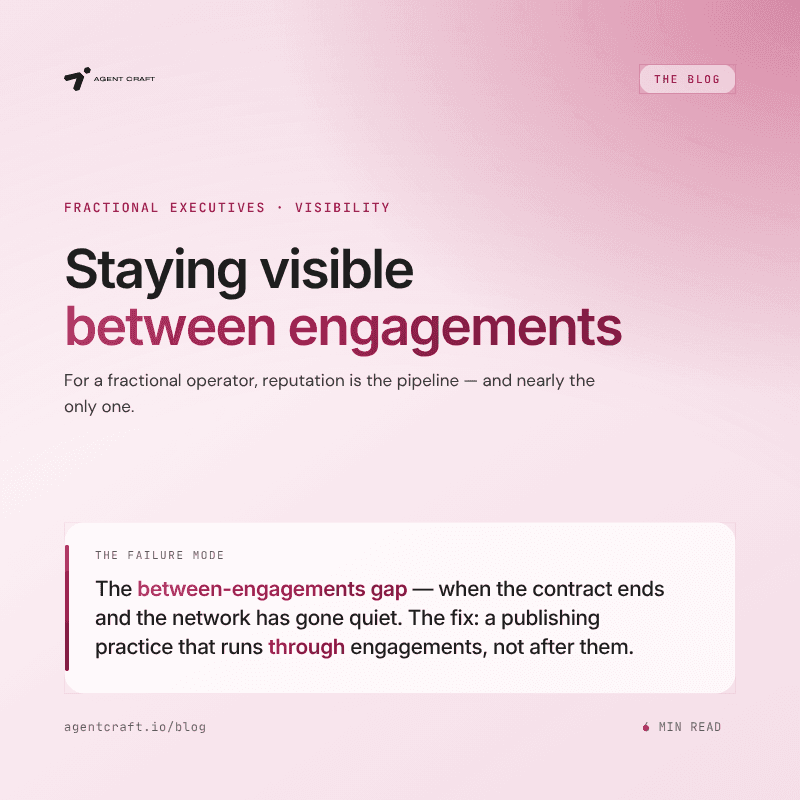
Personal Branding for Fractional Executives: Visible Between Roles
Juan Mouton
VP Marketing
For a fractional executive, reputation is the pipeline between engagements, and it is close to the only one, because the fractional market runs almost entirely on trust: nobody hires a part-time CFO or CMO from a cold advertisement, they hire the person whose judgment they have already watched or whose name arrived through someone who has. That makes visibility a structural requirement of the business model rather than a marketing preference, and it makes the between-engagements gap, the months when the current contract ends and the network has gone quiet, the fractional operator's characteristic failure mode. The fix is a publishing practice that runs through engagements, not after them, and it is more compatible with NDA-heavy work than most fractionals assume.
The visibility problem nobody names
The fractional model has a quiet contradiction built in. During engagements you are effectively invisible: heads-down inside one or two clients, often under confidentiality, doing work whose excellence exactly nobody outside can see. Then the engagement ends, and the pipeline you need was supposed to have been built during the months you were invisible. Full-time executives can coast on an employer's brand between moves; agencies have a firm name that persists; the fractional has only their personal standing, and standing decays on the standard schedule whether or not you were busy. The result is the fractional sawtooth: excellent work, quiet exit, three cold months, repeat. It is the consultant's feast-and-famine wearing a nicer title, and it has the same structural fix: business development that compounds unattended, which in practice means published thinking.
What to publish when everything is under NDA
The standing objection, and the answer is that confidentiality constrains one format and leaves the best four untouched.
Patterns, which belong to you. The recurring diagnosis across your career, the mistake every second company in your function makes, the metric that lies: these are craft, accumulated across every seat you have held, and no NDA covers your craft. Pattern content is also the natural register of a fractional, whose entire pitch is having seen this movie at many companies.
The anonymized composite. A situation-shaped story with the identifiers stripped: names become company types, numbers become ranges, timelines blur, and where necessary two engagements blend into one teaching case. The lesson survives, the client is protected, and done honestly, with no invented facts, only removed ones, this covers most of your best material.
The stance. What your function's orthodoxy gets wrong, and what you do instead. Stances need no client detail at all, and for a fractional they do double duty: they are content, and they are the filter that pre-sorts your next clients toward people who already agree with how you work.
The open question. What you are currently working out about your craft, unresolved. Costs nothing confidential, reads as confidence, and keeps you visibly alive to your field during the deepest delivery weeks.
The one format confidentiality genuinely limits is the named case study, and the honest news is it was always the weakest of the five for building standing; specifics persuade, but patterns position.
The cadence that closes the gap
The arithmetic of the sawtooth is unforgiving: momentum takes roughly a quarter of consistent publishing, and the between-engagement gap is typically shorter than a quarter, which means visibility built after the engagement ends arrives after the gap it was meant to fill. The only version that works runs continuously: one post a week through the engagement, however deep the delivery, plus light presence in your field's conversations. That is the premium schedule, and it is deliberately minimal because it has to survive your busiest months, which is exactly when it matters most. The fractional who holds one-a-week through a nine-month engagement exits into a warm market. The one who went dark exits into the sawtooth, and pays the quarter's toll again.
There is a compounding bonus specific to this model: your published record is also your diligence file. Fractional hires are checked harder than full-time ones, precisely because the engagement is short and the trust must be fast, and a year of visible judgment answers the questions the buyer was going to ask someone anyway. You are not just staying warm between engagements. You are pre-answering the next one's interview.
Where Agent Craft sits in this
The one-a-week-through-delivery schedule above is precisely the schedule manual publishing fails, and it is the schedule Agent Craft was built to hold: spoken patterns captured between calls become posts in your voice across LinkedIn, X, TikTok, and YouTube, positioning enforced, confidentiality judgment left where it belongs, with you. Meanwhile the personal brand CRM keeps the between-engagement pipeline warm, collecting, qualifying, and nurturing the inbound your record produces. The next gap gets decided during this engagement. The system decides it in your favor.
Frequently asked questions
How do fractional executives get clients?
Overwhelmingly through reputation and referral: buyers hire fractional leaders whose judgment they have already seen or heard vouched for. Published thinking is the only pipeline that builds during engagements rather than after them.
What can I post when my work is under NDA?
Patterns from your career, anonymized composites with identifiers stripped, stances on your function's practices, and open questions about your craft. Confidentiality removes named case studies and little else.
How often should a fractional executive post?
One substantial post a week, held through engagements without exception. The cadence is minimal by design, because it must survive delivery-heavy months, which are exactly when the next gap is being decided.
Share
Related Articles
Building in Public: What to Share and What to Keep
The rule set fits in one line: share lessons and process, keep leverage and other people's confidences. Building in public, narrating the real construction of a company or a career as it happens, is the highest-trust content format available, because watching someone decide under uncertainty is a due-diligence process no marketing survives. But the format has failure modes that its cheerleaders skip past, and they all trace to the same error: sharing the wrong category of thing. The categories are knowable in advance, which is what this post is for, the sharing rules, the failure modes, and a decision test that resolves the ambiguous cases in ten seconds.
How Recruiters Actually Find Executives on LinkedIn
Recruiters find executives by searching, and the search runs on words in a handful of profile fields: your headline, your title history, your About section, your listed skills, and your location. If the words a recruiter would type do not appear in those fields, you do not surface, no matter how good you are at the thing they are searching for. That is the entire mechanism, and it means executive findability is less about fame and more about vocabulary: describing yourself in the words your market uses rather than the words your business card uses.
What Makes a Good LinkedIn Headline (With 10 Examples)
A good LinkedIn headline says what you do, for whom, in the words your market would search, front-loaded, inside the 220-character limit. That is the entire formula, and almost nobody's headline follows it, because the default habit is to use the field as a title plate: role, company, done. A title plate wastes the most-read line you own. Your headline travels everywhere your name does, search results, comment threads, connection requests, other people's notifications, and in most of those places it is truncated to its first few words, which is why the front-loading matters as much as the content. Below: the formula unpacked, ten before-and-afters, and the four mistakes that account for most weak headlines.