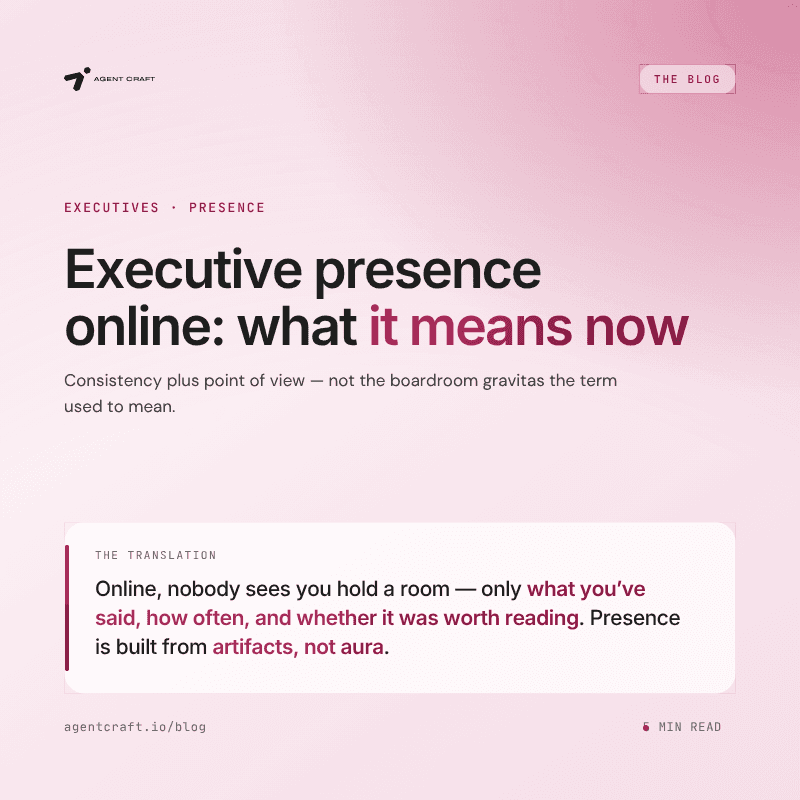
Executive Presence Online: What It Means Now
Juan Mouton
VP Marketing
Executive presence online is consistency plus point of view: being reliably findable, saying substantive things at a rhythm people can trust, and holding recognizable positions on your subject. That is the whole definition, and it is worth stating plainly because the term arrived carrying baggage from the physical world, where it meant bearing, gravitas, command of a room, and the translation is not what people assume. Online, nobody can see you hold a room. They can only see what you have said, how often, and whether it was worth reading, which means digital executive presence is built from artifacts rather than aura, and artifacts can be constructed deliberately.
What survived the translation, and what did not
The in-room version of presence ran heavily on performance: posture, voice, timing, the confidence signals a body gives off. Almost none of that transfers, and the attempts to transfer it are where online presence goes wrong, the keynote register in text form, pronouncements delivered as if from a stage nobody booked, the manufactured gravitas that reads as exactly what it is. Performance without a room is just posting in costume.
What did transfer is the underlying signal the room-presence was always a proxy for: this person has judgment, holds their ground, and is worth listening to. Online, that signal is carried by three observable things. Track record: a body of visible thinking someone can scroll back through, which is what boards, investors, and senior hiring processes actually check. Rhythm: presence at intervals reliable enough to register as steadiness rather than mood. And position: known views on your subject, held across months, engaged with when challenged. Judgment, steadiness, and conviction, in artifact form.
What builds it, specifically
A held lane. Presence attaches to a subject. The executive known for one domain, supply-chain resilience, pricing, the manager layer, has presence in it; the one commenting on everything has activity. Depth in a lane is what makes the scroll-back impressive rather than long.
The senior register: observation. Lessons from the work, patterns across a career, the question currently being worked out. This register carries presence natively because it is what seniority actually sounds like, pattern recognition delivered plainly, and it requires no performance at all. The open question deserves particular mention: publishing what you are still figuring out reads, counterintuitively, as the most senior move available, because only the secure can afford visible uncertainty.
Composure in the threads. How you handle disagreement is the most-watched presence behavior online, because it is the one moment the performance mask would slip if there were one. Engaging a challenge fairly, conceding a fair point, declining to flatten a critic you could flatten: each of these is presence doing its actual job in public. It is the digital equivalent of the room watching how you take a hard question, and it is worth more than any ten posts.
Restraint. What you decline to post is load-bearing: no engagement theater, no manufactured emotion, no trend-chasing outside the lane, no thirst dressed as insight. Presence is partly the visible evidence of an editorial standard, and the standard shows in the absences.
What erodes it
The erosions are the mirror image, and they compound faster than the builders. Inconsistency reads as unsteadiness: the burst-and-vanish pattern tells the audience your presence depends on your mood. Genericness reads as absence of judgment: content that could have come from anyone is presence-neutral at best. Performance reads as insecurity: the humble-brag, the borrowed emotion, the gravitas costume, all signal a person managing an image rather than sharing a mind. And composure failures are near-permanent: the one snappish reply to a critic outlives fifty good posts, because it answered the question everyone was quietly asking.
Building it deliberately: the construction order
Presence sounds like a quality; it assembles like a project. Choose the lane and the positions (one afternoon, and the discovery questions a strategist would ask are the fastest route). Fix the findable surface, since presence starts with being locatable and legible. Then run the rhythm: one substantive observation a week, minimum, held through the quarters, with genuine engagement around it. The honest timeline is the standard one, a quarter before the steadiness registers, and the honest cost is the standard one too: the rhythm is due every week, which is precisely why reliable rhythm signals what it signals. Anyone can be present in a good week. Presence is the record of the other kind.
Where Agent Craft sits in this
Agent Craft builds the artifact layer of presence as a system. The lane and the positions live in your Brand Book, set with a strategy layer built on best practice and twenty-plus years leading global brands. The weekly substance comes from a two-minute voice note, drafted in your voice, screened against the generic and the performed, and published across LinkedIn, X, TikTok, and YouTube on a rhythm your calendar cannot break. The composure in the threads stays yours, as it must, since that is the part being watched. The system makes sure there is always a thread worth having composure in.
Frequently asked questions
What is executive presence online?
Consistency plus point of view: being findable, publishing substantive thinking at a reliable rhythm, and holding recognizable positions on your subject. It is built from artifacts people can check, not from performed gravitas.
How do executives build presence on LinkedIn?
A held lane, weekly observational content, visible composure when challenged, and a clear editorial standard about what never gets posted. The rhythm sustained over a quarter is what converts activity into presence.
What destroys executive presence online?
Burst-and-vanish inconsistency, generic content that could have come from anyone, performed emotion or gravitas, and above all composure failures in the comments, which outlive everything else on the profile.
Share
Related Articles
Building in Public: What to Share and What to Keep
The rule set fits in one line: share lessons and process, keep leverage and other people's confidences. Building in public, narrating the real construction of a company or a career as it happens, is the highest-trust content format available, because watching someone decide under uncertainty is a due-diligence process no marketing survives. But the format has failure modes that its cheerleaders skip past, and they all trace to the same error: sharing the wrong category of thing. The categories are knowable in advance, which is what this post is for, the sharing rules, the failure modes, and a decision test that resolves the ambiguous cases in ten seconds.
LinkedIn Profile Optimization for Executives: Field by Field
An executive profile has one job: when someone arrives checking you out, a recruiter, an investor, a board member, an acquirer running quiet diligence, it answers their question in seconds and gives them a reason to keep reading. Optimizing it is a single afternoon's work, done field by field in priority order: headline, About, experience, banner and photo, featured, skills. Each field below comes with the characteristic executive mistake and its fix, because at senior levels the profiles are rarely empty. They are full of the wrong register: written for the org chart instead of for the stranger deciding whether to trust you.
Why Your LinkedIn Posts Get No Reach (and What Fixes It)
When your posts consistently get no reach, the cause is almost always one of four things: the content is generic enough to be skippable, your subject matter is too scattered for anyone to know what you are for, your openings fail before the substance arrives, or you are measuring the wrong thing and the reach is actually fine. Each has a distinct signature and a distinct fix, and none of them is the fix people reach for first, which is posting more. Volume multiplies whatever is already true, so diagnose before you scale.