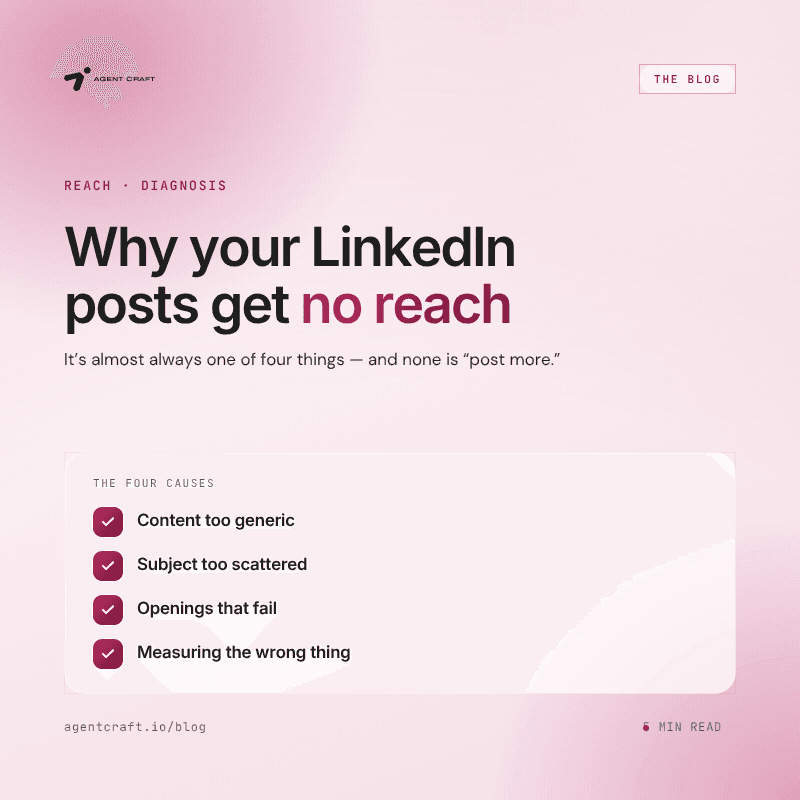
Why Your LinkedIn Posts Get No Reach (and What Fixes It)
Juan Mouton
VP Marketing
When your posts consistently get no reach, the cause is almost always one of four things: the content is generic enough to be skippable, your subject matter is too scattered for anyone to know what you are for, your openings fail before the substance arrives, or you are measuring the wrong thing and the reach is actually fine. Each has a distinct signature and a distinct fix, and none of them is the fix people reach for first, which is posting more. Volume multiplies whatever is already true, so diagnose before you scale.
Cause one: the content is generic
The signature: competent posts, reasonable topics, no traction, and, tellingly, no comments that engage with the substance, because there is no substance to engage, only agreement-shaped statements everyone already holds. Run the swap test on your last ten posts: change the byline to anyone else in your field and see if anything breaks. If nothing breaks, the post could have come from anyone, and readers treat content that could have come from anyone the way they treat all ambient noise: mild agreement, zero retention, scroll.
The fix is specificity with fingerprints. Every post carries something only your experience could supply: the number that surprised you, the step everyone skips, the client conversation reconstructed, the mistake with its actual cost. Feeds are oversupplied with correct opinions and undersupplied with evidence of lived judgment, and the second is the only thing that was ever scarce.
Cause two: no clear lane
The signature: individually decent posts across leadership Monday, productivity Wednesday, industry hot take Friday, and an audience that never consolidates, because nobody can complete the sentence "they are the one who talks about ______." Reach compounds through recognition: readers who know what you are for stop for you, return for you, and send others to you. Scattered subjects reset that recognition to zero with every post, so you are perpetually a stranger, and strangers get stranger-level attention.
The fix is the lane discipline covered at length elsewhere in this library: one to three subjects, held for quarters, everything else declined or bent until its through-line reaches your lane. The reach cost of narrowing feels real for a fortnight and the compounding pays it back with interest, because fifty posts in one lane build on each other and fifty posts in seven lanes are fifty first posts.
Cause three: the opening fails
The signature: decent content, dead numbers, and the tell is in your own drafts: the best sentence is in the middle. Readers decide in the first line or two whether the rest exists, and most professional posts spend those lines warming up, "I have been thinking a lot lately about...", "Wanted to share some reflections on...", which is throat-clearing, and readers extend it no credit. The substance below the fold might as well be unpublished.
The fix is mechanical and slightly painful: write the post, find its most interesting or surprising line, and move it to the top, unintroduced. The strong line was almost always buried mid-draft, because that is where thinking naturally produces it. Promotion, not invention. If no line in the draft is strong enough to open with, that is not a hook problem, and the draft has told you something useful.
Cause four: the metric is wrong
The signature: modest impressions, and, quietly, the right people engaging, a comment from a peer you respect, a profile view from an investor, a DM that opens "been reading your stuff." If that is your situation, you do not have a reach problem, you have a creator's scoreboard installed on a professional's game. For most executives, founders, and independents, the commercially meaningful audience is a few hundred specific people, and a post that reaches sixty of them outperforms one that reaches six thousand strangers by every measure that ever pays. Impressions are the number the platform shows you because it is the number the platform has.
The fix is measuring what the effort is for: profile views from the right titles, inbound conversations, recognition in rooms you enter, the diligence-ready record accumulating behind you. Reach in the raw is a creator's crop. You are probably farming something else.
The diagnostic, in order
Run the causes in sequence against your last dozen posts: swap test first, then the lane sentence ("they are the one who talks about ______", completed by an honest friend), then the buried-lead check, then the scoreboard question. In practice most low-reach cases are cause one wearing cause three's clothes, generic content with soft openings, and the two fixes reinforce: specific material produces strong lines, and strong lines are only worth promoting when the material underneath holds. What the diagnostic almost never returns is "post more," which is worth noticing, given how reliably that is the first lever pulled.
Where Agent Craft sits in this
Three of the four causes above are content problems, and Agent Craft's design takes a side on each: drafts come from your own spoken material rather than prompts (cause one), your lane lives in the Brand Book and off-lane drafts get flagged (cause two), and the system mines your material for its strongest line and leads with it (cause three). Cause four is a decision about what you measure, and the personal brand CRM helps there too: it counts conversations, not impressions, which is the scoreboard this game is actually played on.
Frequently asked questions
Why are my LinkedIn posts getting so few views?
Usually one of four causes: generic content readers can safely skip, scattered subjects that prevent recognition, openings that bury the interesting line, or a metric mismatch where the reach is fine for your actual goals. Diagnose in that order before posting more.
Does posting more increase reach?
Volume multiplies what is already true: more generic posts teach more people to skip you. Fix the content and the lane first; then cadence becomes a lever worth pulling.
How do I know if my content is too generic?
The swap test: put someone else's name on your post and see if anything breaks. If it reads the same under any byline in your field, it will be processed as ambient noise regardless of how correct it is.
Share
Related Articles
Building in Public: What to Share and What to Keep
The rule set fits in one line: share lessons and process, keep leverage and other people's confidences. Building in public, narrating the real construction of a company or a career as it happens, is the highest-trust content format available, because watching someone decide under uncertainty is a due-diligence process no marketing survives. But the format has failure modes that its cheerleaders skip past, and they all trace to the same error: sharing the wrong category of thing. The categories are knowable in advance, which is what this post is for, the sharing rules, the failure modes, and a decision test that resolves the ambiguous cases in ten seconds.
LinkedIn Profile Optimization for Executives: Field by Field
An executive profile has one job: when someone arrives checking you out, a recruiter, an investor, a board member, an acquirer running quiet diligence, it answers their question in seconds and gives them a reason to keep reading. Optimizing it is a single afternoon's work, done field by field in priority order: headline, About, experience, banner and photo, featured, skills. Each field below comes with the characteristic executive mistake and its fix, because at senior levels the profiles are rarely empty. They are full of the wrong register: written for the org chart instead of for the stranger deciding whether to trust you.
How to Write LinkedIn Hooks: The Four Formats That Work
A hook is the first line or two of a post, and it has exactly one job: make the next line necessary. Nearly every hook that works is one of four formats: the dense hook (a complete provocative claim), the punchy-plus-context hook (a short jab followed by one grounding line), the single-line bomb (one sentence, standing alone), or the stacked list (three or four parallel fragments building to a turn). Below are all four with their rules, ten worked examples, and the banned moves, because hooks fail by formula more often than they fail by weakness, and the formulas that kill them are recognizable.