How to Write LinkedIn Hooks: The Four Formats That Work
Juan Mouton
VP Marketing
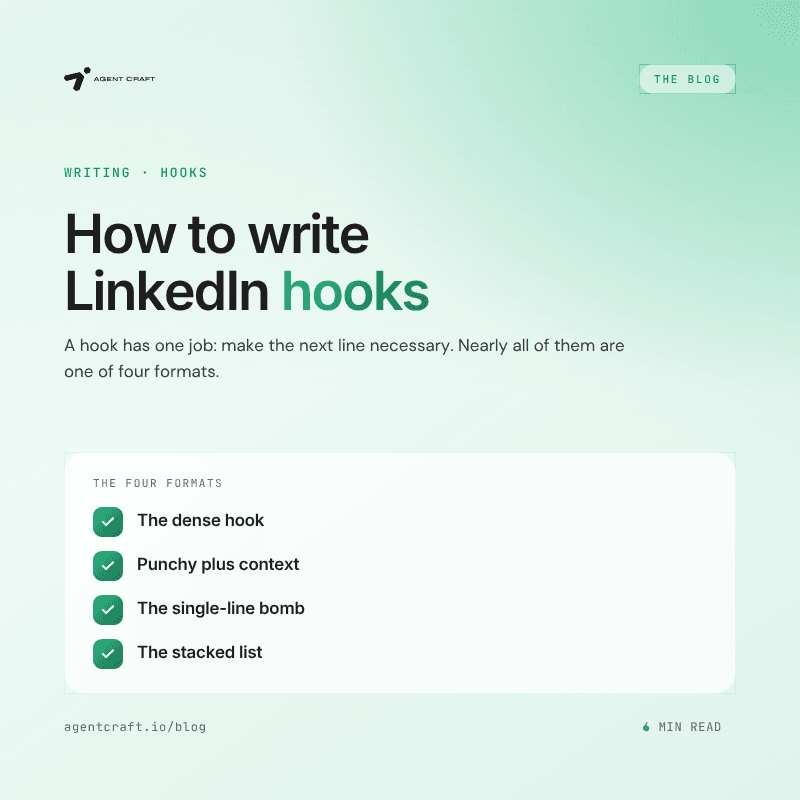
A hook is the first line or two of a post, and it has exactly one job: make the next line necessary. Nearly every hook that works is one of four formats: the dense hook (a complete provocative claim), the punchy-plus-context hook (a short jab followed by one grounding line), the single-line bomb (one sentence, standing alone), or the stacked list (three or four parallel fragments building to a turn). Below are all four with their rules, ten worked examples, and the banned moves, because hooks fail by formula more often than they fail by weakness, and the formulas that kill them are recognizable.
One reframe before the formats, since it changes how you write them: hooks are found, not composed. The strong line is almost always already in your draft, sitting in the middle where thinking naturally deposited it. Hook writing is mostly the discipline of finding that line and promoting it to the top, unintroduced. Writers who compose hooks first and content second produce clickbait over emptiness; writers who mine their material produce openings the post can actually pay off.
Format one: the dense hook
A complete claim, specific and slightly uncomfortable, delivered in one or two full sentences. It works by asserting something the reader must either accept or argue with, and either response requires reading on. Density is the discipline: every word is cargo, no setup, no "I think."
Examples: "The most expensive hire I ever made interviewed perfectly." / "Most consultants lose the deal in the proposal, after winning it in the room."
Format two: punchy plus context
A short jab, then one line that grounds it. The jab creates the itch; the context line proves the post can scratch it. This is the workhorse format for lesson-shaped material, because it pairs surprise with credibility in two moves.
Examples: "We fired our best client. Revenue went up the next quarter." / "I stopped reading resumes. Our hiring got better, and I can tell you exactly why."
Format three: the single-line bomb
One sentence, alone, followed by white space. The format spends everything on compression, and its rule is unforgiving: the line must be genuinely strong, because there is nothing else on screen to help it. Reserve it for the material that earns it, a hard-won reversal, a claim with real edge, and it lands harder than anything else in the set. Use it weekly and it becomes a tic.
Examples: "Your best people already know who should be fired." / "Nobody has ever read a second paragraph to find out if the first one was worth it."
Format four: the stacked list
Three or four short parallel fragments, then a turn. The stack builds a pattern; the turn breaks or completes it. It suits material that is genuinely plural, symptoms, stages, escalating stakes, and it fails as decoration on singular material, where the list is padding wearing rhythm.
Example: "Twelve years in operations. Four turnarounds. Two acquisitions. The lesson from all of it fits in one sentence, and nobody wants to hear it."
The rules that hold across all four
Lead with the concrete: numbers, named situations, and specifics out-pull abstractions in every format. Cut the throat-clearing entirely: any hook beginning "I have been thinking about," "Wanted to share," or "Hot take:" has spent its opening on packaging. No questions as hooks: "Have you ever wondered why...?" hands the reader a decision ("no") instead of an itch, and rhetorical questions read as the oldest formula on the platform. No withheld nouns ("This one habit changed everything"): curiosity-gap mechanics read as bait to exactly the audience whose trust is worth having. And the hook must be paid: whatever the opening promises, the post delivers, because an unpaid hook converts one post's reach into a standing discount on your name.
Ten hooks, mined from ordinary material
To show the promotion move in action, each pair below is a buried line and its hook form. "In my experience teams often hide problems from leadership" becomes "Your team already knows what is broken. They are deciding whether to tell you." / "We learned pricing was more important than we thought" becomes "We raised prices 40% and lost two customers. Both were unprofitable." / "Delegation was hard for me at first" becomes "The first thing I delegated came back wrong. That was the point." The pattern in every promotion: the general observation trades up to its most specific, most consequential instance, stated plainly, with the safety removed.
Where Agent Craft sits in this
The four formats above, with their rules and banned moves, are the published spec Agent Craft's hook writer runs: it mines your spoken material for the strongest line and drafts it into each format for you to choose from, because the promotion move is easier to judge than to perform on your own draft. The spec is free and works by hand. Applied honestly to your last five posts, it will find at least three buried leads. It always does.
Frequently asked questions
What makes a good LinkedIn hook?
A specific, slightly uncomfortable claim in one of four formats: dense, punchy plus context, single-line bomb, or stacked list. Concrete beats abstract, and the strongest hook is usually a line already buried in your draft.
Should LinkedIn hooks be questions?
No. Questions hand the reader an exit ("no") instead of an itch, and rhetorical openings read as formula. State the claim the question was circling.
How long should a LinkedIn hook be?
One to two lines, because that is what renders before the fold and what attention grants you. The format varies; the budget does not.
Share
Related Articles
Building in Public: What to Share and What to Keep
The rule set fits in one line: share lessons and process, keep leverage and other people's confidences. Building in public, narrating the real construction of a company or a career as it happens, is the highest-trust content format available, because watching someone decide under uncertainty is a due-diligence process no marketing survives. But the format has failure modes that its cheerleaders skip past, and they all trace to the same error: sharing the wrong category of thing. The categories are knowable in advance, which is what this post is for, the sharing rules, the failure modes, and a decision test that resolves the ambiguous cases in ten seconds.
LinkedIn Profile Optimization for Executives: Field by Field
An executive profile has one job: when someone arrives checking you out, a recruiter, an investor, a board member, an acquirer running quiet diligence, it answers their question in seconds and gives them a reason to keep reading. Optimizing it is a single afternoon's work, done field by field in priority order: headline, About, experience, banner and photo, featured, skills. Each field below comes with the characteristic executive mistake and its fix, because at senior levels the profiles are rarely empty. They are full of the wrong register: written for the org chart instead of for the stranger deciding whether to trust you.
Why Your LinkedIn Posts Get No Reach (and What Fixes It)
When your posts consistently get no reach, the cause is almost always one of four things: the content is generic enough to be skippable, your subject matter is too scattered for anyone to know what you are for, your openings fail before the substance arrives, or you are measuring the wrong thing and the reach is actually fine. Each has a distinct signature and a distinct fix, and none of them is the fix people reach for first, which is posting more. Volume multiplies whatever is already true, so diagnose before you scale.