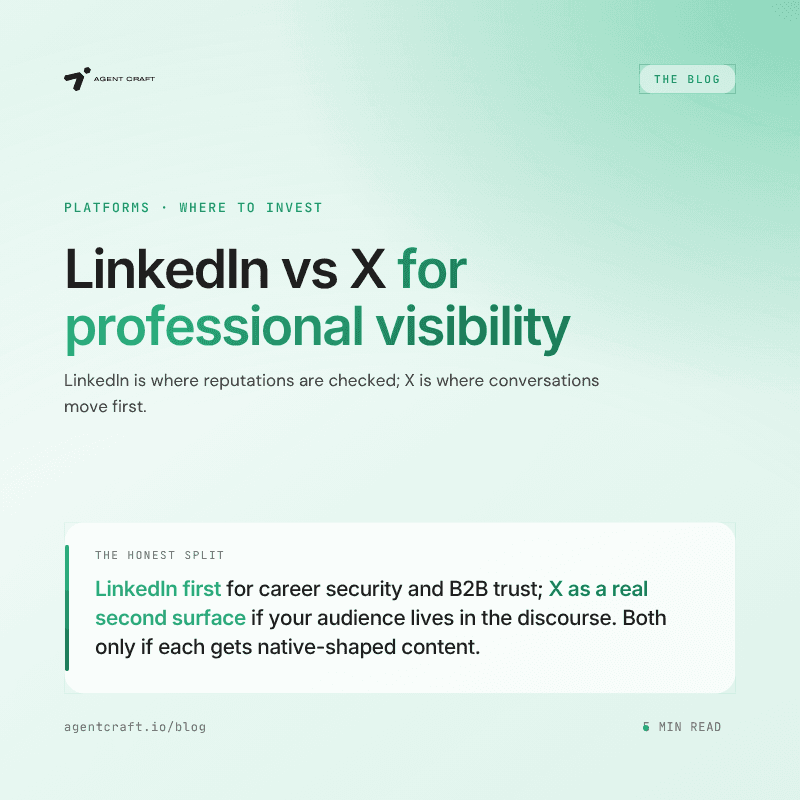
LinkedIn vs X for Professional Visibility: Where to Invest
Juan Mouton
VP Marketing
The honest split: LinkedIn is where professional reputations are checked, so it wins for career security, B2B trust, and anyone whose buyers are operators; X is where conversations move faster and earlier, so it earns its place for technical founders, investors, developer audiences, and anyone whose market lives in the discourse. For most professionals the answer is LinkedIn first, X as a genuine second surface if your audience is there, and both only if each gets content in its native shape. Where to invest depends on one question: where do the people who matter to your work actually look?
What LinkedIn is structurally good at
LinkedIn is the surface of record for professional identity. Recruiters search it, buyers diligence it, boards and investors quietly check it before meetings, and your profile plus your visible thinking is what they find. Three consequences follow. It is the default for the security motive: if your goal is being findable and credible when circumstances change, LinkedIn is close to the whole game, because that is where the checking happens. It is the default for B2B trust: operators, executives, and mid-market buyers live there professionally, and a year of visible judgment on LinkedIn is the diligence file they read. And it rewards the professional register natively: lessons, patterns, and observations from real work are what the audience came for.
Its honest limits: the conversation is slower and more filtered, the tone runs formal, and news arrives late. By the time a topic is being discussed on LinkedIn, it has usually been argued about elsewhere for days.
What X is structurally good at
X is where several specific professional worlds actually think in public: technical and AI builders, venture investors, developer tools, media, and the founders adjacent to all of them. In those worlds, X is not a side channel; it is the room where the conversation happens, faster and rougher than anywhere else. Its strengths are speed (topics surface days before they reach other platforms), directness (senior people are unusually reachable in replies), and compounding through conversation, since the reply culture builds relationships in a way broadcast formats do not.
Its honest limits: outside those worlds, professional buyers are thinner on the ground, the signal-to-noise ratio demands more filtering effort, and the platform rewards a register, shorter, sharper, thread-shaped, that takes deliberate adaptation. X presence is materially valuable to a specific slice of professionals and close to optional for the rest.
The decision, by who you are
If your motive is career security, an executive building standing and optionality, LinkedIn is near-exclusive: recruiters and peers look there, and X adds little for that job. If you are a founder, consultant, or independent selling to operators, LinkedIn is primary and X is worth adding once the LinkedIn practice is stable, because some of your buyers argue in both rooms. If you are a technical founder, in developer tools, AI, or anything venture-adjacent, X may genuinely be your first surface, with LinkedIn as the formal record behind it. And if you are unsure, run the audit: find ten people who represent your exact audience and see where they actually post, reply, and lurk. Their behavior is the answer; platform debates are not.
The rule for running both
One input, two shapes, never one post twice. The platforms reward different forms, and a LinkedIn post pasted onto X announces itself as exactly that, which costs credibility with the audience most fluent in the difference. The companion post in this library covers the re-forming mechanics in full. The strategic point here is simpler: both platforms is a real option only if you can afford each its native shape, and with the processing done by hand, that roughly doubles the desk work per idea, which is the honest price of the two-surface strategy and the reason most people who attempt it manually end up running one surface and syndicating badly to the other.
Where Agent Craft sits in this
Agent Craft makes the two-surface question stop being a workload question. One voice note becomes content shaped natively for each platform, a LinkedIn post and an X thread built separately from the same thinking, plus TikTok and YouTube when your audience lives there too, which no other tool in this category does. The strategy layer, built on best practice and twenty-plus years of global brand leadership, holds your positioning constant across every surface while the form adapts. Invest where your audience is. The system removes the penalty for being in more than one place.
Frequently asked questions
Is LinkedIn or X better for professional visibility?
LinkedIn for career security and B2B trust, because that is where professional checking happens. X for technical founders, investors, and developer-adjacent audiences, where the earlier, faster conversation lives. Audit where your specific audience actually posts before deciding.
Should I post the same content on LinkedIn and X?
Same thinking, different shapes: the platforms reward different forms, and a pasted LinkedIn post reads as a pasted LinkedIn post on X. Re-form rather than repost, or run one surface well instead.
Do executives need to be on X?
Usually not: the career-security job, being findable and credible to recruiters and peers, lives almost entirely on LinkedIn. X earns its place when your specific market genuinely converses there.
Share
Related Articles
Building in Public: What to Share and What to Keep
The rule set fits in one line: share lessons and process, keep leverage and other people's confidences. Building in public, narrating the real construction of a company or a career as it happens, is the highest-trust content format available, because watching someone decide under uncertainty is a due-diligence process no marketing survives. But the format has failure modes that its cheerleaders skip past, and they all trace to the same error: sharing the wrong category of thing. The categories are knowable in advance, which is what this post is for, the sharing rules, the failure modes, and a decision test that resolves the ambiguous cases in ten seconds.
LinkedIn Profile Optimization for Executives: Field by Field
An executive profile has one job: when someone arrives checking you out, a recruiter, an investor, a board member, an acquirer running quiet diligence, it answers their question in seconds and gives them a reason to keep reading. Optimizing it is a single afternoon's work, done field by field in priority order: headline, About, experience, banner and photo, featured, skills. Each field below comes with the characteristic executive mistake and its fix, because at senior levels the profiles are rarely empty. They are full of the wrong register: written for the org chart instead of for the stranger deciding whether to trust you.
Why Your LinkedIn Posts Get No Reach (and What Fixes It)
When your posts consistently get no reach, the cause is almost always one of four things: the content is generic enough to be skippable, your subject matter is too scattered for anyone to know what you are for, your openings fail before the substance arrives, or you are measuring the wrong thing and the reach is actually fine. Each has a distinct signature and a distinct fix, and none of them is the fix people reach for first, which is posting more. Volume multiplies whatever is already true, so diagnose before you scale.