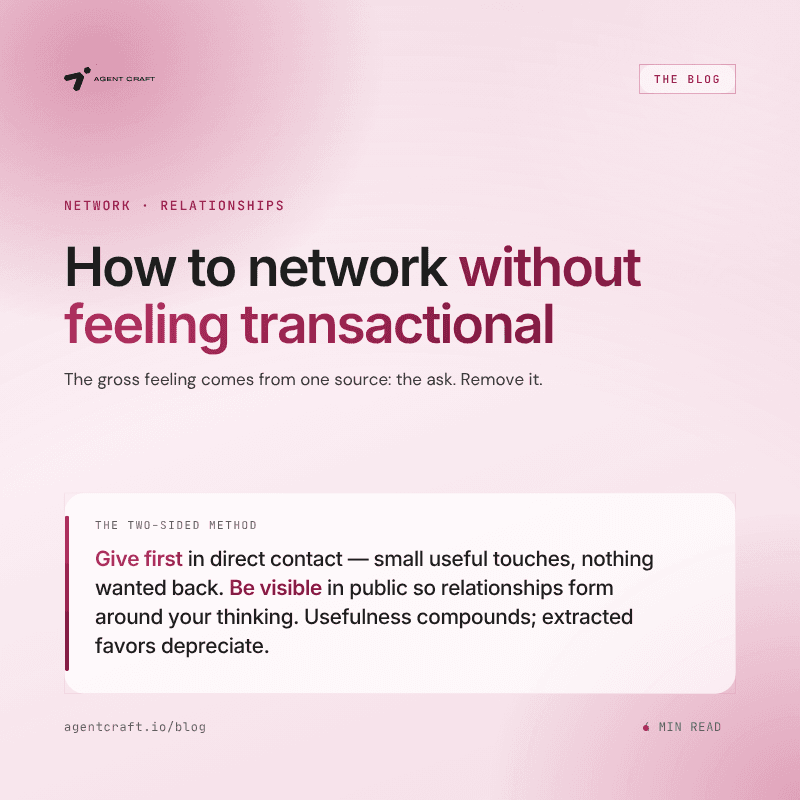
How to Network Without Feeling Transactional
Juan Mouton
VP Marketing
The transactional feeling comes from one source: the ask. Remove the ask, and networking becomes what it always should have been, being useful and visible to people whose work touches yours, which nobody has ever felt gross about. The method is two-sided: give first in your direct contact, small useful touches with nothing wanted back, and be visible in public, so that relationships form around your thinking without you soliciting them at all. Run both and the strange result is a stronger network than the transactors build, because the currency they are spending, extracted favors, depreciates, and the one you are spending, demonstrated usefulness, compounds.
Why the ick is accurate, and what it is detecting
The discomfort deserves respect before dismantling, because it is not squeamishness, it is good taste. What feels wrong about classic networking, the coffee with an agenda, the "let's stay in touch" with an invoice implied, the connection request from someone who clearly ran a search, is that the relationship is being used as a delivery mechanism for a want, and both parties can feel the machinery. Your instinct against it is the same instinct your contacts have, which is exactly why the transactional style underperforms: everyone's detector works. So the fix is not overcoming the ick, powering through the discomfort like the sales books suggest. The fix is doing the version the ick was never aimed at, and that version has a strict rule: contact carries value or warmth, never a request, until the relationship is genuinely warm, at which point most requests become unnecessary anyway, because warm relationships volunteer what cold ones must be asked for.
The give-first moves, costed in minutes
The direct half of the method is a small repertoire, each move under five minutes.
The relevant send. An article, a tool, an introduction thread they would want to see, with one line on why it made you think of them. Full stop where the ask would go. This is the workhorse, and it works because it is literally the relationship doing its job: people whose work touches yours, being useful to each other.
The specific congratulations. Their promotion, launch, or milestone, plus one detail that proves you actually know their work. The detail is the entire move; without it you are one of forty hollow congrats.
The unprompted vouch. Recommending them, citing them, or connecting them to an opportunity, without being asked and sometimes without telling them. The ones they discover later are worth triple.
The genuine question. Asking their view on something squarely in their expertise, when you actually want it. Being consulted is a gift; people remember who considers them worth asking.
Two or three of these a week, distributed across current and dormant contacts, is the entire direct practice: call it fifteen minutes, and the constraint was never time, it was the mistaken belief that contact required a pretext. Value is the pretext.
Content: networking at scale, without the contact
The public half is where the method escapes arithmetic. Every piece of useful thinking you publish is a give-first move delivered to your entire network at once, including the several hundred dormant contacts you could never touch individually. They read silently for months, your name re-enters their working memory attached to usefulness, and then the mechanism completes itself: a comment arrives, then a message, then a "we should talk," none of it solicited, all of it warm on arrival. This is networking with the polarity reversed, inbound instead of outbound, and it dissolves the transactional problem completely, since nobody has ever felt gross about being sought out. It also compounds where direct contact cannot: the touch you send reaches one person once; the pattern you publish keeps reaching people for years.
The two halves feed each other, and that is the design: the publishing warms the wide network passively, the direct touches deepen the specific relationships that matter, and neither ever carries an ask, which means when you finally do need something, the layoff, the raise, the pivot, you are not calling in favors from strangers. You are letting a warm network do what warm networks do unprompted, which was the entire point of the premiums.
Where Agent Craft sits in this
Agent Craft runs the public half of this method as a system, which is the half that scales. A two-minute voice note becomes the useful thinking your whole network receives, in your voice, across LinkedIn, X, TikTok, and YouTube, week after week, with a strategy layer keeping it aimed at what you want to be known for. The direct touches stay yours, five minutes at a time, as they should, since demonstrated warmth is the one thing that cannot be delegated. And when the reversed polarity starts producing inbound, the personal brand CRM collects it, qualifies it, and keeps it warm by email. Give first at scale, give first in person, and let the asks become unnecessary.
Frequently asked questions
How do I network without being transactional?
Remove the ask: direct contact carries value or warmth only, two or three small touches a week, while public content does the wide-scale relationship warming for you. Requests wait until relationships are warm, where most become unnecessary.
What should I say when reconnecting with someone professionally?
A specific reason you thought of them plus something useful or genuinely warm, and nothing requested. A relevant link, a detailed congratulations, or a real question in their expertise all work; a vague coffee ask does not.
Is posting content really networking?
It is networking at scale: every useful piece reaches your entire network including dormant contacts, re-attaching your name to usefulness without a single outbound message. The inbound it produces arrives warm, which solves the transactional problem at its root.
Share
Related Articles
Building in Public: What to Share and What to Keep
The rule set fits in one line: share lessons and process, keep leverage and other people's confidences. Building in public, narrating the real construction of a company or a career as it happens, is the highest-trust content format available, because watching someone decide under uncertainty is a due-diligence process no marketing survives. But the format has failure modes that its cheerleaders skip past, and they all trace to the same error: sharing the wrong category of thing. The categories are knowable in advance, which is what this post is for, the sharing rules, the failure modes, and a decision test that resolves the ambiguous cases in ten seconds.
LinkedIn Profile Optimization for Executives: Field by Field
An executive profile has one job: when someone arrives checking you out, a recruiter, an investor, a board member, an acquirer running quiet diligence, it answers their question in seconds and gives them a reason to keep reading. Optimizing it is a single afternoon's work, done field by field in priority order: headline, About, experience, banner and photo, featured, skills. Each field below comes with the characteristic executive mistake and its fix, because at senior levels the profiles are rarely empty. They are full of the wrong register: written for the org chart instead of for the stranger deciding whether to trust you.
Why Your LinkedIn Posts Get No Reach (and What Fixes It)
When your posts consistently get no reach, the cause is almost always one of four things: the content is generic enough to be skippable, your subject matter is too scattered for anyone to know what you are for, your openings fail before the substance arrives, or you are measuring the wrong thing and the reach is actually fine. Each has a distinct signature and a distinct fix, and none of them is the fix people reach for first, which is posting more. Volume multiplies whatever is already true, so diagnose before you scale.