How to Stay Visible Between Roles (Without Looking Desperate)
Juan Mouton
VP Marketing
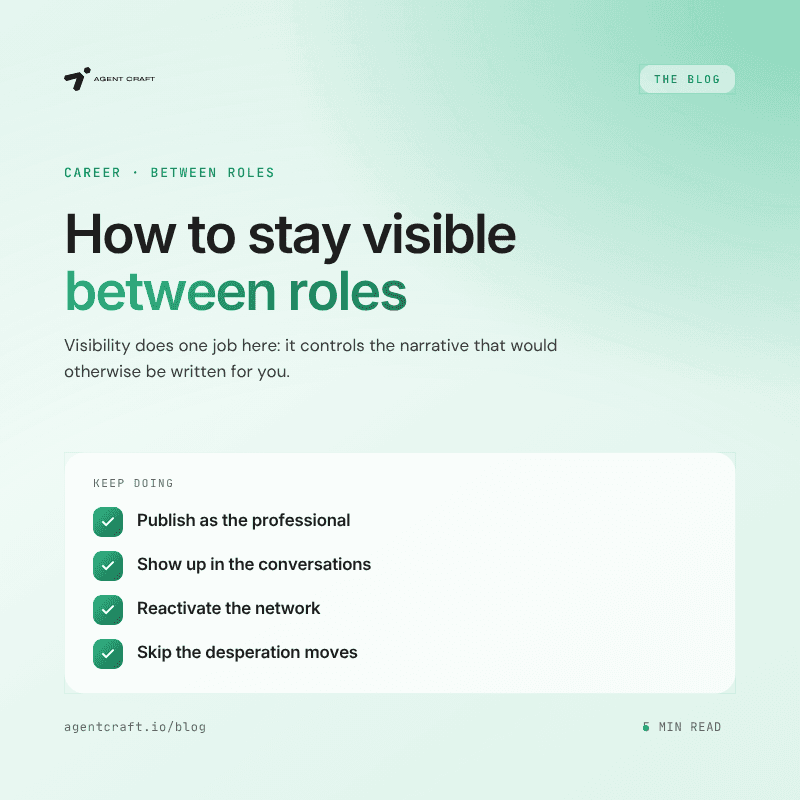
Between roles, visibility does one job: it controls the narrative that would otherwise be written for you. The method is to keep publishing as the professional you are rather than the job-seeker you temporarily also are, one substantive piece a week from your expertise, genuine presence in your field's conversations, and deliberate reactivation of the network, while avoiding the three moves that read as desperation. Done right, the gap becomes the most visible stretch of your career instead of a silence people interpret, because the honest structural truth of the in-between is that you finally have the one asset employment always rationed: time to think in public.
The narrative problem, stated plainly
A gap is not a fact people observe; it is a blank people fill, and unmanaged blanks get filled with the least flattering available story. Silence between roles reads, to the checking eye, as either drift or damage, and the checking eye is exactly who matters now: every recruiter, hiring manager, and referrer in your next process will look, and what they find is the narrative. Publishing flips the read completely. A person visibly thinking, sharp observations, live engagement, a mind clearly still on the field, presents as a professional between chapters rather than a professional in trouble, and the difference in how those two people are approached, evaluated, and priced is the entire argument for the practice. You cannot stop people from wondering. You can decide what the evidence says when they check.
What to say, and the register that carries it
The content of the in-between is the same observational register as always, with one advantage and one adjustment. The advantage: distance. Freshly out of a seat, you can see and say things the seat obscured, what the industry gets wrong, patterns across your whole run, lessons that were too close to write about while living them, and this material is often the best of a career, because perspective is the one thing the gap supplies free. The adjustment: presence over reference. Write from your expertise, not about your situation. The subject is supply-chain resilience or the manager layer or pricing, as it always was; the subject is never the search.
The formats, ranked for the moment: the career-spanning pattern (what fifteen years actually taught, now visible from outside), the current-eye piece (what you are seeing in the market right now, which quietly demonstrates you are engaged and sharp), and the open question (what you are thinking through, which reads as confidence and starts conversations). One a week is the floor and plenty.
What to avoid, because these are the tells
Three moves undo the entire effect. The public plea, "open to opportunities, please share," which converts your whole feed into a search artifact and every subsequent post into its supporting material; announce availability once, cleanly, in the profile banner and a single dignified post, then return to substance. The bitterness leak, any commentary that reads as aimed at the former employer, which costs more than every good post combined, since your next hirer reads it as a preview. And the visible scramble, sudden frantic posting from an account silent for years, which tells its own story; if you are starting from silence, start at a calm one-a-week, not a panicked seven.
The week-by-week structure
Week one: the quiet setup. Profile pass (headline in market language, About current, the availability signal placed once), plus three no-ask reactivation messages to dormant contacts, value or warmth only. Week two: first post, a pattern from the career, and daily fifteen-minute engagement begins, genuine comments in your field. Weeks three and four: the rhythm sets, one post weekly, three network touches weekly, replies to everything on your own posts. From week five: hold the rhythm and let the mechanism work, the posts rewarming the wide network passively while the touches deepen specific relationships, and expect the compounding on its normal clock, with conversations typically arriving through the warmed network before they arrive through applications. The practice also solves the gap's psychological problem, which nobody warns you about: the days need a professional spine, and a publishing practice is one, small, steady, and visibly productive.
And one line for afterwards, because it is the lesson of the whole episode: the practice that carried you through the gap is the same one that prevents the next gap from being cold. Keep it when the new role starts. That is the policy staying in force.
Where Agent Craft sits in this
Agent Craft runs the visibility half of the in-between as a system: a two-minute voice note becomes the weekly substance, in your voice, across LinkedIn, X, TikTok, and YouTube, with a strategy layer keeping it aimed at your expertise rather than your situation, which is exactly the discipline the moment requires. The network touches and the conversations stay yours, as they should. And when the warmed network starts producing conversations, the personal brand CRM collects and organizes them, so the search runs on inbound rather than applications alone. The gap gets a narrative. You get to be the one who wrote it.
Frequently asked questions
What should I post on LinkedIn between jobs?
Substantive observations from your expertise: career-spanning patterns, current market reads, and open questions, one a week. Announce availability once, cleanly, then keep the feed about your field rather than your search.
Should I say I am looking for work on LinkedIn?
Once, with dignity: the profile signal plus a single clear post. Repeated public pleas convert your presence into a search artifact and read as desperation to exactly the audience you need reading otherwise.
How long does it take for visibility to produce opportunities between roles?
Warm-network conversations often start within weeks of consistent touches and posting; the broader compounding runs on the standard quarter. Starting the practice on day one of the gap, or better, before it, is what compresses the timeline.
Share
Related Articles
How to Network Without Feeling Transactional
The transactional feeling comes from one source: the ask. Remove the ask, and networking becomes what it always should have been, being useful and visible to people whose work touches yours, which nobody has ever felt gross about. The method is two-sided: give first in your direct contact, small useful touches with nothing wanted back, and be visible in public, so that relationships form around your thinking without you soliciting them at all. Run both and the strange result is a stronger network than the transactors build, because the currency they are spending, extracted favors, depreciates, and the one you are spending, demonstrated usefulness, compounds.
Building in Public: What to Share and What to Keep
The rule set fits in one line: share lessons and process, keep leverage and other people's confidences. Building in public, narrating the real construction of a company or a career as it happens, is the highest-trust content format available, because watching someone decide under uncertainty is a due-diligence process no marketing survives. But the format has failure modes that its cheerleaders skip past, and they all trace to the same error: sharing the wrong category of thing. The categories are knowable in advance, which is what this post is for, the sharing rules, the failure modes, and a decision test that resolves the ambiguous cases in ten seconds.
How Recruiters Actually Find Executives on LinkedIn
Recruiters find executives by searching, and the search runs on words in a handful of profile fields: your headline, your title history, your About section, your listed skills, and your location. If the words a recruiter would type do not appear in those fields, you do not surface, no matter how good you are at the thing they are searching for. That is the entire mechanism, and it means executive findability is less about fame and more about vocabulary: describing yourself in the words your market uses rather than the words your business card uses.