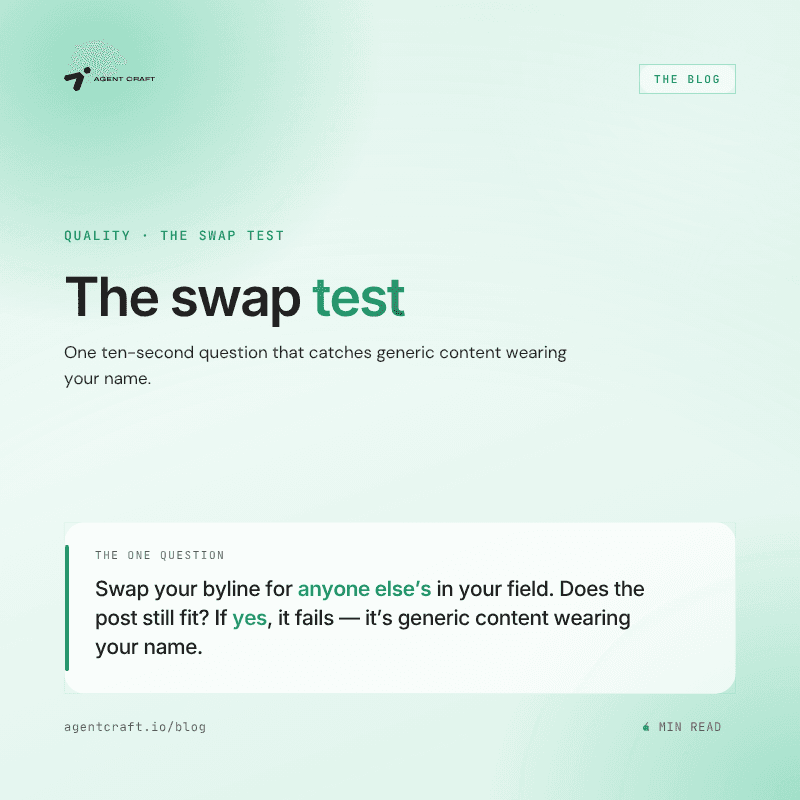
The Swap Test: Could Your Content Have Come From Anyone?
Juan Mouton
VP Marketing
The swap test is one question applied to anything you are about to publish: if you swapped your byline for that of anyone else in your field, would the post still make sense, still feel right, still fit? If yes, the post fails. It is generic content wearing your name, and publishing it builds everyone's reputation fractionally and yours not at all. The test takes ten seconds, requires no tools, and is the single highest-leverage quality gate available to anyone building a professional reputation, because it checks the only thing that was ever scarce in a feed: evidence that a specific person, with specific experience, is behind the words.
Why the test works
A reputation is, mechanically, an association: your name attached to a way of seeing. Every post either deposits into that association or does not, and the deciding factor is distinctiveness, whether the post could only have come from you. Generic posts are not neutral; they are camouflage. A correct, competent, swappable post dissolves you into the field's background noise, and readers process background noise the way they process all of it: mild agreement, zero retention of the byline. You can publish a hundred swappable posts and be exactly as unknown as when you started, which is the quiet tragedy of most professional content: consistent effort, correctly executed, depositing into nobody's account.
The test also explains why the AI-content panic is aimed slightly wrong. Machines did not invent swappable content; humans were producing it by hand for years, the same reheated best practices, the same agreeable observations. AI industrialized the genericness and made the tell-tale patterns famous, but the underlying failure was always byline-independence, and the test catches it regardless of what produced the words.
What breaks under the swap, and what survives
Run the mental swap and watch what happens to specific elements. What survives the swap, and therefore fails the test: correct general opinions ("consistency matters"), summarized best practices, agreeable observations about the industry, motivational abstractions, and any advice that arrives without a scar attached. All true, all interchangeable, all camouflage.
What breaks under the swap, and therefore passes: the number that surprised you ("we raised prices 40% and lost two customers, both unprofitable"), the reconstructed conversation, the mistake with its actual cost attached, the step everyone skips that you learned about the hard way, the stance a specific colleague would argue with you about, the open question you are genuinely sitting in. These break because they are load-bearing biography: put another name on them and the post becomes a lie. That breakage is the entire asset.
The compressed version, useful mid-draft: fingerprints. Does this post contain anything with your fingerprints on it? One genuine fingerprint per post clears the bar. Zero fingerprints and no amount of polish will.
Running it on your last ten
The retroactive audit takes ten minutes and is usually clarifying in the uncomfortable way. Open your last ten posts. For each, perform the swap honestly, a peer's name, a competitor's name, and score it: breaks or survives. Most professionals who run this for the first time score two or three breaks out of ten, which explains more about their traction than any algorithm theory, and the pattern in the failures is nearly always the same: the posts were written from opinion when they could have been written from experience. You had the fingerprint material, the week's actual events, and reached past it for the general statement, because the general statement felt safer. It was. Safety is what camouflage is for.
The going-forward practice is one gate at the end of drafting: swap, check, and if nothing breaks, either add the fingerprint the post is missing, the specific, the scar, the number, or decline to ship. Declining is a real option and an underused one; a skipped post costs a day of cadence, while a swappable one teaches your best readers your name is skimmable, and that lesson compounds.
Where Agent Craft sits in this
The swap test is Agent Craft's internal quality bar, so this page is us publishing the standard we hold ourselves to. Inside the system, every draft is screened for byline-independence before you see it, which is possible because drafts are built from your spoken material in the first place: fingerprints in, fingerprints out, across LinkedIn, X, TikTok, and YouTube. The test itself is ten seconds, by hand, on anything. If it improves your next post, it has done its job for both of us.
Frequently asked questions
What is the swap test for content?
Swap your byline for anyone else's in your field and check whether the post still fits. If nothing breaks, the content is generic, and publishing it builds the field's noise floor rather than your reputation.
How do I make my content pass the swap test?
One fingerprint per post: a specific number, a real conversation, a mistake with its cost, a genuinely held stance. Write from your week's actual events rather than from general opinion, and the fingerprints arrive on their own.
Does the swap test apply to AI-written content?
It applies to all content regardless of source, which is its point: the failure was always byline-independence, not the tool. AI-assisted content built from your own material can pass; hand-written generic content fails.
Share
Related Articles
Building in Public: What to Share and What to Keep
The rule set fits in one line: share lessons and process, keep leverage and other people's confidences. Building in public, narrating the real construction of a company or a career as it happens, is the highest-trust content format available, because watching someone decide under uncertainty is a due-diligence process no marketing survives. But the format has failure modes that its cheerleaders skip past, and they all trace to the same error: sharing the wrong category of thing. The categories are knowable in advance, which is what this post is for, the sharing rules, the failure modes, and a decision test that resolves the ambiguous cases in ten seconds.
LinkedIn Profile Optimization for Executives: Field by Field
An executive profile has one job: when someone arrives checking you out, a recruiter, an investor, a board member, an acquirer running quiet diligence, it answers their question in seconds and gives them a reason to keep reading. Optimizing it is a single afternoon's work, done field by field in priority order: headline, About, experience, banner and photo, featured, skills. Each field below comes with the characteristic executive mistake and its fix, because at senior levels the profiles are rarely empty. They are full of the wrong register: written for the org chart instead of for the stranger deciding whether to trust you.
Why Your LinkedIn Posts Get No Reach (and What Fixes It)
When your posts consistently get no reach, the cause is almost always one of four things: the content is generic enough to be skippable, your subject matter is too scattered for anyone to know what you are for, your openings fail before the substance arrives, or you are measuring the wrong thing and the reach is actually fine. Each has a distinct signature and a distinct fix, and none of them is the fix people reach for first, which is posting more. Volume multiplies whatever is already true, so diagnose before you scale.