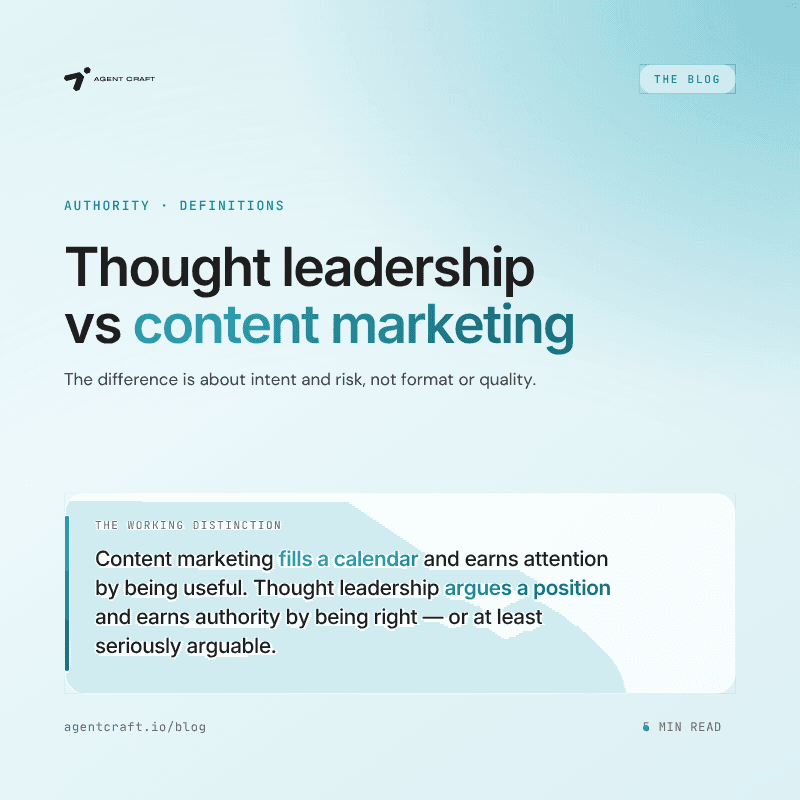
Thought Leadership vs Content Marketing: The Difference That Matters
Juan Mouton
VP Marketing
Content marketing fills a calendar; thought leadership argues a position. That is the working distinction, and it is about intent and risk rather than format or quality. Content marketing serves an audience's existing questions, how to do X, what is Y, and earns attention by being useful; thought leadership stakes a view the audience did not already hold, and earns authority by being right, or at least by being seriously arguable. Both are legitimate. Both compound. The trouble starts when one is dressed as the other, which is most of what currently wears the thought-leadership label, and the mislabeling matters because the two are built differently, measured differently, and fail differently.
The anatomy of each, side by side
Content marketing answers demand that already exists. Its unit is the useful answer: the guide, the comparison, the how-to, the checklist. Its virtue is service, its measure is whether the reader's problem got solved, and its risk profile is low, being wrong is rare because the material is mostly settled knowledge, well organized. Done seriously it is a real asset: a library of genuinely best answers is a pipeline machine, and there is no shame anywhere in it.
Thought leadership creates a view where none existed. Its unit is the position: the claim about where the field is going, the practice everyone runs that no longer works, the reframe that reorganizes how a problem is seen. Its virtue is direction, its measure is whether the field's conversation moved, and its risk is the entire point: a position that nobody could dispute is not a position, and the willingness to be publicly wrong is what the authority is paid for. Leadership implies a direction, and a direction requires having picked one before it was safe.
The compressed test: could a competent professional in your field have written this piece without disagreeing with anything in it? If yes, it is content marketing, whatever the deck calls it. If a reasonable colleague would push back, you are in thought-leadership territory, and the pushback is the confirmation, not the problem.
Why most output is neither
The uncomfortable middle deserves naming, because it is where most professional content actually lives: material with the costume of thought leadership, the confident register, the "here is what nobody is telling you" framing, and the risk profile of content marketing, which is to say none, because underneath the costume sits the field's consensus, restated. This hybrid fails both jobs at once. It is not useful enough to serve as content marketing, since it answers no specific question, and it is not arguable enough to function as thought leadership, since it stakes nothing. It is the swap test failing at essay length: correct, competent, and interchangeable, which the audience processes as ambient noise regardless of the production values. The fix is honest sorting: push each piece toward one job or the other. Either make it more useful, more specific, more complete as an answer, or make it more arguable, sharpen the claim until someone real would dispute it. The middle is the only position that pays nothing.
Which one you should be doing
For a company: mostly content marketing, and proudly. A brand account is structurally suited to useful answers and structurally unsuited to positions, since a committee cannot hold a view with a straight face. For an individual professional building standing: a deliberate mix, weighted by goal. The useful-answer work builds findability and goodwill; the position work builds the association that constitutes a reputation, because people are remembered for what they claimed, not for what they explained. A workable personal ratio is most content in the useful-observational register with a genuine position argued every few weeks, which keeps the risk budget spent where it buys the most. And one sequencing note: positions land harder from someone whose useful work has already proven they know the terrain. Service first earns the right to direction, which is the polite way of saying that a hot take from an unknown is just heat.
What a genuine position requires
Three things, none of them courage-theater. Experience underneath it, because positions argued from reading collapse under the first real question. A named opposition, since a position rejects something specific that reasonable people actually practice, and rejecting a straw man is the costume again. And durability: you will still hold this view next quarter, defend it when challenged, and revise it publicly if the evidence moves, which is itself the highest-authority move in the genre. If a claimed position fails any of the three, it is content wearing conviction, and the audience's detector for that is better than yours.
Where Agent Craft sits in this
Agent Craft is built to keep you out of the costume middle. Your genuine positions live in the Brand Book, set with a strategy layer built on best practice and twenty-plus years leading global brands, and drafts that fence-sit on a question you have taken a side on get flagged before they ship. The useful-answer work and the position work both draft from your own spoken thinking, in your voice, across LinkedIn, X, TikTok, and YouTube, and the swap test runs on everything, because interchangeable is the one register the system refuses. Which job each piece does is a strategy decision. The system makes sure each piece actually does one.
Frequently asked questions
What is the difference between thought leadership and content marketing?
Content marketing answers questions the audience already has and is measured by usefulness; thought leadership argues positions the audience did not hold and is measured by whether the field's thinking moved. The test: would a reasonable peer dispute it?
Is thought leadership better than content marketing?
Different jobs, not ranks: useful answers build findability and goodwill, positions build the association that becomes a reputation. Individuals building standing need some of both, weighted toward whichever goal is current.
Why does most thought leadership feel empty?
Because most of it is consensus wearing conviction: the confident register without an arguable claim underneath. It fails as service and as direction simultaneously, which is why audiences process it as noise.
Share
Related Articles
Building in Public: What to Share and What to Keep
The rule set fits in one line: share lessons and process, keep leverage and other people's confidences. Building in public, narrating the real construction of a company or a career as it happens, is the highest-trust content format available, because watching someone decide under uncertainty is a due-diligence process no marketing survives. But the format has failure modes that its cheerleaders skip past, and they all trace to the same error: sharing the wrong category of thing. The categories are knowable in advance, which is what this post is for, the sharing rules, the failure modes, and a decision test that resolves the ambiguous cases in ten seconds.
LinkedIn Profile Optimization for Executives: Field by Field
An executive profile has one job: when someone arrives checking you out, a recruiter, an investor, a board member, an acquirer running quiet diligence, it answers their question in seconds and gives them a reason to keep reading. Optimizing it is a single afternoon's work, done field by field in priority order: headline, About, experience, banner and photo, featured, skills. Each field below comes with the characteristic executive mistake and its fix, because at senior levels the profiles are rarely empty. They are full of the wrong register: written for the org chart instead of for the stranger deciding whether to trust you.
Why Your LinkedIn Posts Get No Reach (and What Fixes It)
When your posts consistently get no reach, the cause is almost always one of four things: the content is generic enough to be skippable, your subject matter is too scattered for anyone to know what you are for, your openings fail before the substance arrives, or you are measuring the wrong thing and the reach is actually fine. Each has a distinct signature and a distinct fix, and none of them is the fix people reach for first, which is posting more. Volume multiplies whatever is already true, so diagnose before you scale.