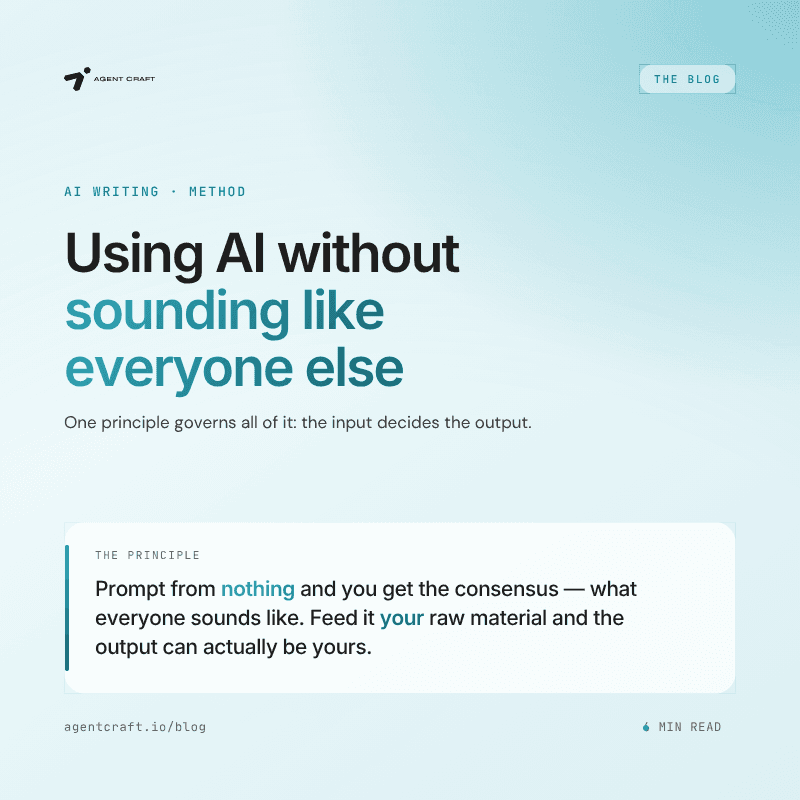
How to Use AI for Your Personal Brand Without Sounding Generic
Juan Mouton
VP Marketing
The principle that governs everything: the input decides the output. Prompt an AI from nothing and it returns the consensus of everything it has read, which is by definition what everyone else sounds like; feed it your own raw material, your spoken thinking, your transcripts, your real documents, and it has your specifics, your phrasing, and your stances to work with, and the output can actually be yours. Every technique below is a variation on that one principle, plus the editing pass that strips the surface tells. Get the input right and AI is leverage for a personal brand. Get it wrong and you are paying a machine to make you indistinguishable at scale.
Why prompting harder does not work
The instinctive fix for generic output is prompt engineering: more adjectives, "write in a confident but approachable executive tone," style instructions stacked on style instructions. It fails for a structural reason worth internalizing: style instructions can only repaint what the model already has, and what it has, absent your material, is the average. You can ask for the average in a casual voice or a bold voice; it remains the average. The missing ingredient was never tone. It was cargo, the specifics only you possess, and no instruction can request what was never supplied. This is why two people can use the identical tool and one produces content with fingerprints while the other produces upholstered consensus: they are not prompting differently, they are feeding differently.
The working methods, ranked by input quality
Speech first. Record yourself answering one real question for two minutes, the problem you solved this week, the pattern you keep seeing, the practice you disagree with, and give the AI the transcript as the raw material. Spoken thinking is the richest input available: it carries your natural phrasing, your emphasis, your stories, and the specifics your typing hand would have edited into blandness. The AI's job becomes structural, finding the post inside the rambling and shaping it, rather than generative, and structural work is what these systems are genuinely good at.
Real documents second. The memo you wrote, the client email explaining a decision, your notes from the post-mortem. Anything you produced for a real purpose carries fingerprints, because it was made under the pressure of an actual situation. "Turn this into a post" from a real artifact beats "write a post about delegation" from nothing, every single time.
Your archive third. Feed it your own past writing, the posts that worked, the way you actually construct sentences, as a standing reference for voice. Weaker than fresh material because it can only echo, but it keeps the surface honest.
Cold prompts last, meaning never for publishable content. Ideation, outlines, and devil's advocacy from a cold prompt are fine, useful, even. Publishable words from a cold prompt are the consensus in your clothes.
The editing pass that removes the uniform
Even with rich input, models revert to their habits, so every draft gets one mechanical pass against the known tells, in order of importance. Substance check first: does the post still contain your fingerprint, the number, the scar, the reconstructed moment, or did it get summarized out in the shaping? Restore it if so; this check outranks all the stylistic ones combined. Then the surface: delete the em dashes, break the parallel triads, kill any "it's not X, it's Y" construction, and purge the hollow lexicon (game-changer, delve, unlock, elevate, seamless, leverage-as-verb). Then read it aloud once, and fix every sentence your mouth would not say, because your mouth is the final voice authority and it is incorruptible. Ten minutes, total, and the difference between wearing the uniform and wearing your own clothes.
The standing gate at the end is the swap test: byline swapped for a peer's, does anything break? If nothing breaks, the input was too thin or the shaping too aggressive, and the fix is upstream, not another adjective in the prompt.
The honest workflow, end to end
Two minutes of speech on a real question. Transcript to the model with your positioning attached: who this is for, what you want to be known for, what you reject. Draft back. The ten-minute pass: substance restored, tells stripped, read aloud. Swap test. Ship or decline. Total cost per post, fifteen to twenty minutes against the hour-plus of composing from a blank page, with the thinking, which was always the valuable part, untouched at two minutes. That is what AI is actually for in this game: not replacing your thinking, which is the product, but collapsing the distance between your thinking and a published post that sounds like it came from you. Because it did.
Where Agent Craft sits in this
The workflow above is Agent Craft's architecture, described as a manual practice: speech as input, positioning as standing context, tell-screening before anything ships. The system's version holds your strategy permanently, built on best practice and twenty-plus years of global brand leadership, runs the editing pass automatically, and publishes the result across LinkedIn, X, TikTok, and YouTube, which no other tool in this category does. The principle is free and improves any workflow. The system is the principle with the labor removed.
Frequently asked questions
How do I make AI-written content sound like me?
Change the input: build from your own spoken material or real documents instead of cold prompts, keep your specifics in during shaping, and strip the surface tells (em dashes, triads, hollow vocabulary) in a final pass.
Why does AI content all sound the same?
Because prompted from nothing, models return the consensus of their training, and style instructions can only repaint it. Distinctiveness has to be supplied, and it lives in your raw material.
What is the best AI workflow for LinkedIn content?
Two minutes of speech on a real question, transcript plus your positioning to the model, a ten-minute edit for substance and tells, then the swap test. Fifteen to twenty minutes per post with the thinking intact.
Share
Related Articles
Building in Public: What to Share and What to Keep
The rule set fits in one line: share lessons and process, keep leverage and other people's confidences. Building in public, narrating the real construction of a company or a career as it happens, is the highest-trust content format available, because watching someone decide under uncertainty is a due-diligence process no marketing survives. But the format has failure modes that its cheerleaders skip past, and they all trace to the same error: sharing the wrong category of thing. The categories are knowable in advance, which is what this post is for, the sharing rules, the failure modes, and a decision test that resolves the ambiguous cases in ten seconds.
LinkedIn Profile Optimization for Executives: Field by Field
An executive profile has one job: when someone arrives checking you out, a recruiter, an investor, a board member, an acquirer running quiet diligence, it answers their question in seconds and gives them a reason to keep reading. Optimizing it is a single afternoon's work, done field by field in priority order: headline, About, experience, banner and photo, featured, skills. Each field below comes with the characteristic executive mistake and its fix, because at senior levels the profiles are rarely empty. They are full of the wrong register: written for the org chart instead of for the stranger deciding whether to trust you.
Why Your LinkedIn Posts Get No Reach (and What Fixes It)
When your posts consistently get no reach, the cause is almost always one of four things: the content is generic enough to be skippable, your subject matter is too scattered for anyone to know what you are for, your openings fail before the substance arrives, or you are measuring the wrong thing and the reach is actually fine. Each has a distinct signature and a distinct fix, and none of them is the fix people reach for first, which is posting more. Volume multiplies whatever is already true, so diagnose before you scale.