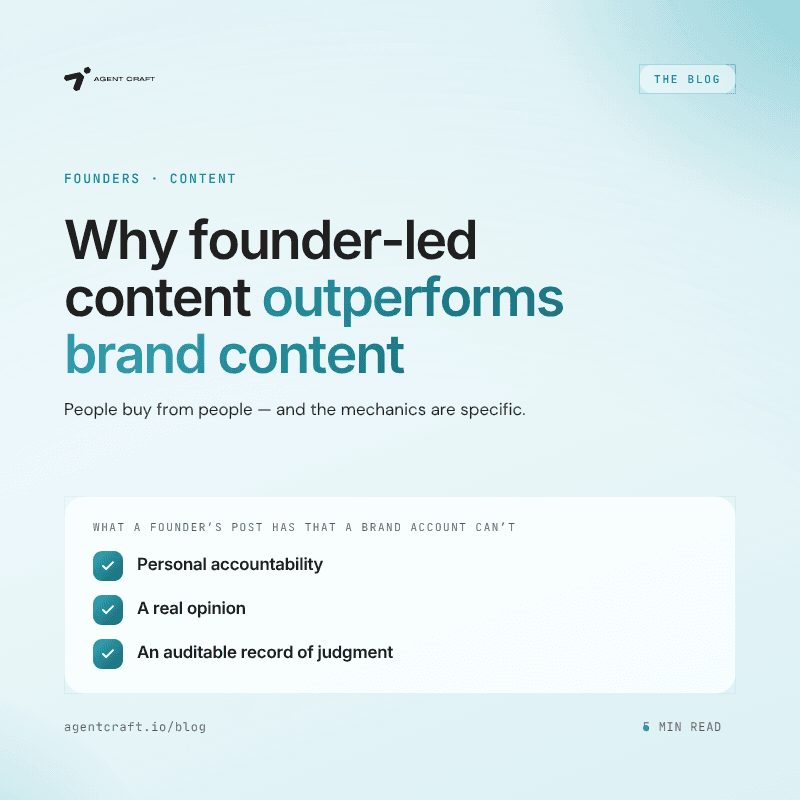
Founder-Led Content: Why It Outperforms Brand Content
Juan Mouton
VP Marketing
Founder-led content outperforms brand content because people buy from people, and the mechanics behind that phrase are specific: a founder's post carries personal accountability, can hold an opinion, and accumulates an auditable record of judgment, while a brand account structurally has none of the three. Readers do not need to articulate this to act on it; they simply stop for the human and scroll past the logo, and they are being rational when they do. For any company whose sale runs on belief, services, expertise, early-stage products, anything bought before it can be fully verified, the founder's voice is the most efficient marketing asset available, and usually the least deployed.
The mechanics, one at a time
Accountability. Every reader knows corporate content is reviewed, sanded, and attributable to no one in particular, and prices it accordingly: as marketing, which is to say, at a steep discount. A founder's post is different in kind, not degree, because it carries personal risk, a name, a standing among peers, a reputation that pays for errors, and claims that cost something to make are the only claims that mean something. The discount and the premium are both the market working correctly.
Opinion. Markets are arguments, and buyers pick a side before they pick a vendor. A founder can say "the standard approach in our category is wrong, and here is what we do instead," which is a belief, a differentiation, and a customer filter in one sentence, and the buyers who agree arrive already aligned with the product's premise. A brand account attempting the same move produces a committee performing conviction, and reads exactly like that. Category arguments are founder work because only a person can plausibly hold a position.
The auditable record. By the time a serious buyer books a call, they have usually checked, and a publishing founder has handed them a year of visible decisions, positions held and revised, hard questions engaged honestly. That is a due-diligence process the buyer runs alone, at midnight, before you knew they existed, and no landing page survives comparison with it, because landing pages assert and records demonstrate. Buyers who arrive through the record arrive substantially pre-sold, which is why founder-sourced pipeline closes differently: the trust work happened before the funnel started measuring.
What counts as founder content, and what does not
The performing version fails on contact, so the definition matters. Founder content is the founder's actual thinking: the decision and its logic, the pattern surfacing in customer conversations before the market names it, the stance on the category's defaults, the honest account of what went sideways and what changed after. The test is simple and strict: if the company account could have posted it, it is not founder content, it is corporate content wearing a face, and the milestone announcements, launch reposts, and we-are-thrilled material that fill most founder feeds fail it completely. The feed does not need the founder's face on the company's news. It needs the founder's mind on the company's market.
The sustainability problem, which is the real problem
None of the above is controversial, and yet most founder feeds are quiet, because the mechanics collide with the calendar: the founder is the busiest person in the company, and content run as a separate job loses to every operational fire, permanently. The fix is a reframe with teeth: founder content is exhaust from work already happening, not a new workstream. The founder already thinks about the market daily, already makes the decisions, already hears the customer patterns first; the content is that thinking captured, and capture costs two minutes of talking, not two hours of writing. The decision was the expensive part, and it was already paid for. Founders who sustain this for years are not the ones with spare time. They are the ones who stopped manufacturing content and started capturing it, and whose system could carry a bad fortnight without the feed going dark, because bad fortnights are when the habit either survives or does not.
One caveat, stated because founder-led advice usually omits it: trust concentrated in one person is key-person risk in the marketing, the same as anywhere else in the business. The mature version multiplies voices as the company grows rather than diluting the one that works. The founder proves the channel; the senior team eventually joins it.
Where Agent Craft sits in this
Agent Craft is the capture-and-manufacture system the reframe above requires. The founder talks for two minutes about what they were already deciding, and the system does the rest: drafts in their voice, strategy enforced by a layer built on best practice and twenty-plus years of global brand leadership, published across LinkedIn, X, TikTok, and YouTube, which no other tool in this category does. Then the loop closes commercially: the personal brand CRM collects the buyers the thinking pre-sold, qualifies them, and nurtures them by email until they book the call. The founder supplies the judgment. That was always the part that could not be delegated, and it is the only part that remains.
Frequently asked questions
Why does founder content perform better than brand content?
Accountability, opinion, and record: a founder's claims carry personal risk, can take sides, and accumulate an auditable history of judgment. Brand accounts have none of the three, and readers price the difference automatically.
What should founders post about?
Decisions and their logic, patterns from customer conversations, stances on category defaults, and honest accounts of what went wrong. If the company account could have posted it, it does not qualify.
How do busy founders sustain content?
By capturing instead of manufacturing: the market thinking is already happening daily, and two minutes of spoken capture per decision is the raw material. A system that handles everything after the talking is what survives the bad fortnights.
Share
Related Articles
Building in Public: What to Share and What to Keep
The rule set fits in one line: share lessons and process, keep leverage and other people's confidences. Building in public, narrating the real construction of a company or a career as it happens, is the highest-trust content format available, because watching someone decide under uncertainty is a due-diligence process no marketing survives. But the format has failure modes that its cheerleaders skip past, and they all trace to the same error: sharing the wrong category of thing. The categories are knowable in advance, which is what this post is for, the sharing rules, the failure modes, and a decision test that resolves the ambiguous cases in ten seconds.
LinkedIn Profile Optimization for Executives: Field by Field
An executive profile has one job: when someone arrives checking you out, a recruiter, an investor, a board member, an acquirer running quiet diligence, it answers their question in seconds and gives them a reason to keep reading. Optimizing it is a single afternoon's work, done field by field in priority order: headline, About, experience, banner and photo, featured, skills. Each field below comes with the characteristic executive mistake and its fix, because at senior levels the profiles are rarely empty. They are full of the wrong register: written for the org chart instead of for the stranger deciding whether to trust you.
Why Your LinkedIn Posts Get No Reach (and What Fixes It)
When your posts consistently get no reach, the cause is almost always one of four things: the content is generic enough to be skippable, your subject matter is too scattered for anyone to know what you are for, your openings fail before the substance arrives, or you are measuring the wrong thing and the reach is actually fine. Each has a distinct signature and a distinct fix, and none of them is the fix people reach for first, which is posting more. Volume multiplies whatever is already true, so diagnose before you scale.